While conducting nature guiding walks, one of the biggest concerns is often ‘Will the birds show up?’ After gaining a deeper understanding of relationships among the flora and fauna species within any ecosystems, I have come to realise that if birds are elusive, I can instead look for the tree species they tend to frequent. Trees, after all, provide a more reliable presence (barring events like lightning strikes or removal by authorities for various reasons).
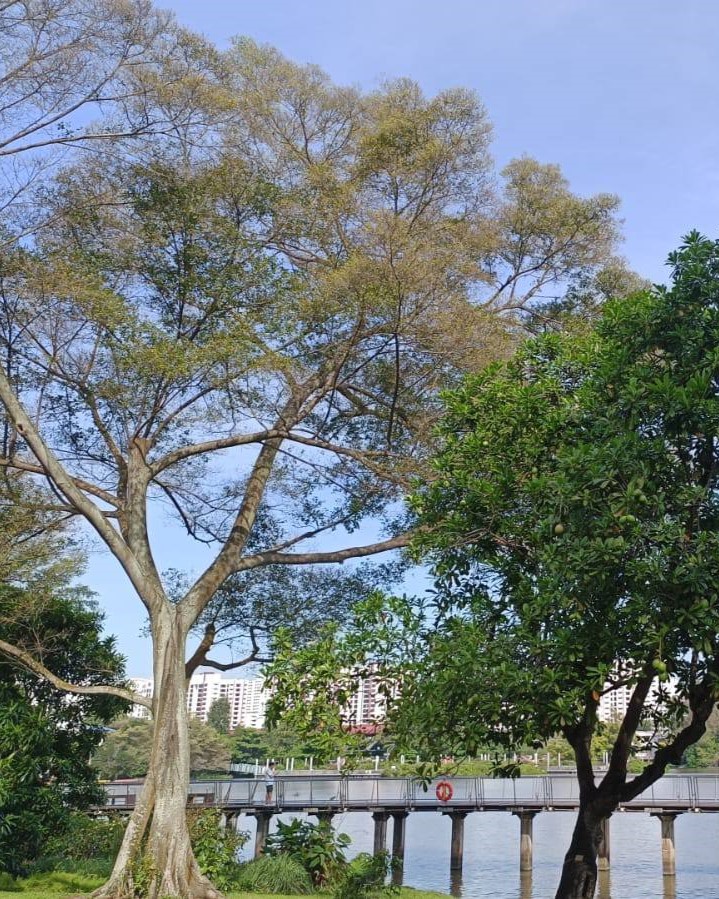
One of the tree species I often look out for bird sightings is the Albizia Tree, specifically Falcataria falcata (see link from uforest for more detailed documentation of its physical features). Typically seen from a distance from boardwalks in nature parks or park connectors within secondary forests, these trees are notable for being among the world’s fastest-growing species (can reach maturity within 5 years), which has led to their popular use in reforestation projects.
So why are Albizia trees often located away from areas with high human traffic? It’s because they belong to the softwood species, characterised by low-density wood and a shallow root system. These features make them vulnerable, especially in a tropical equatorial climate with frequent lightning, heavy rainfall, and strong winds that can cause breakage of branches and uprooting due to soil erosion. Thus, many of those grown nearer to human traffic may have already been removed over the years. In fact, after googling more about the tree species, I found an article regarding NParks removing a patch of Albizia trees at the Bukit Batok Nature Park in 2017 due to safety concerns (See link). And specifically 10 years earlier in 2007, a Singaporean was crushed to death by a toppled Albizia tree, with two others injured (see link).
The two ways to identify an Albizia tree is its small compound leaves, smooth greyish bark. The other prominent features will be the tree cavities and broken branches. Read more to find out why.
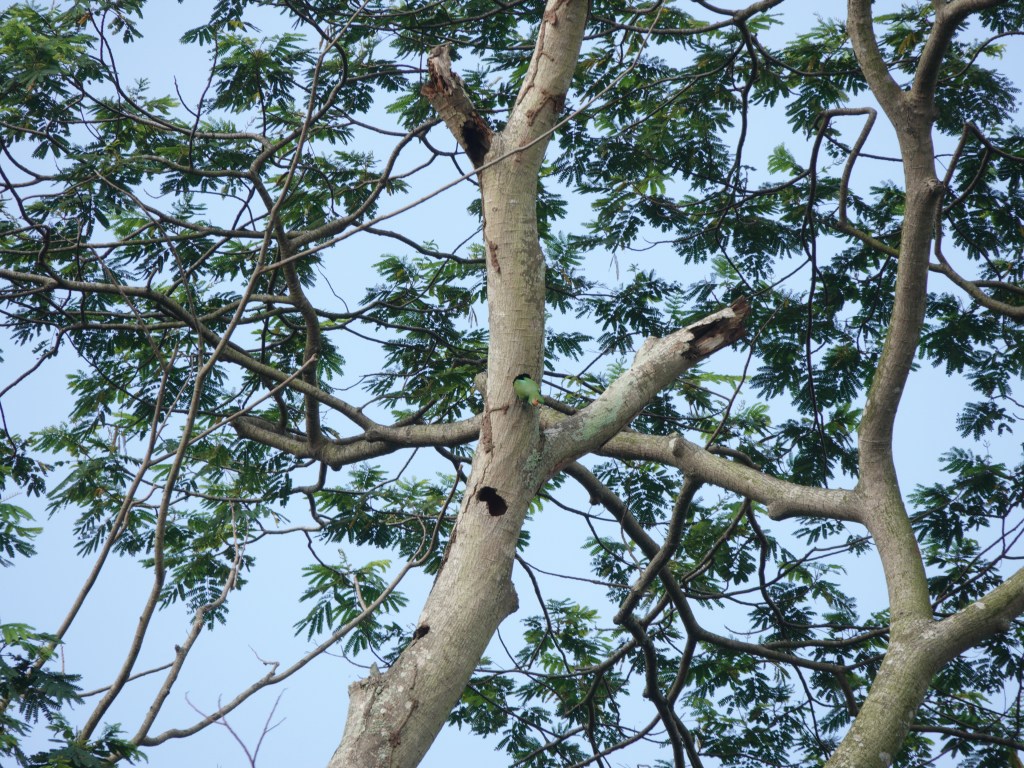
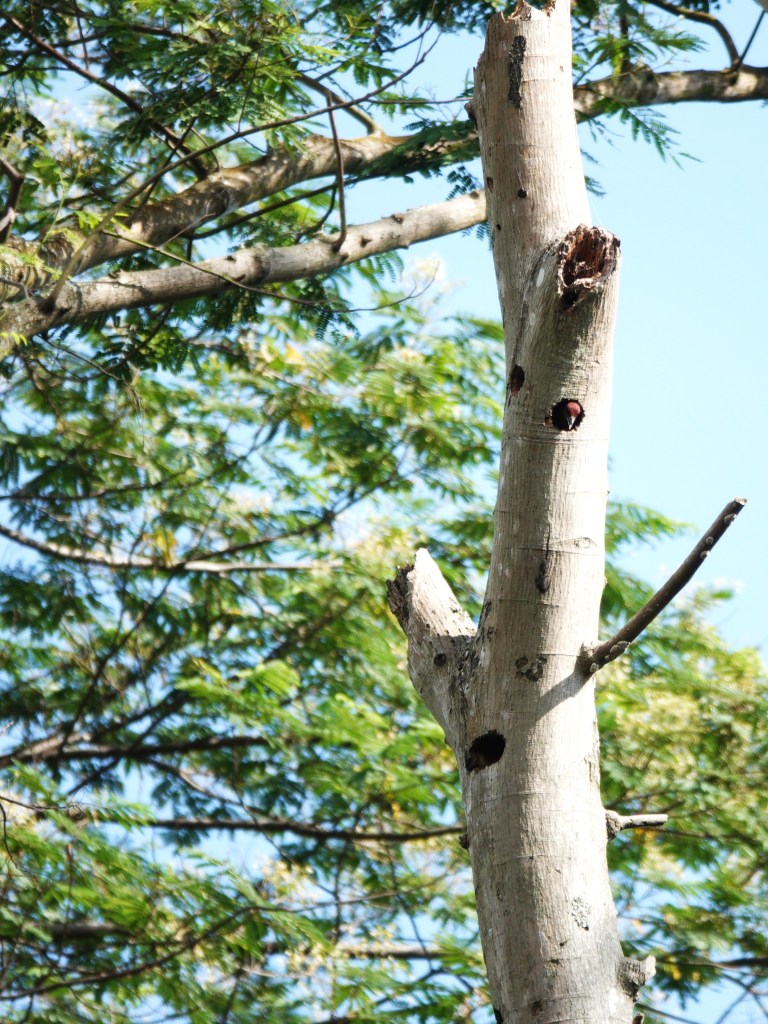
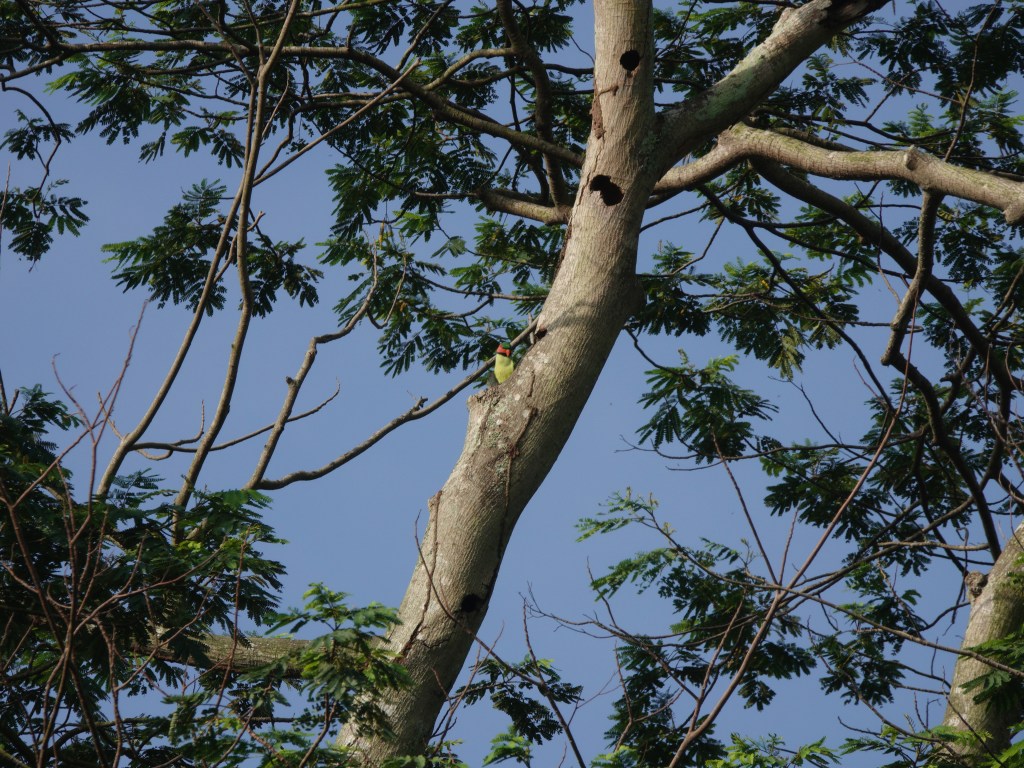
Interestingly, the same characteristics that make Albizia trees potential safety hazards for humans also make them attractive to certain bird species, such as Lineated Barbets, Banded Woodpeckers, Long-Tailed Parakeets, Hill Mynas and Oriental Pied Hornbills (there may be many others which I have yet observed). The reason lies in the tree’s softer, lower-density wood, which is easier for woodpeckers to excavate cavities for nesting. Barbets may also exploit the more brittle or damaged areas with portions of dead wood to create their own cavities. In contrast, mynas, parakeets and hornbills often rely on existing cavities, using those vacated by other birds for nesting though they do have strong beaks to further shape the holes. Thus, the mynas, parakeets and hornbills are known as “secondary cavity nesters” i.e. they utilise cavities that have already been created by birds with strong beaks that are built for such purposes.
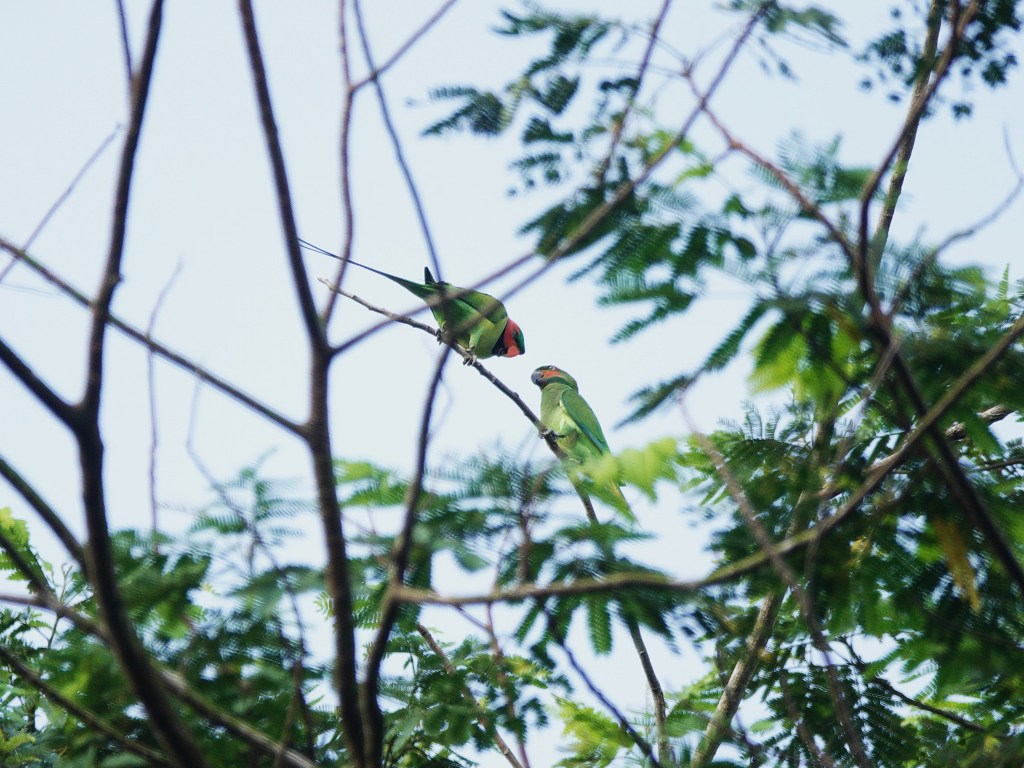
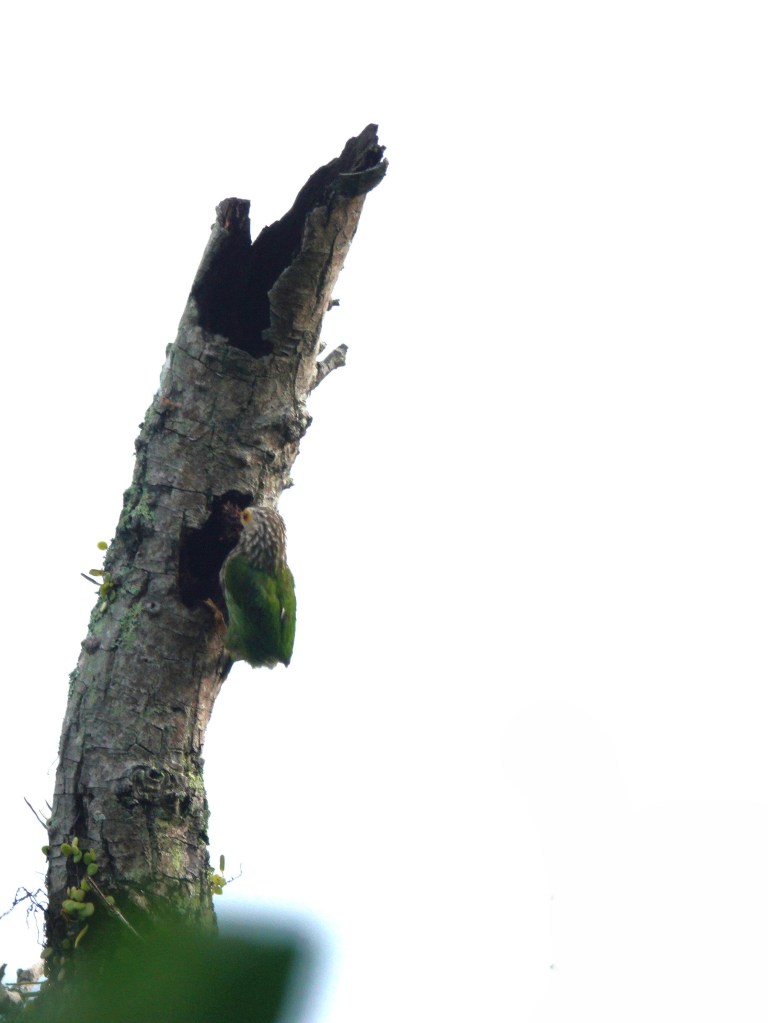
A Banded Woodpecker looking out of the cavity along Daily Farm Nature Park (between Singapore Quarry and MOE Dairy Farm Outdoor Adventure Learning Centre).A Long-Tailed Parakeet peering out from its home. There are so many other cavities above it. This explains why the integrity of the tree structure may be weak and hence a safety hazard.Two Long-Tailed Parakeets on an Albizia tree in either Rifle Range Nature Park or Hindhede Nature Park (I have forgotten where exactly I took this photograph).A Lineated Barbet further excavating a hole at Bidadari Park. It is not known if this is a dead Albizia that have been left there for birds to perch and nest (the bark seems too rough to be one). Bidadari used to have many Albizia trees before the park was opened (You may refer to one of the photographs from uforest)
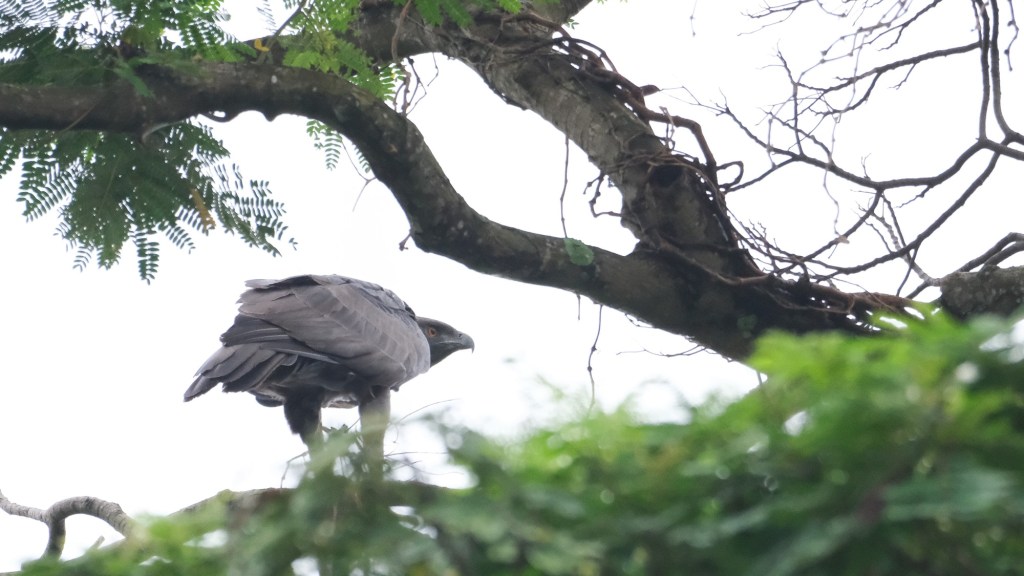
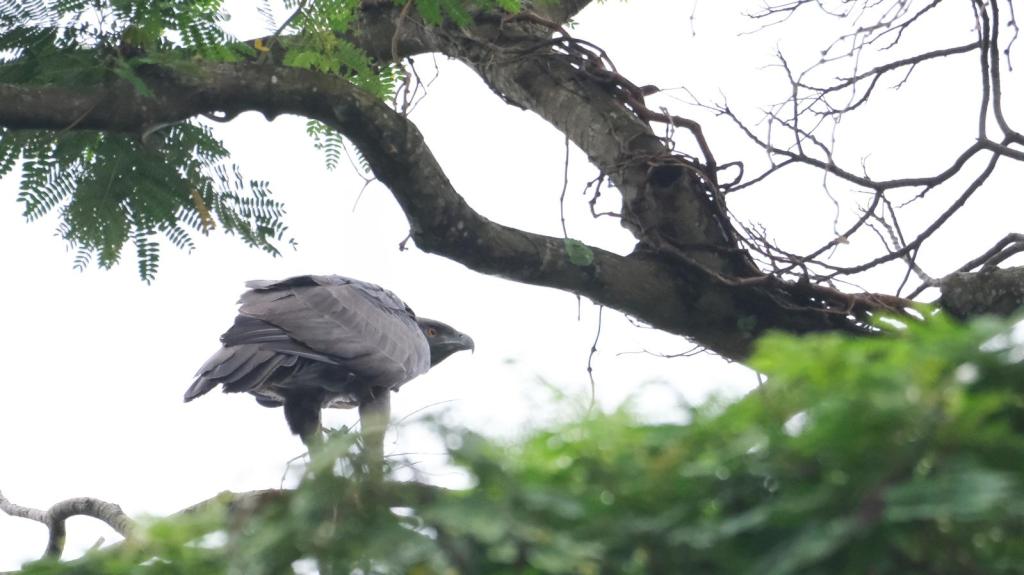
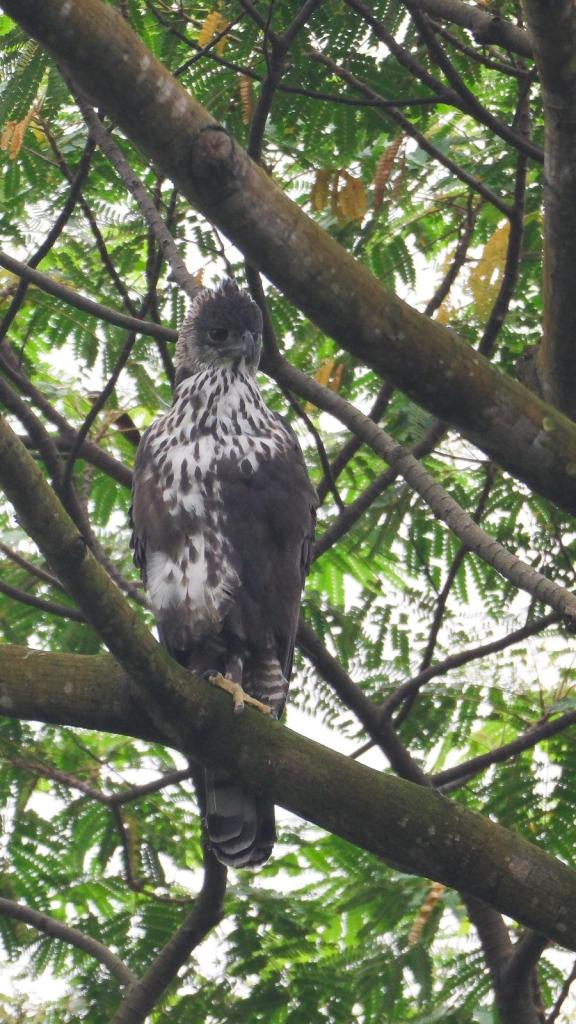
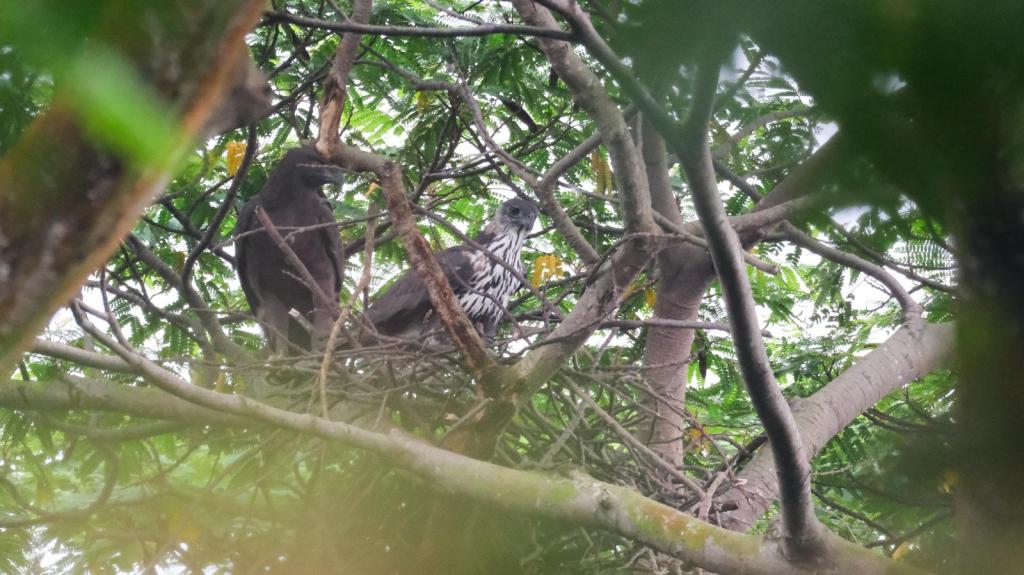
The sparse foliage at the canopy of the Albizia tree also makes it an ideal spot for birders to look for raptors, which often perch on the tree’s horizontally stretching branches. This vantage point likely provides the raptors with an unobstructed view of potential prey from a significant height, a luxury not afforded by trees with denser canopies where leaves and branches would block their line of sight. In fact, the height, shape and structure of the branches also encourage raptors to construct their eyries on the Albizia canopy. This has been well-documented by many others. Below are some of the photographs taken by Gabriel and I that illustrate the above points.
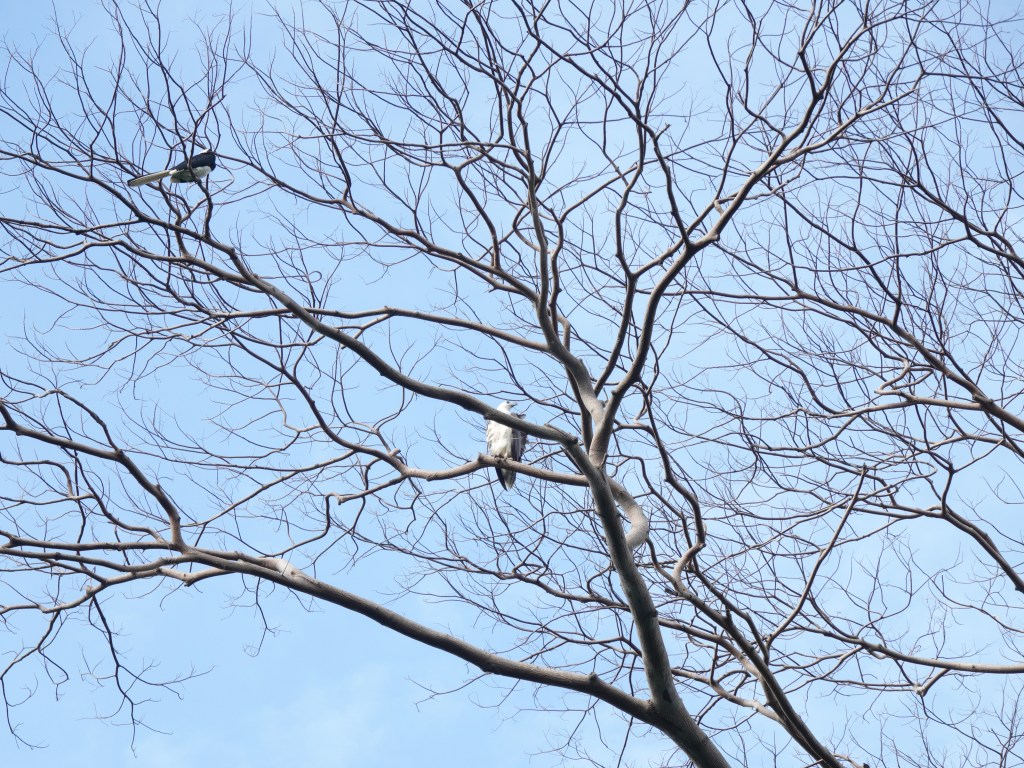
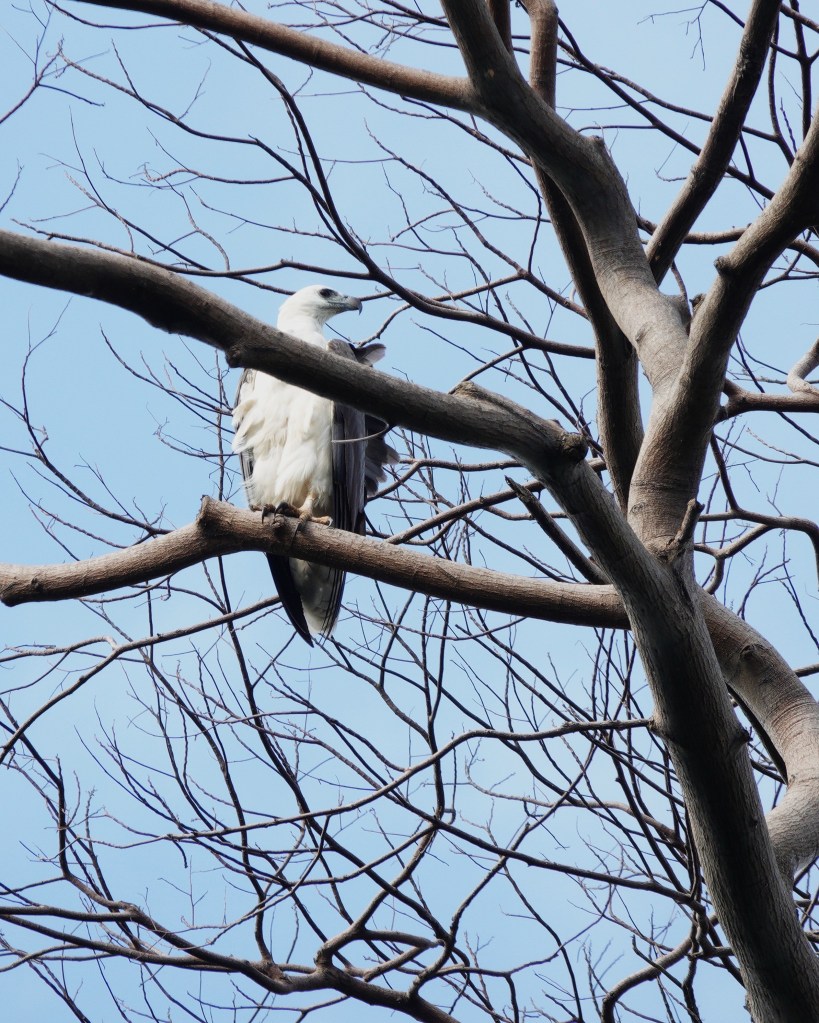
An Oriental Pied Hornbill and a White-Bellied Sea Eagle perched on a dead Albizia tree in Punggol. Although the smooth grey bark hints at the tree’s identity, confirmation would ideally require the presence of leaves.A closer view of the smooth bark.A Changeable Hawk Eagle (dark-morphed) perched on an Albizia in Chua Chu Kang. (Photo by Gabriel Kang)The majestic pose of the Changeable Hawk Eagle. You can see the small leaflets of the Albizia in the background. (Photo by Gabriel Kang)Indeed, the Albizia tree is a favourite nesting place for raptors. You can see the eyrie (raptor’s nest) on this particular one in Chua Chu Kang. (Photo by Gabriel Kang)
I have also found a well-documented article from the journal publication “Nature in Singapore”, published by NUS whereby the Changeable Hawk Eagles and the Oriental Pied Hornbills nested on the Albizia in the Dover Forest. It is an enjoyable read for those who would like to find out more. (Click here to access the article)
In conclusion, the Albizia tree presents a complex trade-off between supporting biodiversity and posing safety risks to humans. Effective management of this dilemma requires a collaborative approach, with NParks working closely with the community and various stakeholders to make informed decisions that balance human safety with environmental conservation. Education plays a crucial role in this process, helping people understand the reasons behind tree removal and the importance of prioritising safety while supporting species biodiversity. For nature guides and birders, I hope this post provides valuable insights and fosters a deeper appreciation for the importance of flora in supporting the fauna we admire. Don’t forget your binoculars, as these trees are often located at a distance from walking paths for reasons already mentioned.
Thank you Siyang for providing information about the Albizia trees and Gabriel for the wonderful photos of the Changeable Hawk Eagles.
Just One Tree’ is a blog series that explores how individual trees support life. Each post delves into the unique ecosystem centered around a single tree, showcasing its vital role in sustaining various forms of life.
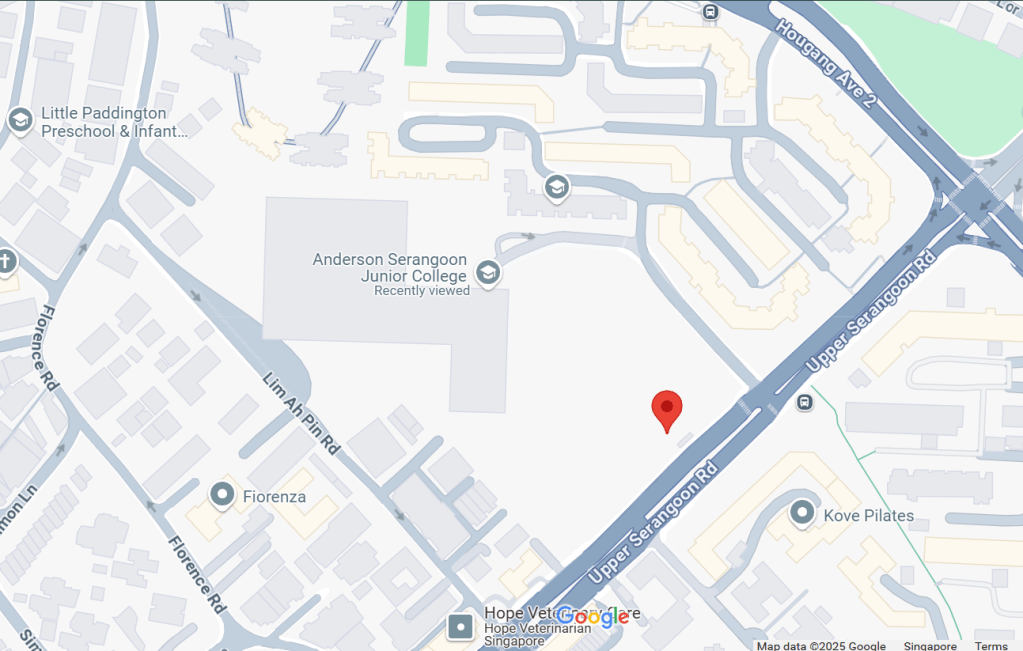
In this inaugural post of the series, I spotlight a particular tree along Upper Serangoon Road. I discovered this arboreal wonder while cycling to buy the famous Yong’s Teochew Kueh for my parents on the 9th January 2025. The tree stands within the vicinity of Anderson Serangoon Junior College (formerly Serangoon Junior College, where I studied for three months before transferring to Anderson Junior College in Ang Mo Kio in 1999).
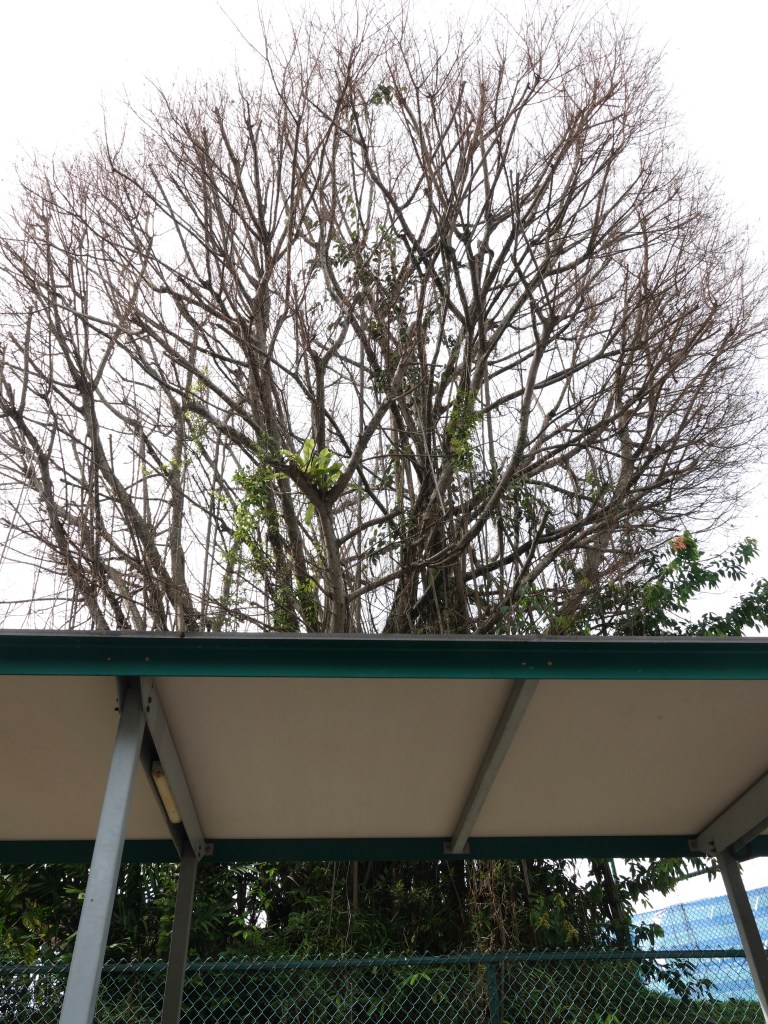
What caught my attention was the tree’s unusual appearance – it was completely stripped of its leaves. My immediate reaction was one of concern and curiosity: What had happened to this tree?
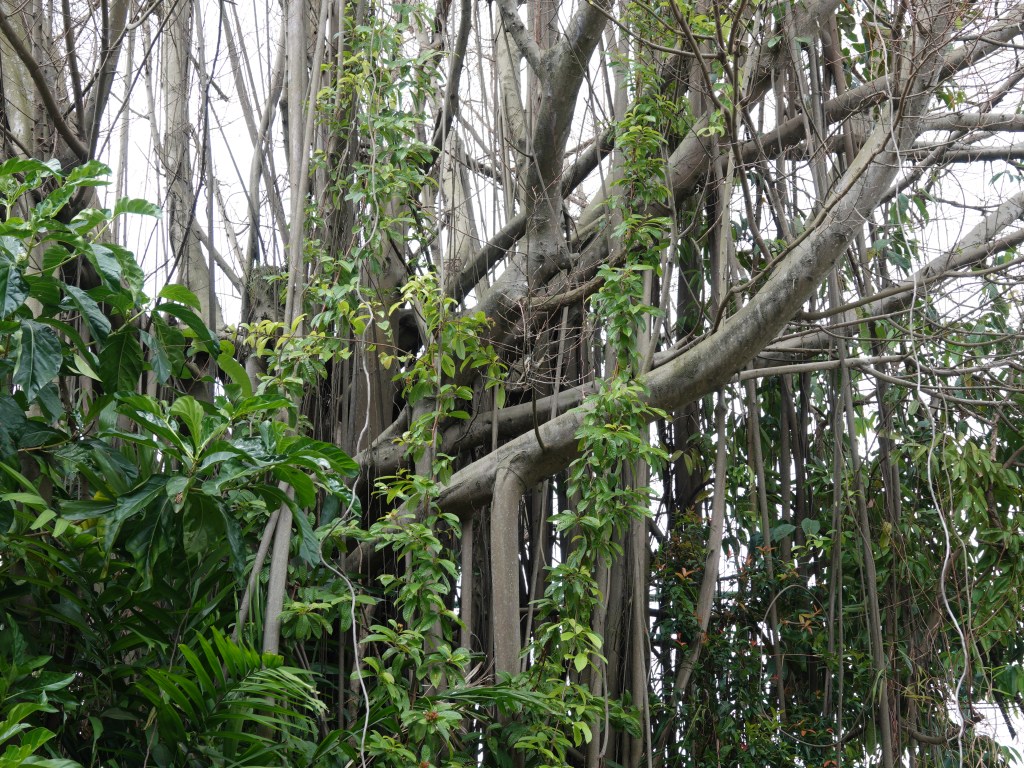
Upon closer observation, I noticed dangling aerial roots, a characteristic feature that left no doubt about its identity. This tree is a Ficus species, most likely a Ficus microcarpa, as it is one of the most common Ficus species grown in urban areas.
The location of the tree is pinned. I documented the details about this tree at the bus stop area on the 9th Jan 2025. (Source: Google Map)By referring to Google Streetview, I caught a glimpse of the tree’s former splendor. Examining its structure and leaf arrangement, I was able to rule out Ficus benjamina, as it lacks the characteristic droopy appearance. Unfortunately, the resolution wasn’t sufficient to discern the leaf shape, making a definitive identification impossible. (Source: Google Street View)The fate of the entire tree as of January 2025: The visible green patches belong to an unknown climber and some epiphytic plants, not to the Ficus itself.There are other flora species at the base of the Ficus. On the left, it looks like a Noni tree (Morinda citrifolia) with a palm species growing below it. On the right is probably a wild cinnamon tree (Cinnamomum iners).
What’s Causing the Treeto Become Botak?
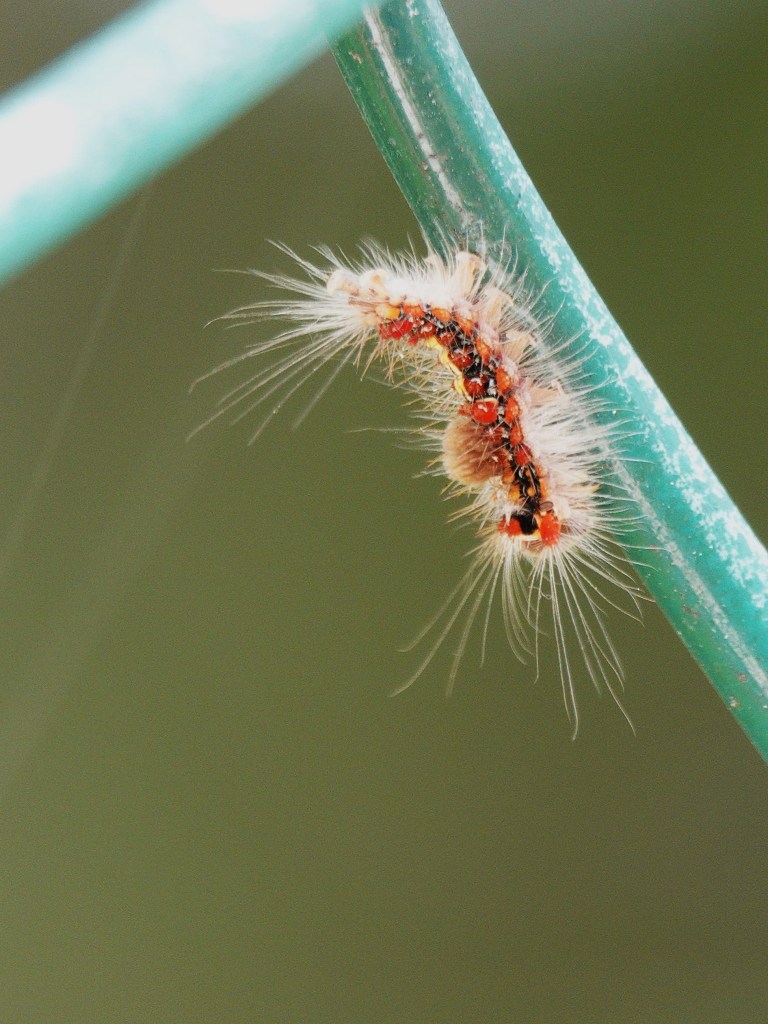
I parked my bicycle at the bus stop and approached the fence. Immediately, I found the answer: caterpillars! And not just any caterpillars, but Clear-Winged Tussock Moth (Perina nuda) caterpillars. Also known as the Banyan Tussock Moth, they weren’t just crawling all over the fence; they were also on the bus stop, the walkway shelter, and even on the ground.
As I was photographing them, one fell on my neck. I instinctively brushed it away in fright, worried that its bristles might cause an allergic reaction (fortunately, they didn’t).
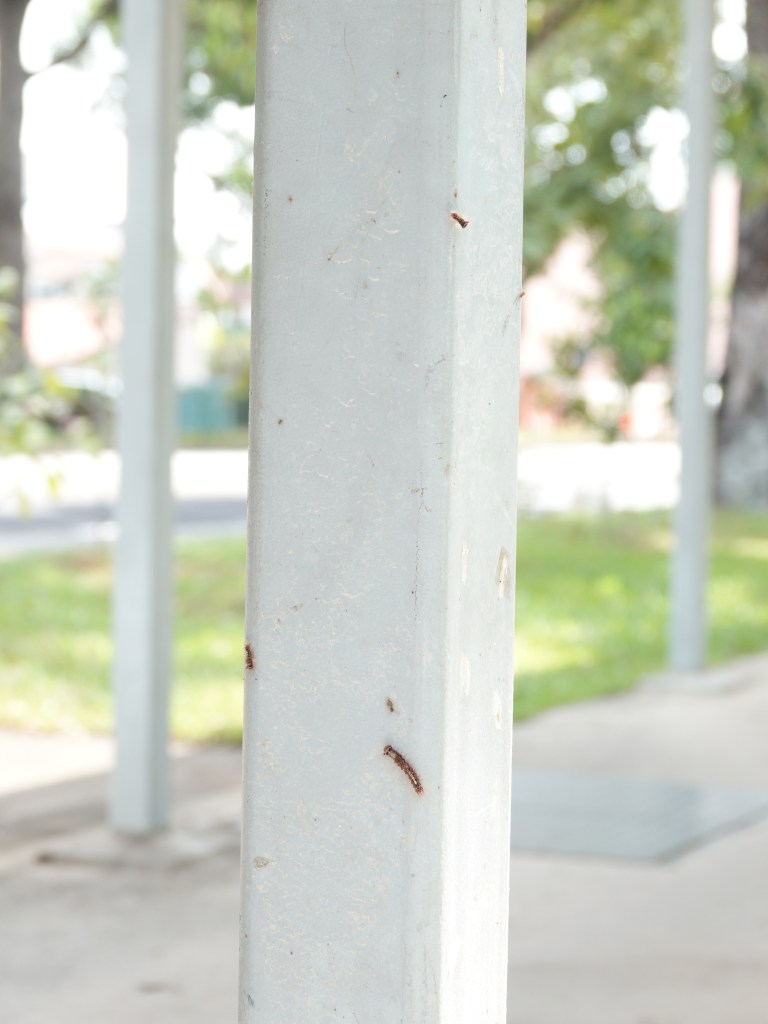
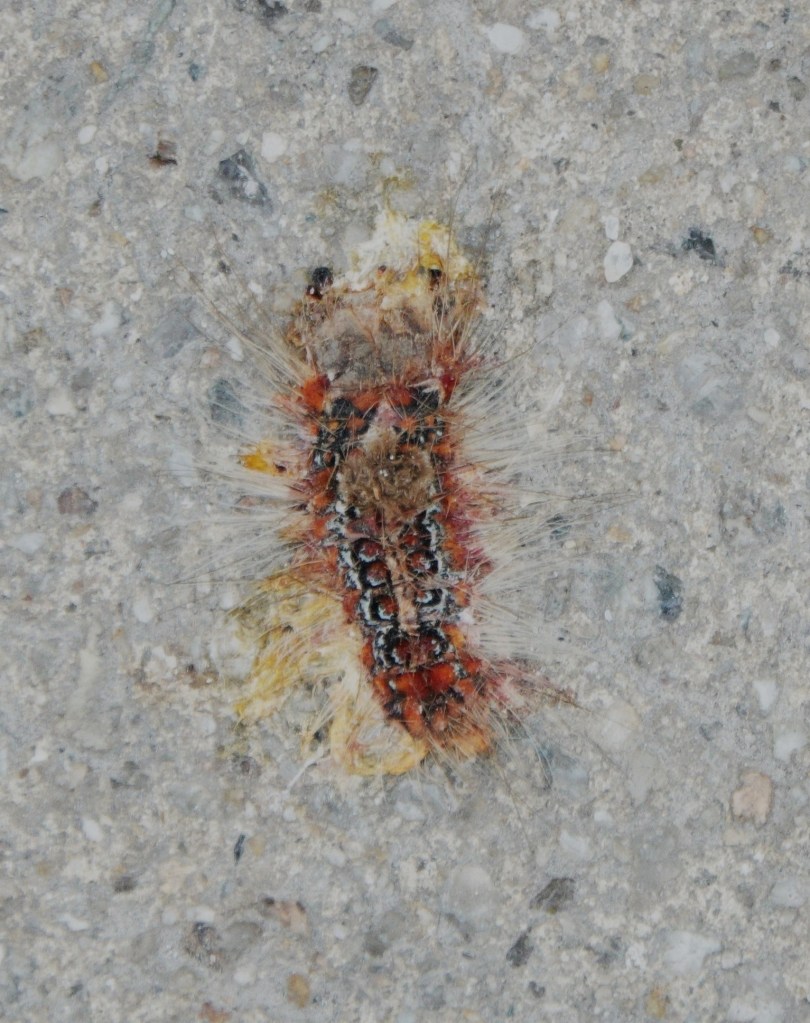
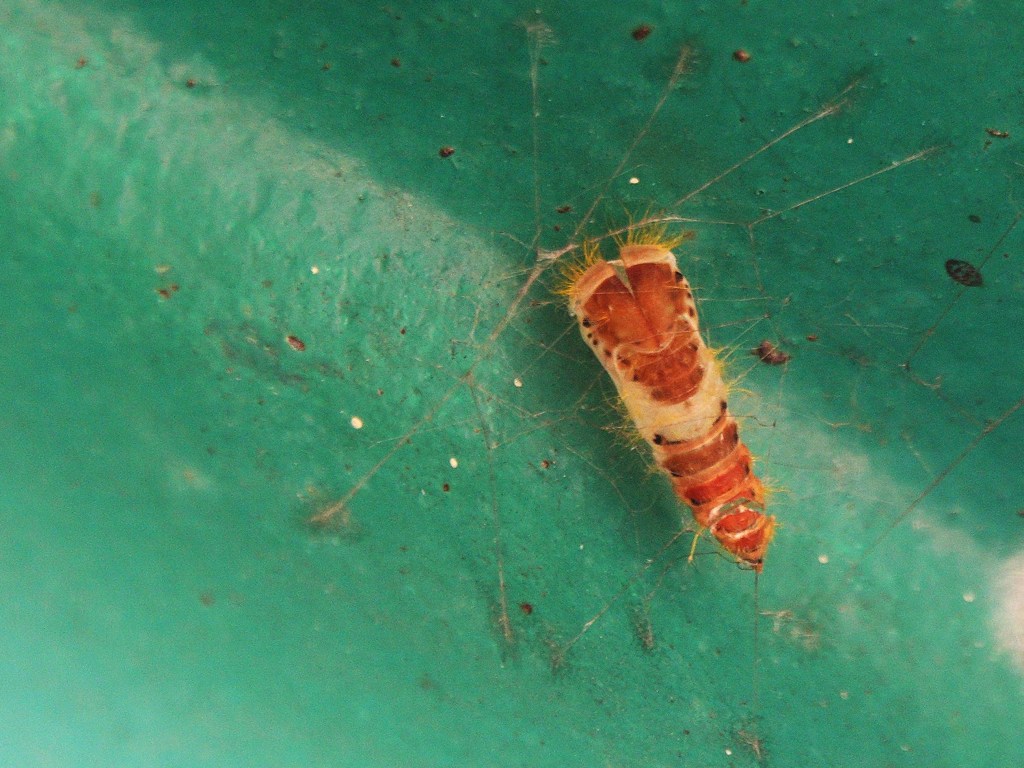
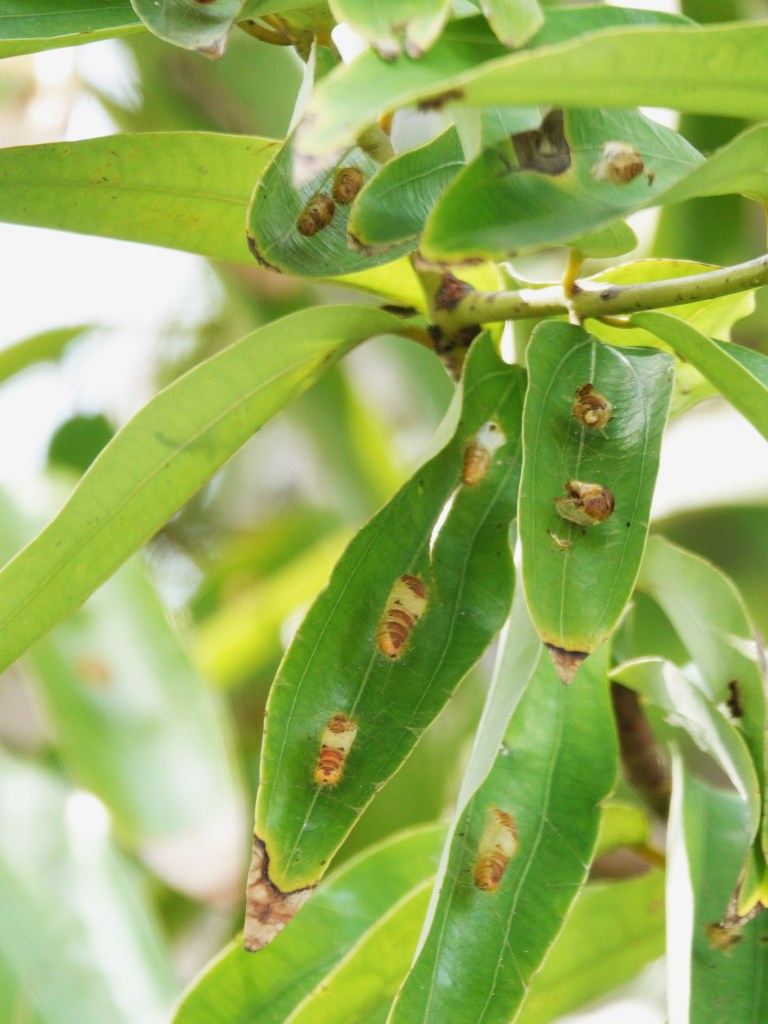
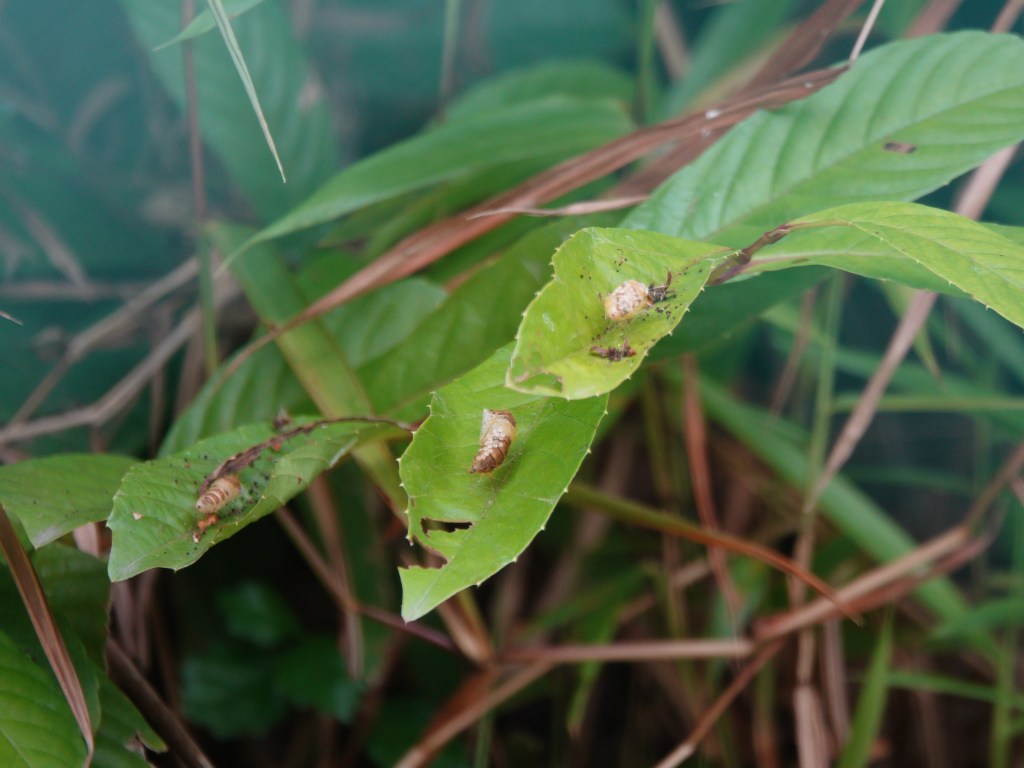
Sighted the first one on the fence.You can see 5 of them of varying sizes on the metal pillar of the sheltered walkway. There are also a couple of flattened ones on the walkway, either unknowingly crushed by bicycles, PMDs or pedestrians. This particular pupa at the top of the sheltered walkway has already eclosed (i.e. emerged as a moth).More pupae on the Wild Cinnamon PlantAnd a lot more on the Noni plant too.
Predators of the Caterpillars: A Search for Evidence
Having previously observed numerous cuckoos feasting on Phauda flammans caterpillars infesting a Ficus microcarpa in Jurong Lake Gardens, I hoped to see more cuckoos on this tree. I scanned closely for any fleeting movements against the bright afternoon sun. Instead of cuckoo-sized birds, I spotted two flycatchers darting around in their signature fly-catching moves, repeatedly returning to their ‘favorite’ perches after aerial forays.
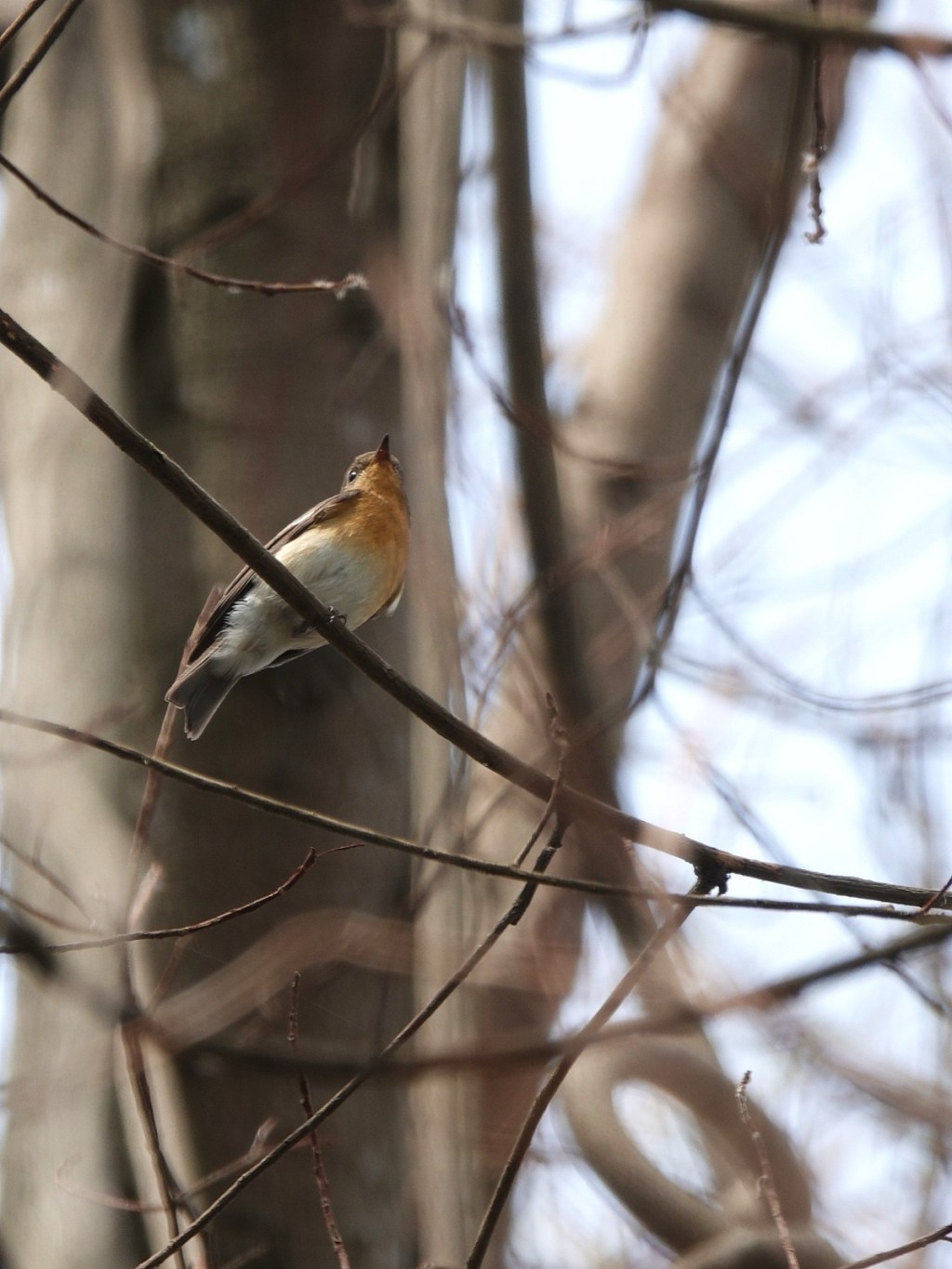
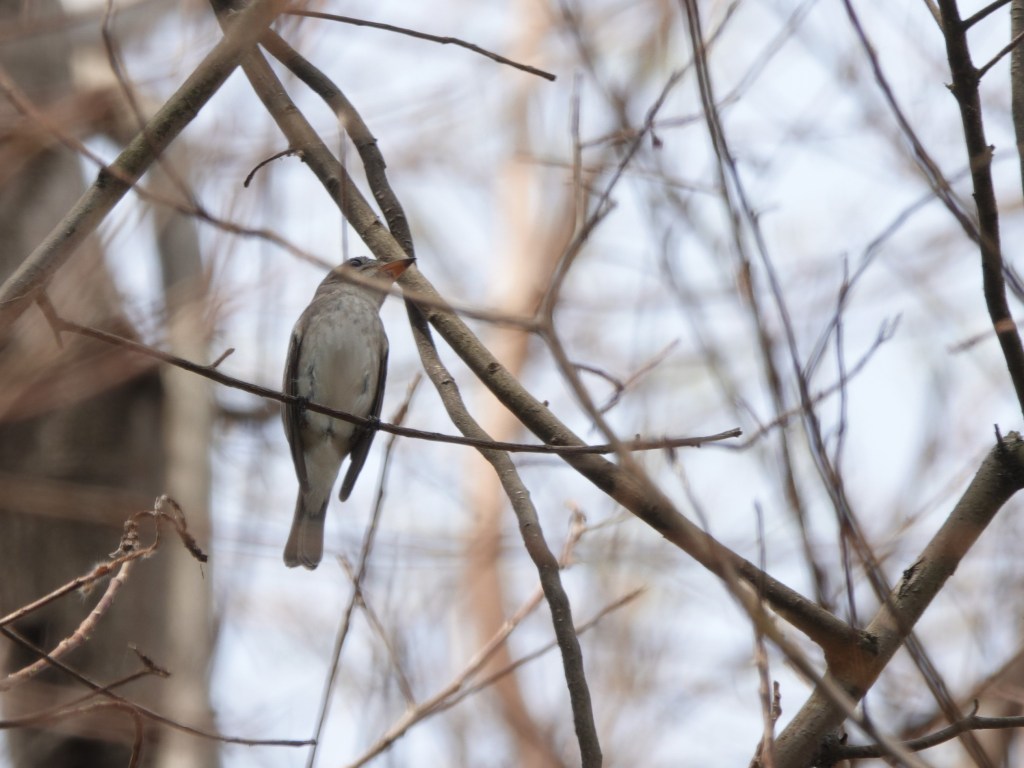
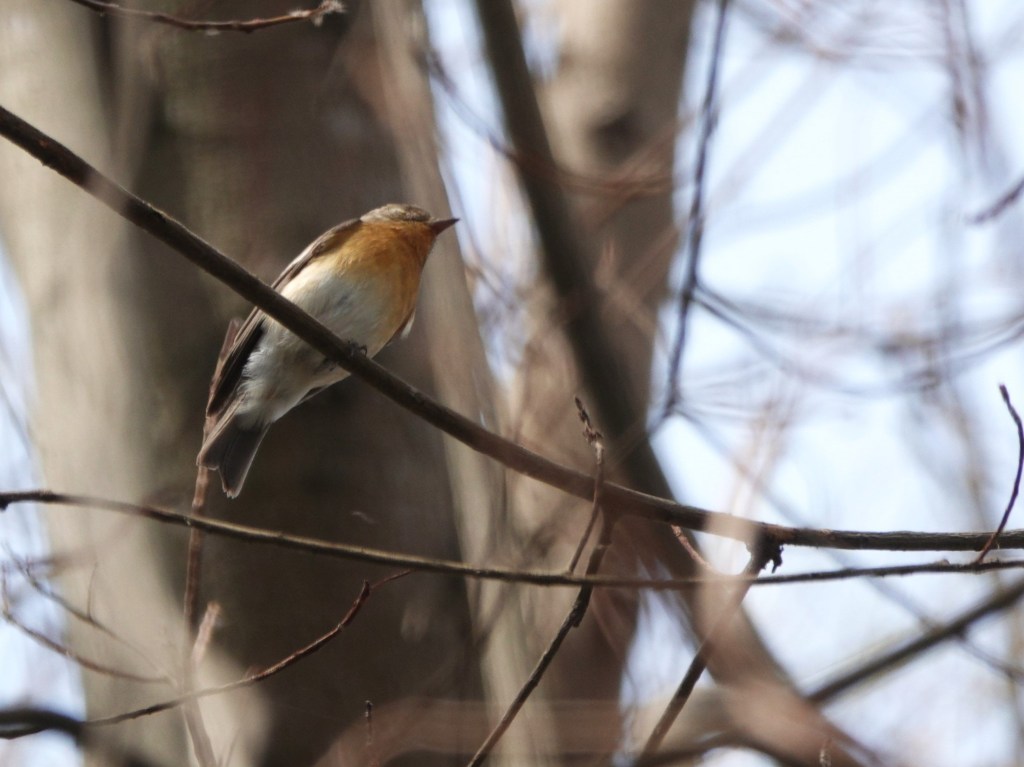
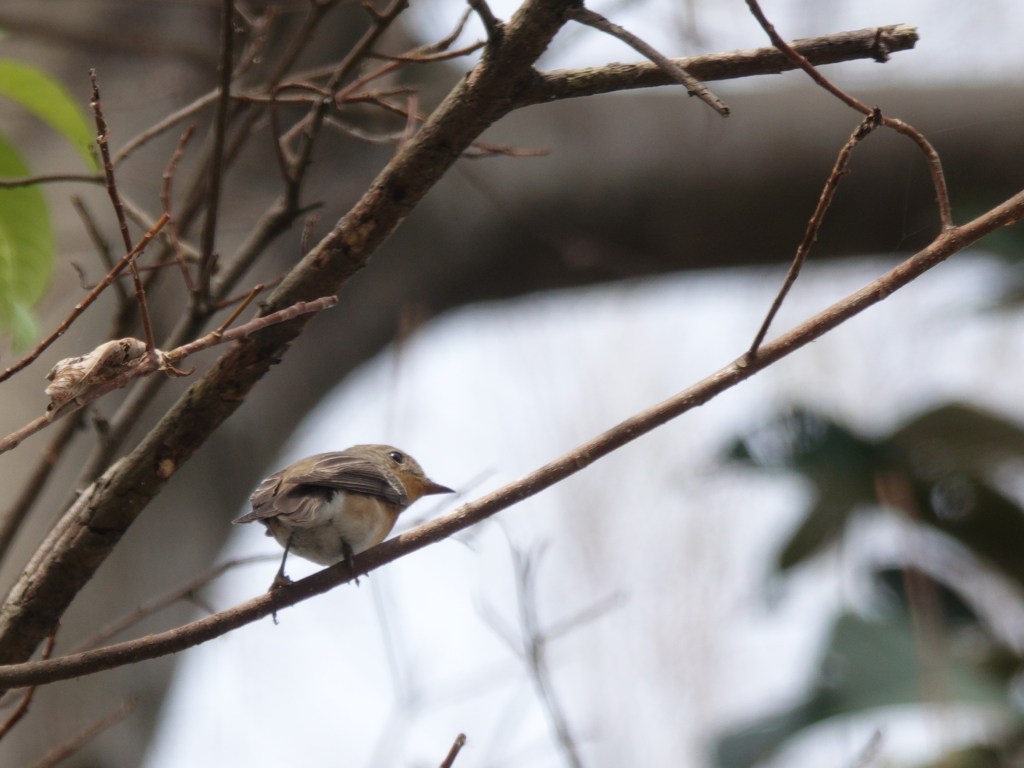
Initially, I expected both to be common migrants – Asian Brown Flycatchers (Muscicapa dauurica). To my surprise, one of them has an orangey throat! It was a female Mugimaki Flycatcher (Ficedula mugimaki)! Interestingly, this uncommon visitor appeared very drowsy, frequently closing its eyes while perched on a branch.
I first sighted an Asian Brown Flycatcher flying around the tree. But I was not able to document if it ate any of the caterpillars or its adult moth. A Mugimaki Flycatcher on a tree along the highly urbanised Upper Serangoon Road.How cute it is with its eyes closed. A front view of the tired Mugimaki Flycatcher.It occasionally opened its eyes before flying to another branch.
Without photographic evidence of either flycatcher species feeding on the Clear-Winged Tussock Moths or their caterpillars, I couldn’t conclude whether these hairy caterpillars are part of their diet. This is in contrast to cuckoos, which have been documented feasting on Clear-Winged Tussock moths in my previous blog post. Nevertheless, I am quite positive that the flycatchers may be feeding on the smaller caterpillars or even the adult moths.
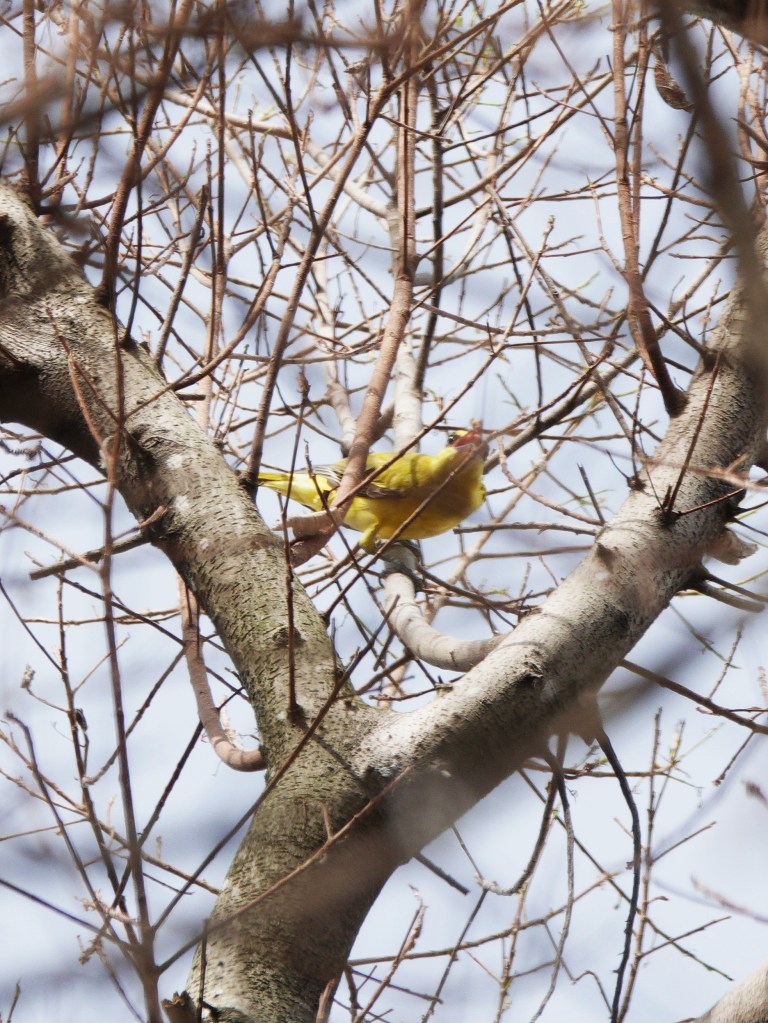
A Black-Naped Oriole was observed to be consuming something. But due to the many obstructing branches, it was impossible to get a clearer shot of the content it was feeding on. Nevertheless, I have seen orioles eating all sorts of caterpillars so I am sure it does consume the Tussock Moth caterpillars.
While photographing, an attendant, possibly ASRJC’s Operations Manager, approached and spoke with me. He shared his recent discovery of the infestation and mentioned that despite spraying copious amounts of pesticides, the caterpillars persisted. I suggested letting nature take its course, pointing out the presence of three insectivorous birds in the tree during our conversation as evidence of nature’s self-balancing mechanisms.
After capturing over a hundred photographs, I finally departed to purchase the Teochew kuehs. Just thinking about the Koo Chai Kueh (Teochew Chives Dumpling) is making my mouth water now.
Takeaway for Readers: Ficus – Nature’s Keystone Species
Ficus trees are commonly recognised as ‘keystone species’ – organisms that have a disproportionately large impact on their environment relative to their abundance. If removed, these trees can cause significant changes within the ecosystem. Given their elevated status in the ecological hierarchy, it’s always worthwhile to take a closer look at Ficus trees. By doing so, you’ll learn to appreciate how they support a diverse array of fauna species.
For wildlife photographers, learning to recognise different Ficus species can be immensely beneficial. These trees are often hotspots of biodiversity, attracting a wide variety of birds, mammals, and insects. By identifying Ficus trees in your area, you can increase your chances of capturing diverse wildlife interactions and behaviours. Whether you’re interested in photographing fruit-eating birds, nectar-feeding insects, insectivorous birds or even arboreal mammals, Ficus trees can serve as natural wildlife magnets, providing you with excellent photographic opportunities throughout the year.
Update: 24th March 2025
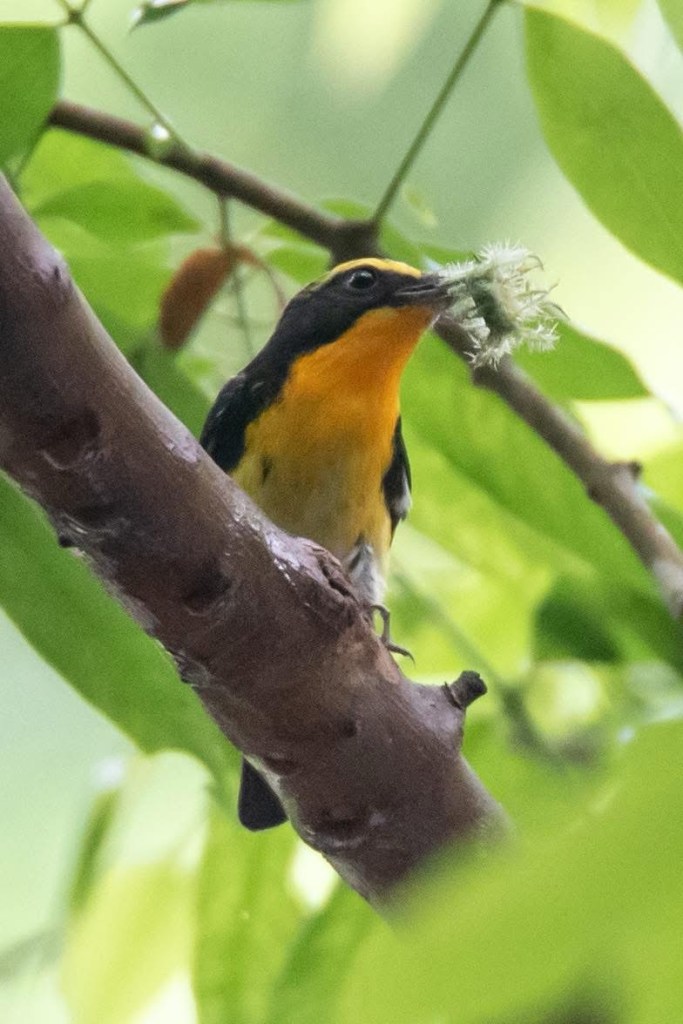
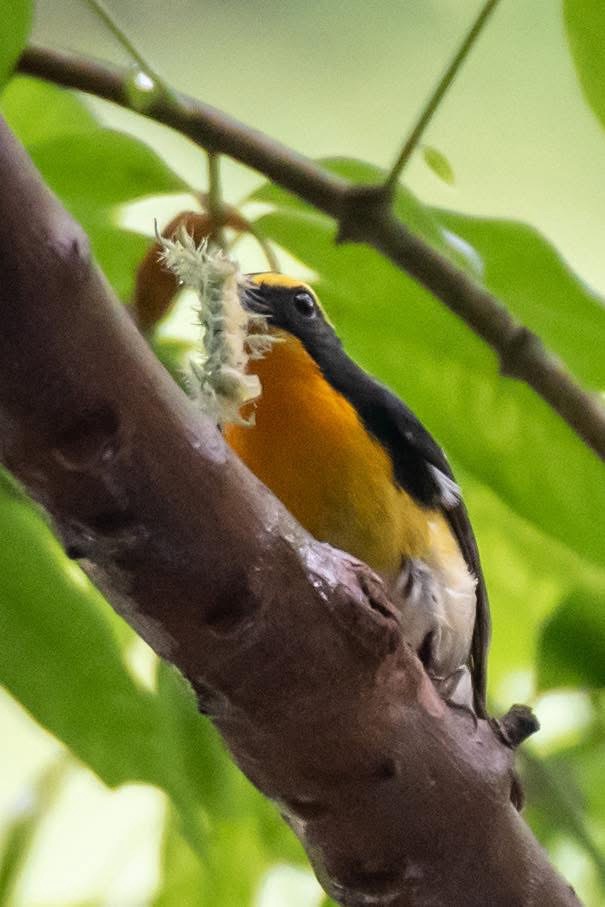
A wildlife enthusiast (Lui Nai Hui) just shared two photographs of a male Narcissus Flycatcher, Ficedula narcissina, spotted in Dairy Farm Nature Park) munching on a Stinging Nettle Slug, a caterpillar that has painful stings with venomous hairs.
These photo-evidences clearly demonstrate that Flycatchers, like cuckoos, can consume potentially venomous caterpillars. Based on this observation, I am confident that both the Asian Brown Flycatcher and the Mugimaki Flycatcher fed on the Clear-Winged Tussock Moth caterpillars infesting the tree.
One evening, as you stroll along a quiet street, a distinct aroma catches your attention – a sweet floral scent fills the air. Without giving it much thought, you continue your walk. Suddenly, the sweet fragrance is replaced by a peppery, musty, and pungent odor that wafts through the night air.
Your mind briefly recalls old tales linking nighttime flower fragrances to supernatural presences. One such legend speaks of the frangipani scent associated with the Pontianak, a vampiric ghost of a beautiful woman who died during childbirth. According to folklore, when that sweet scent turns pungent, it signals that the Pontianak has become vengeful and is approaching fast.
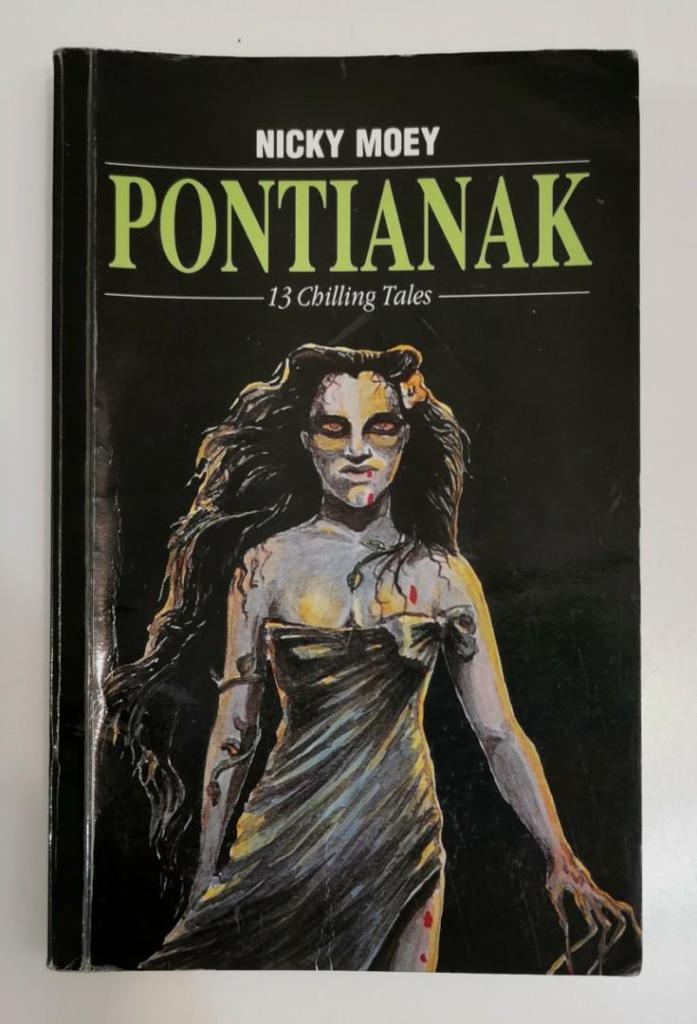
One of the many books on Pontianak that I had in my teenage days, which has contributed to my fear of flower scent at night.
A shiver runs down your spine, and goosebumps prickle across your skin. Your breathing quickens, and with each rapid inhale, the scent seems to intensify, filling your senses with its mysterious fragrance.
You remember some advice given from Russell Lee’s True Singapore Ghost Story Book – Do not look back or look up or you may see something you do not want to see, perhaps on the tree. Or some old wives’ tales – Do not shine your torchlight at the trees or else you may see the evil spirit and further aggravate it.
Tapping on Your Rationale Brain with Flora Knowledge
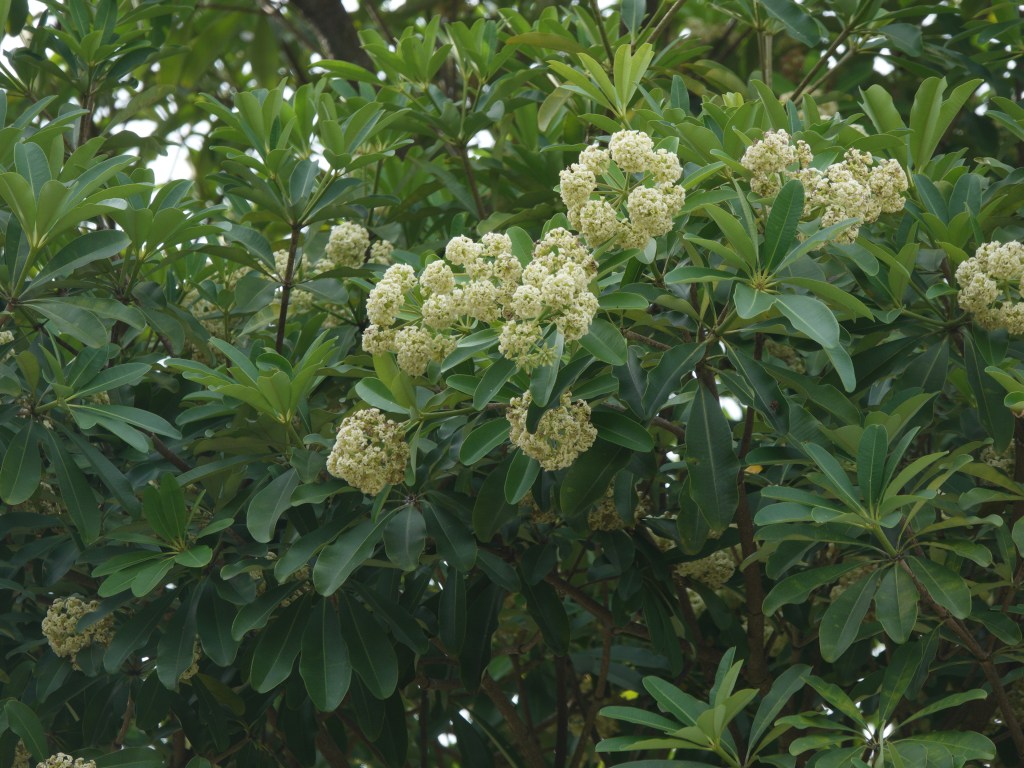
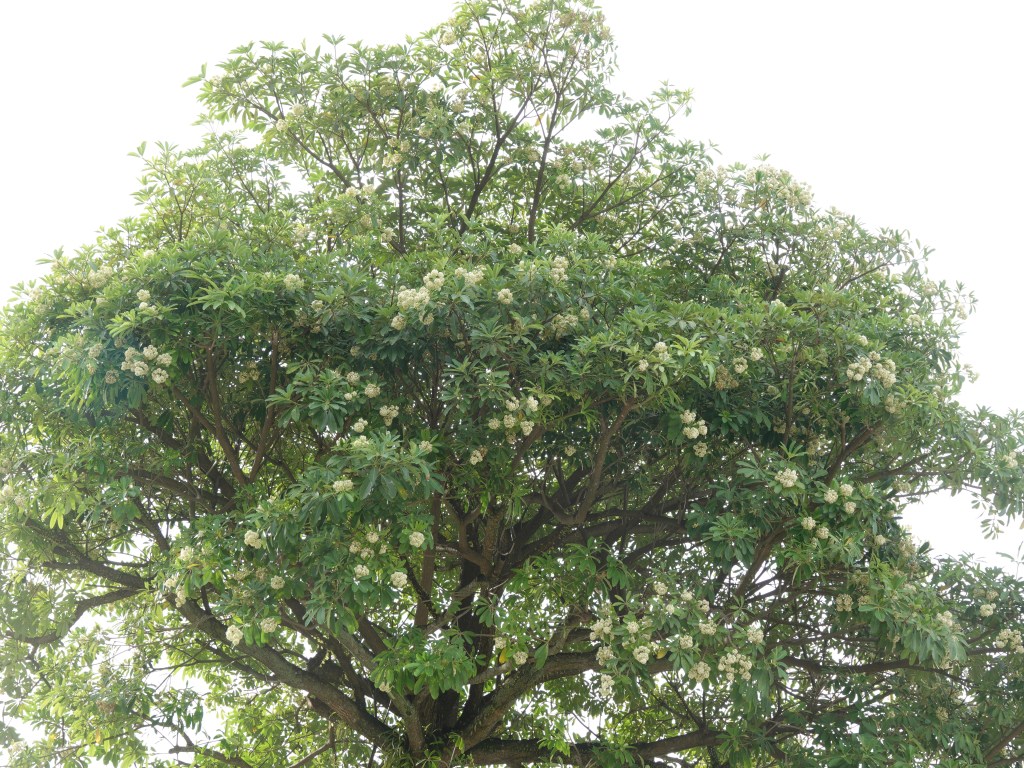
If you do have a torchlight with you and choose to disregard those warnings, you may spot clusters of tiny yellowish-green flowers on a few tall, sturdy trees nearby. This tree is the Alstonia scholaris, more commonly known as the Indian Pulai, and ominously referred to as the Devil Tree or Satan Tree, for reasons previously mentioned.
The greenish-yellow flower clusters of the Alstonia Scholaris. Do you notice the leaves are held together in clusters as well? Photograph taken in Bukit Panjang. Commonly planted in our neighbourhoods.
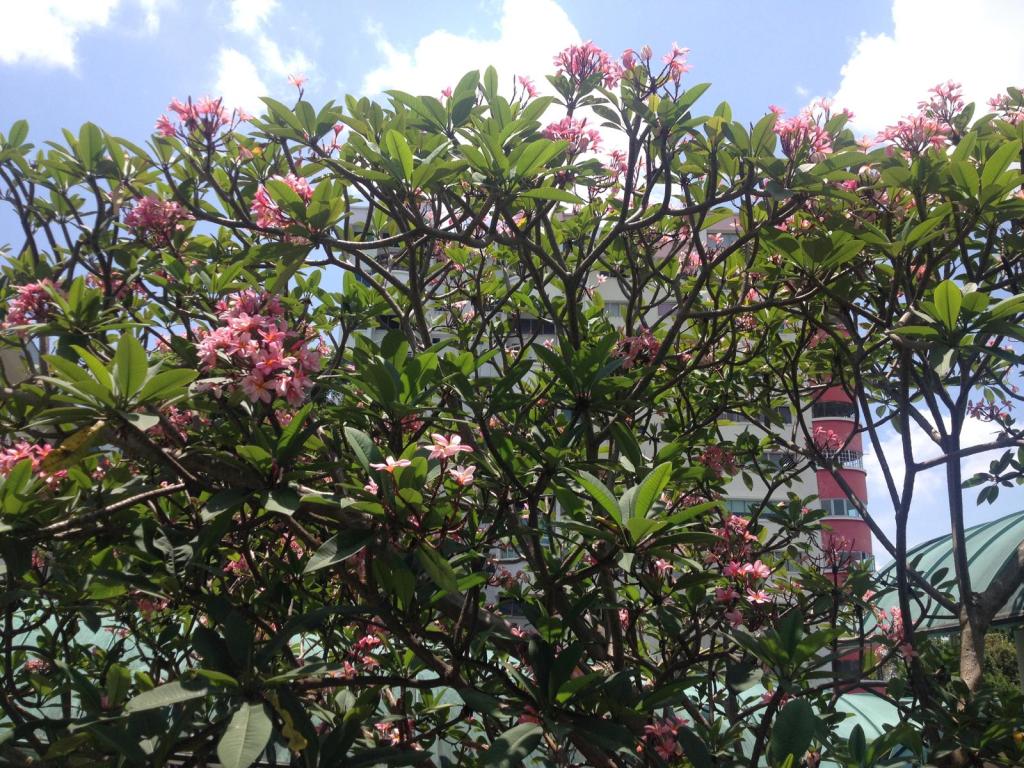
Should you retrace your steps, you’ll likely notice some Frangipani trees (Plumeria obtusa) in the vicinity, their fragrant flowers in full bloom.
Frangipani trees are also planted in many HDB estates.
The shift in scent is likely due to your proximity to two types of trees commonly found along pavements in housing estates and roadsides. Specifically, the overpowering fragrance of the Alstonia tree is probably the culprit, and you’re not alone in finding it overwhelming – many people share your aversion to its exceedingly pungent aroma. It is so smelly that a city in south-central Vietnam cut down over 3,000 trees (out of the 4,000 planted) in 2015 due to their overpowering and unpleasant smell, which has become unbearable for local residents (Click here for source).
In fact, the tree’s strong odour has led to some rather colourful nicknames. While we’ll refrain from mentioning the more crude monikers, it’s worth noting that the tree’s distinctive scent has certainly made an impression, inspiring a variety of descriptive (if not always flattering) names (You may refer to a reddit discussion on Alstonia Scholaris here)
Why Some Flowers Emit Strong Scent at Night?
You might still wonder, “Why is the scent so strong at night? It must be something supernatural?” The answer lies firmly in the realm of science, not the supernatural. Understanding nocturnal plant behaviour reveals a hidden world of ecological interactions that occur while most of us sleep.
Plant pollination takes on a different character after sunset, with specialised night-active insects and animals playing crucial roles. The strong nighttime fragrance isn’t a ghostly phenomenon – it’s a sophisticated biological mechanism.
Why do both the Plumeria and the Alstonia expend so much energy producing scents at night? After all, aren’t most butterflies and bees inactive during these hours? The answer lies in these trees’ fascinating relationship with nocturnal pollinators.
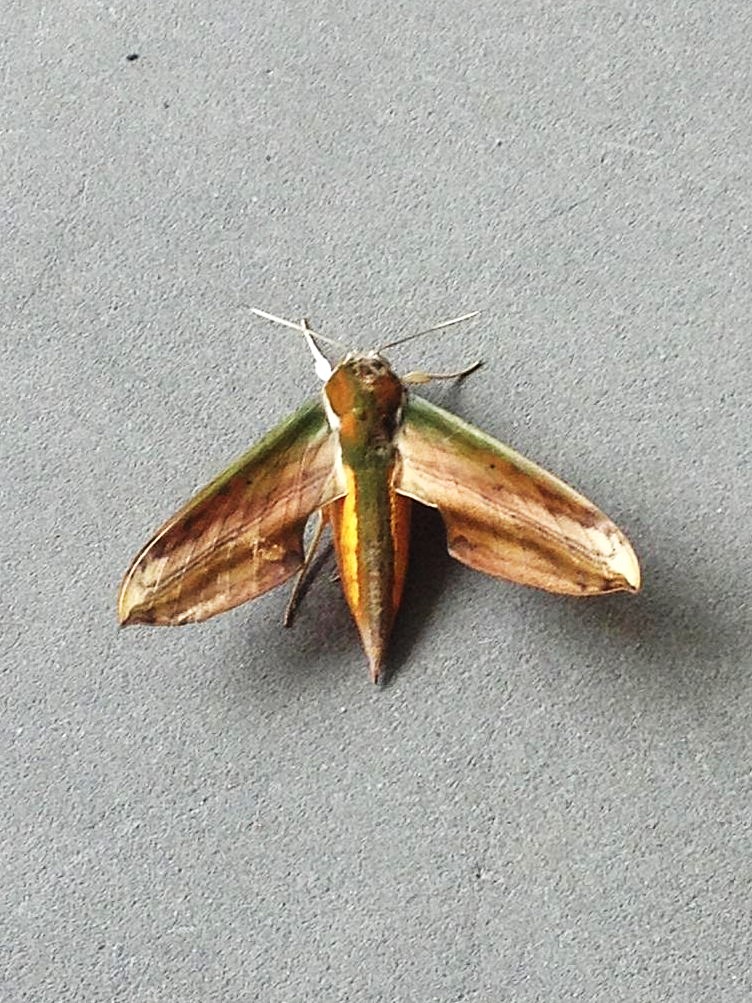
Some sphinx moths (also known as Hawkmoths), for instance, the Oleander Hawk Moth and the Yam Hawk Moth with their impressively long proboscises, are perfectly adapted to feed on and pollinate night-blooming flowers. (Note that not all hawk moths are nocturnal; some species, such as the hummingbird and pellucid hawk moths, are active during the day. Additionally, not all moths are pollinators, as some species lack a functional mouthpart for feeding, for instance, the Atlas Moth). These moths, along with certain species of bats, form a crucial link in the chain of nocturnal pollination. By releasing their potent fragrances after dark, the Plumeria and Alstonia trees have evolved to attract these nighttime visitors, ensuring their continued reproduction and survival.
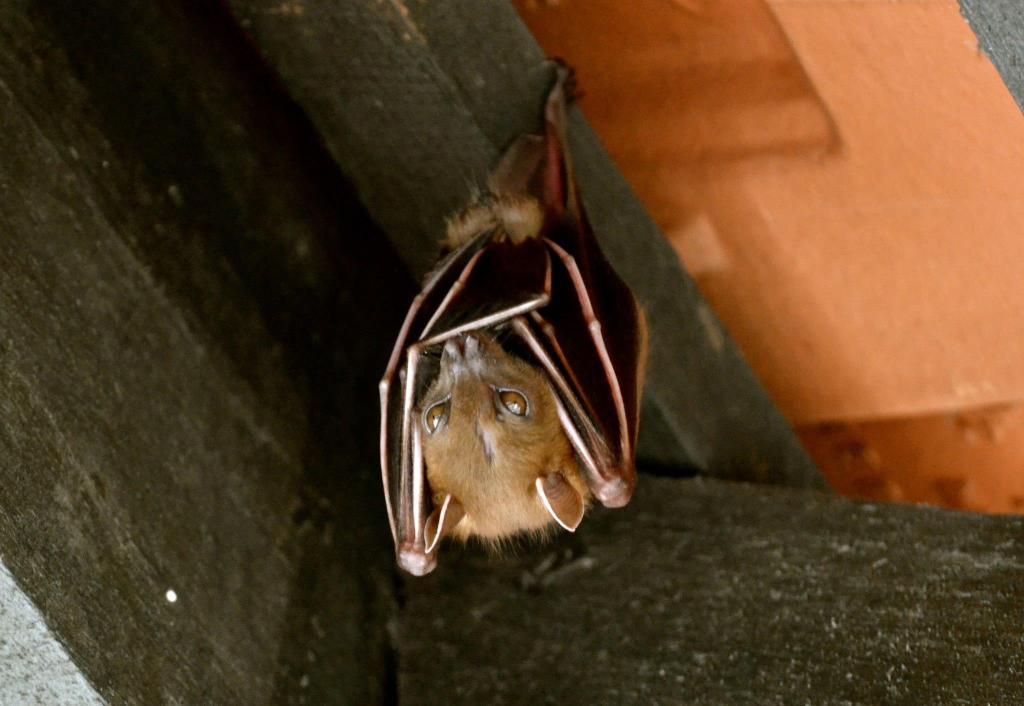
Yam Hawk Moth – A night dwelling moth that helps with pollination in the wee hours. The Lesser Dog-Faced Bat is a common sight, even in our urban areas. While I couldn’t find specific documentation of this species contributing to pollination, fruit bats in general do play a role while feeding on nectar.
These night-active pollinators are attracted to the strong scents and large, robust flowers of plants like Plumeria and Alstonia. While feeding on the nectar, they are also unintentionally transferring pollen from flower to flower, ensuring the plants’ reproduction.
Some Interesting Features of the Alstonia and Plumeria
The species name “scholaris” reflects the tree’s historical significance in education. Traditionally, its wood was used to craft slates for schoolchildren’s lessons, and it was also a preferred timber for making pencils. Interestingly, local lore suggests that the fragrance of the tree’s flowers had cognitive benefits, improving learning for those who sat beneath its branches. However, this notion is likely met with skepticism by many, as the scent of the flowers is often described as pungent and overpowering, rather than invigorating or conducive to learning.
There is another common name for the Alstonia tree i.e. saptaparni (in sanskrit), which literally means seven-leaves tree as the Alstonia’s leaves are held in clusters, usually adds up to 7. However, it is not always the case as botanically, it ranges from 4-8. For more interesting features of Alstonia Scholaris, click here to read more.
See the clusters of 7 leaves, which isn’t always the case though.
On the other hand, the Plumeria has deep cultural and historical roots, symbolising the exotic Oriental ‘East’ for centuries. This symbolism has been perpetuated in outdated tourism imagery, which often features bikini-clad, brown-skinned women adorned with frangipani flowers in their hair, reinforcing a problematic and stereotypical representation of tropical cultures. Ironically, the Frangipani actually originates from the tropical regions of South America – the ‘West’. For a more nuanced understanding of the Frangipani tree’s cultural and historical significance, click here for a recommended read.
Conclusion
The next time you catch a whiff of sweet fragrance, that suddenly turned pungent on a nighttime walk, remember – you’re not experiencing something supernatural, but rather witnessing an age-old dance between plants and their pollinators. This nocturnal plant behaviour, far from being ominous, is a testament to the incredible adaptability and ingenuity of nature.
Mutualism in natural science refers to a symbiotic relationship between two different species where both organisms benefit from the interaction. This type of relationship is widespread in nature and plays a crucial role in many ecosystems.
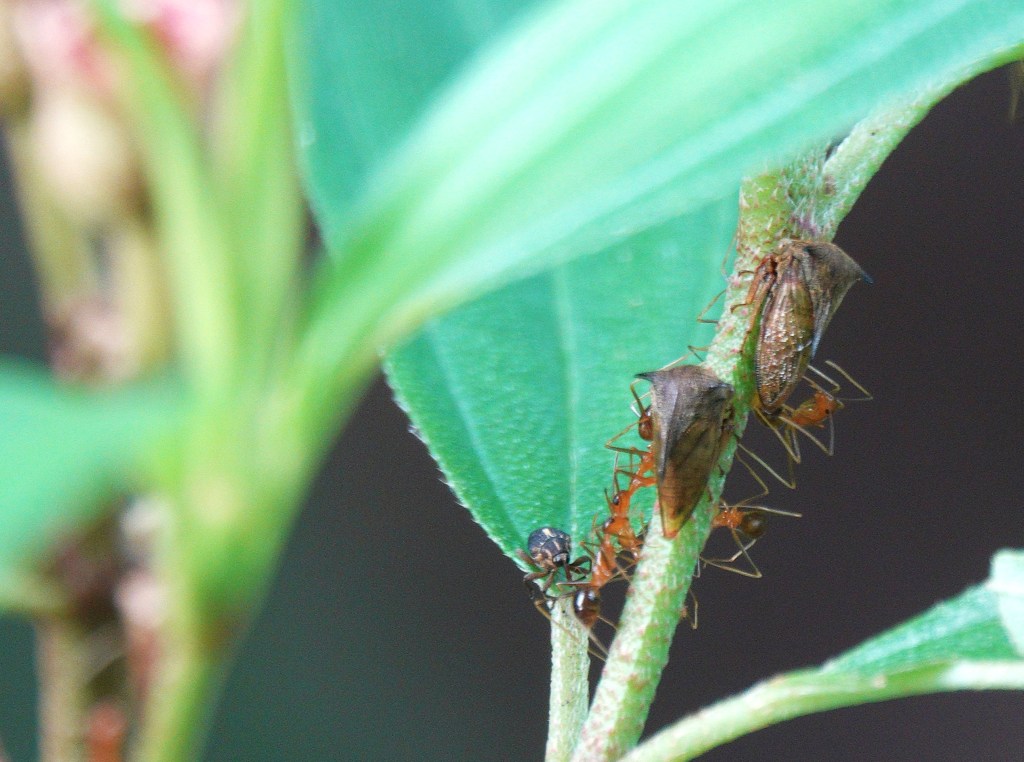
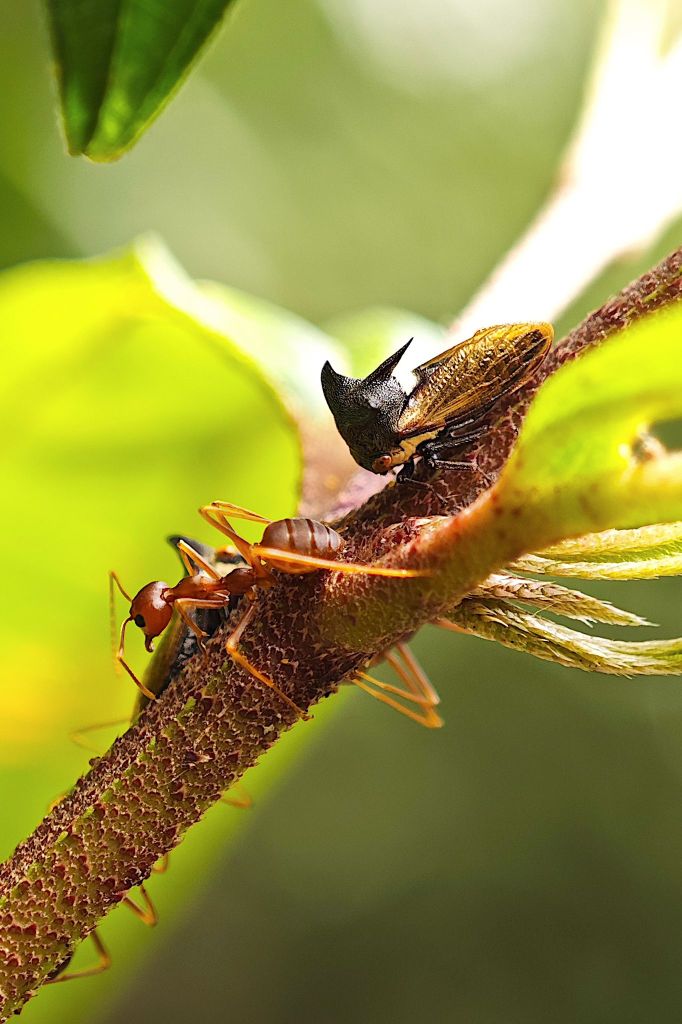
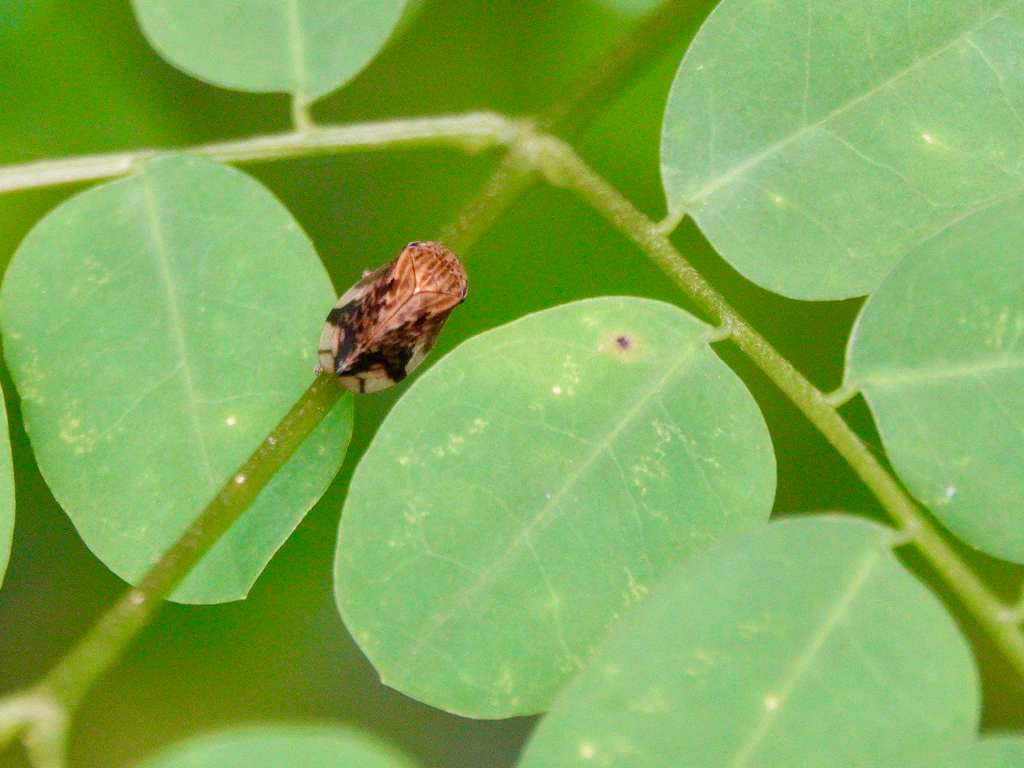
Treehoppers (Membracidae) are small, fascinating insects known for their unique appearance. These tiny bugs, usually smaller than a fingernail, have unusual protrusions on their backs that help them blend in with plants. They use their sharp mouthparts to feed on tree sap, which can sometimes make them a nuisance to gardeners. With thousands of species worldwide, these odd-looking insects continue to intrigue both scientists and nature lovers, showcasing the incredible diversity of the insect world. In this post, I will be documenting the symbiotic relationship between treehoppers and ants, which is observed in Singapore.
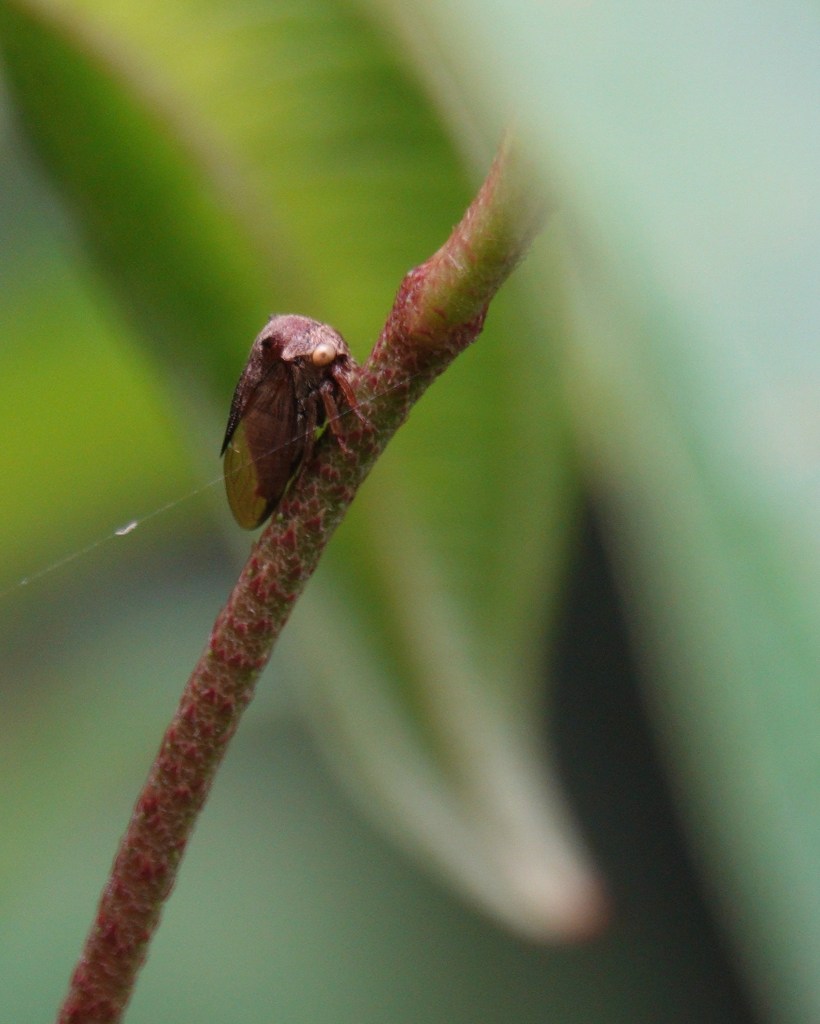
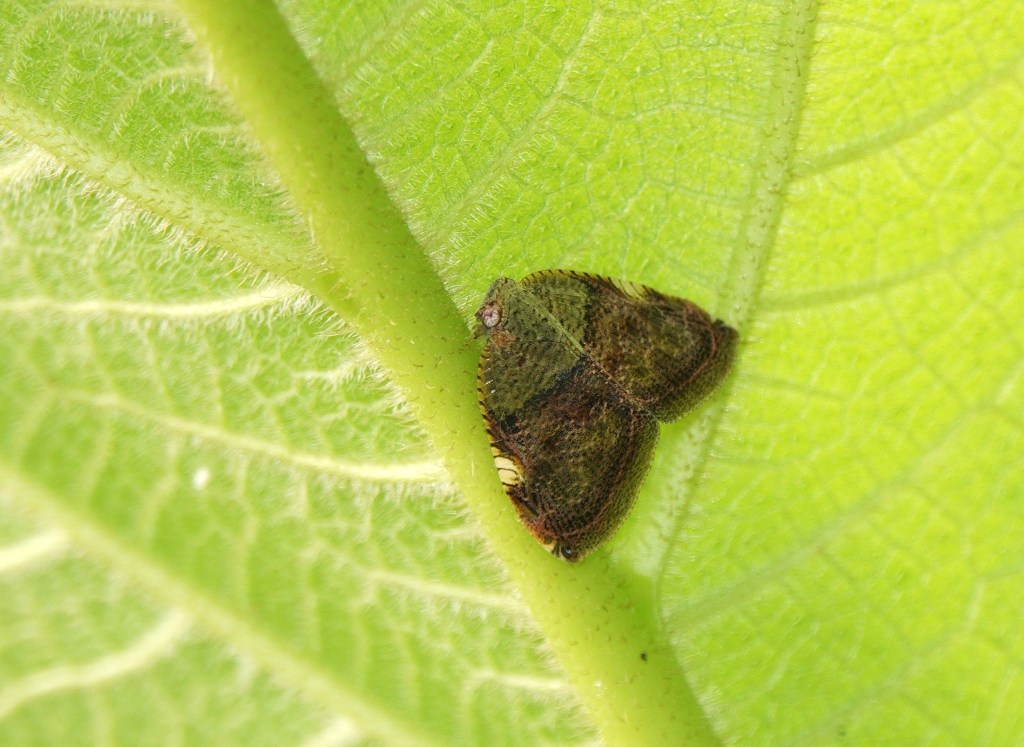
An unidentified treehopper.
A Moment in Nature
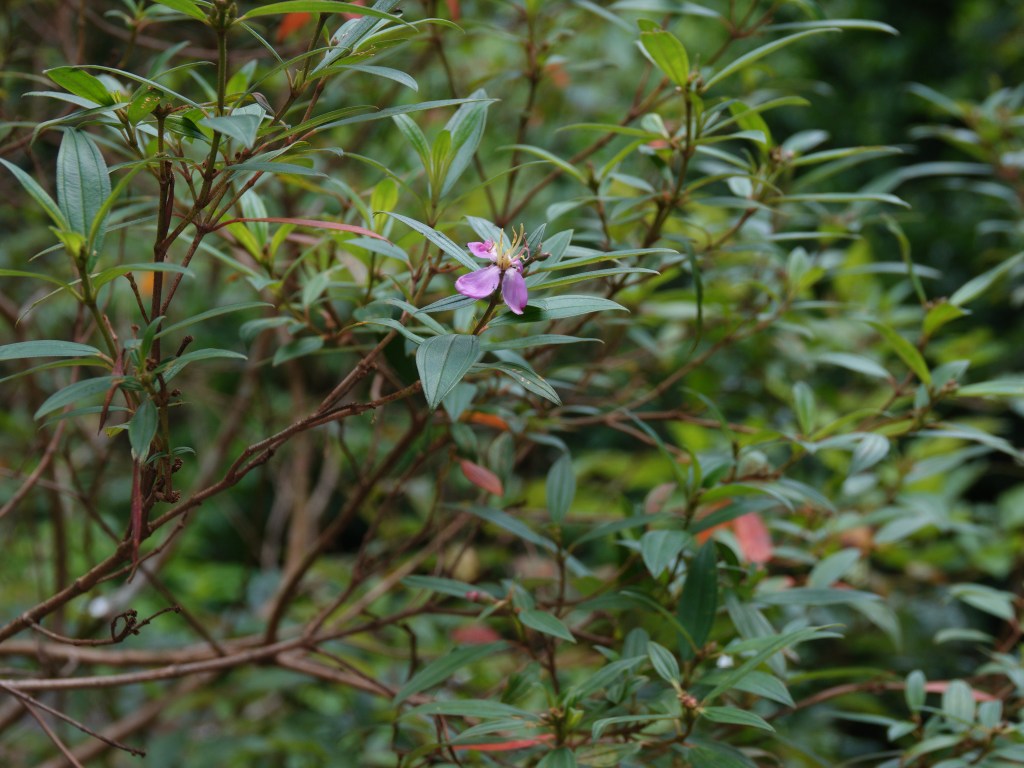
In the fascinating world of insect interactions, treehoppers and ants have developed this mutually beneficial relationship. During a recent visit to Thomson Nature Park in Singapore, I observed a remarkable example of this symbiosis on the Singapore Rhododendron shrub (Melastoma malabathricum). The same observation was also recorded in Pulau Ubin on a Melastoma.
Singapore Rhododendron shrub (Melastoma malabathricum). Photo taken in Dairy Farm Nature Park.
A group of Red Weaver Ants (Oecophylla) was actively tending to numerous unidentified treehoppers along the plant’s stems. Upon closer inspection, it became apparent that the ants were gently stimulating the treehoppers, encouraging them to secrete honeydew – a sweet, nutrient-rich liquid that the ants consume.
Red weaver ants were actively ‘milking’ treehoppers for their honeydew, while a weevil stood by. Have you observe the bizarrely shaped pronotum on the treehoppers? That is where the two ‘horns’ are located. Photo taken along Old Upper Thomson Road.
Treehoppers benefit from the Red Weaver Ants’:
Protection from predators and parasites
Care for treehopper nymphs
Red Weaver Ants benefit from Treehoppers’:
Honeydew, a sweet substance excreted by treehoppers, which serves as a valuable food source
Another mutualistic relationship between the Red Weaver Ants and the Treehoppers (possibly Nilautama minutispina Funkhouser) was documented in Pulau Ubin. Photo Credit: Gabriel Kang
Next time you’re out in nature, take a moment to look closely at the plants around you. You might just witness your own example of mutualism in action between a treehopper and some ant species!
What About other Hoppers?
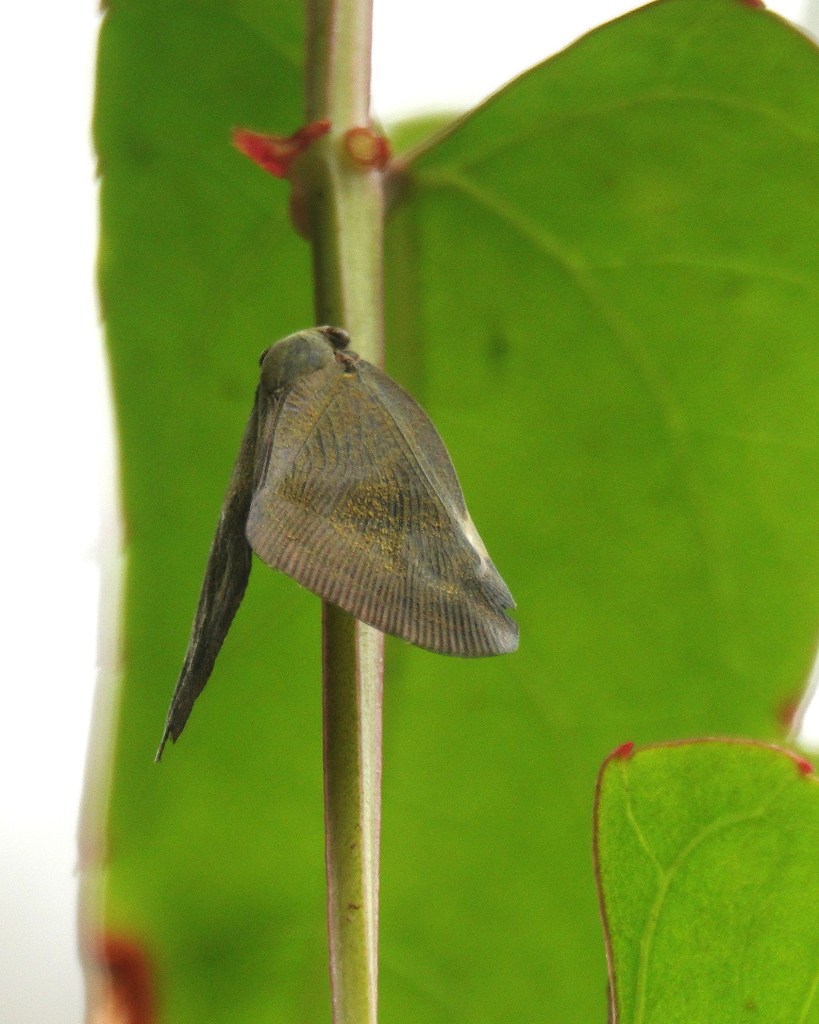
At this juncture, I am unsure if there are any mutualistic relationship between these other hoppers and ants.
Now, let us dwell into some basic background knowledge on leafhoppers, froghoppers and planthoppers, at least by their common names.
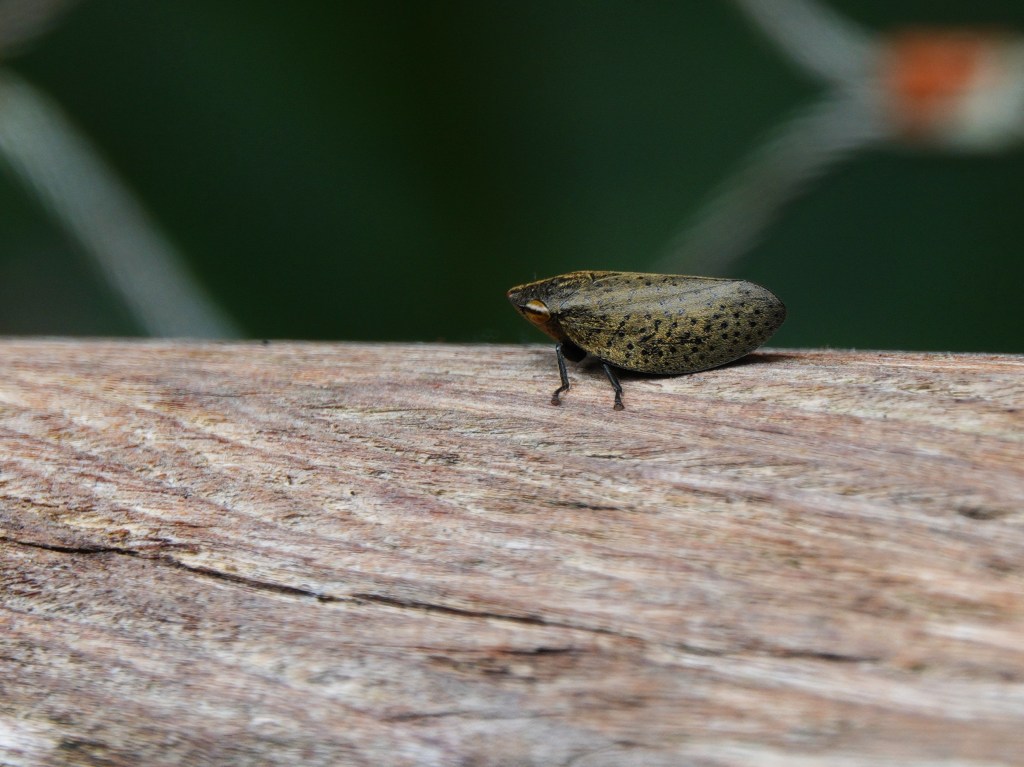
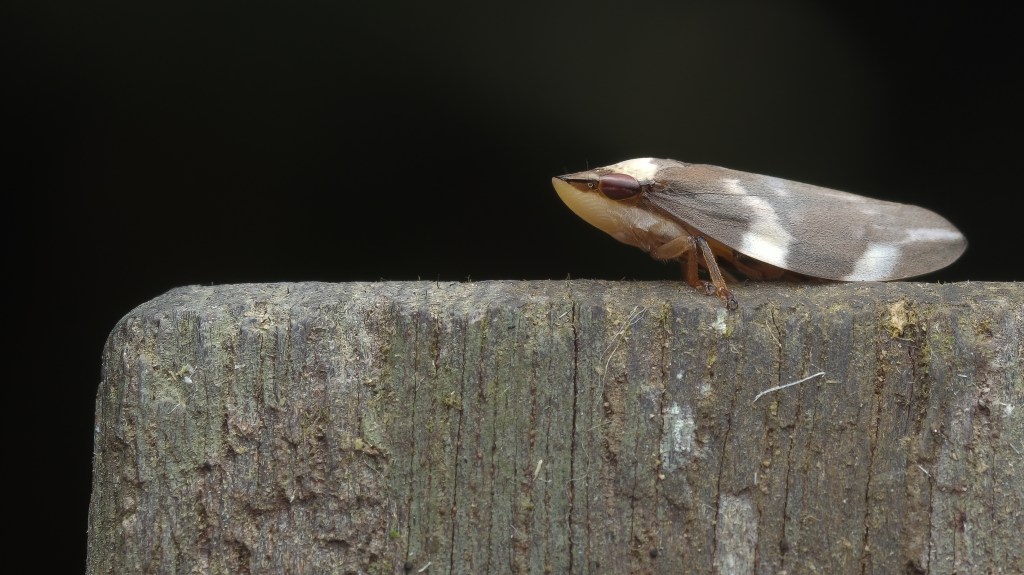
These other hoppers belong to the order Hemiptera, commonly known as True Bugs. These insects are characterised by their sucking mouthparts and a developmental stage called “nymph” before reaching adulthood. While Leafhoppers, Treehoppers, and Spittlebugs share a closer evolutionary relationship with Cicadas, Planthoppers are slightly more distant relatives within the order. As their names suggest, most possess the ability to jump, which aids in their survival and dispersal.
Captured in various locations across the island of Singapore, these images of planthoppers, froghoppers and leafhoppers offer a glimpse into the unique characteristics and behaviors of these intriguing insects.
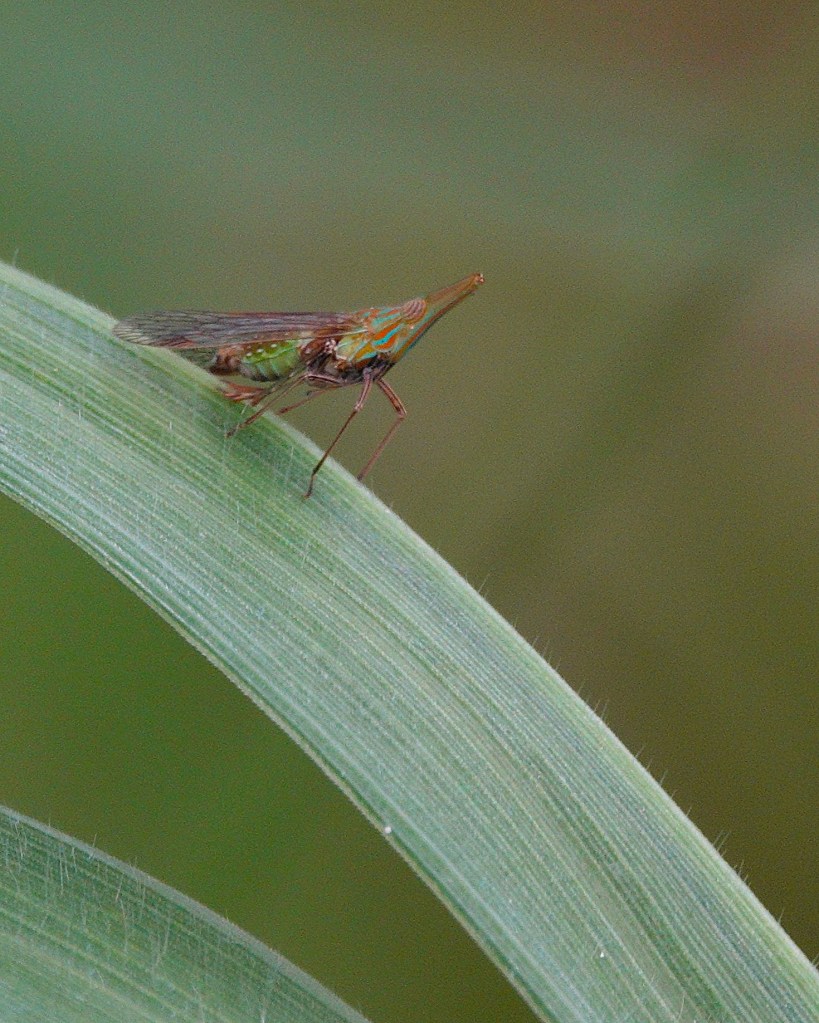
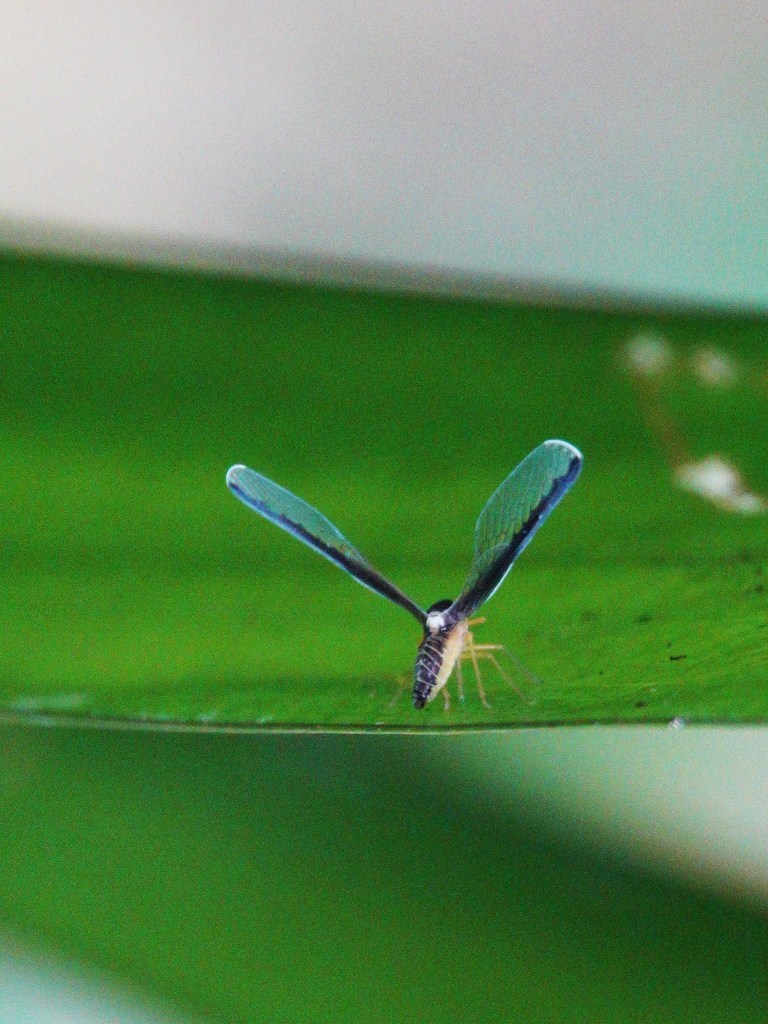
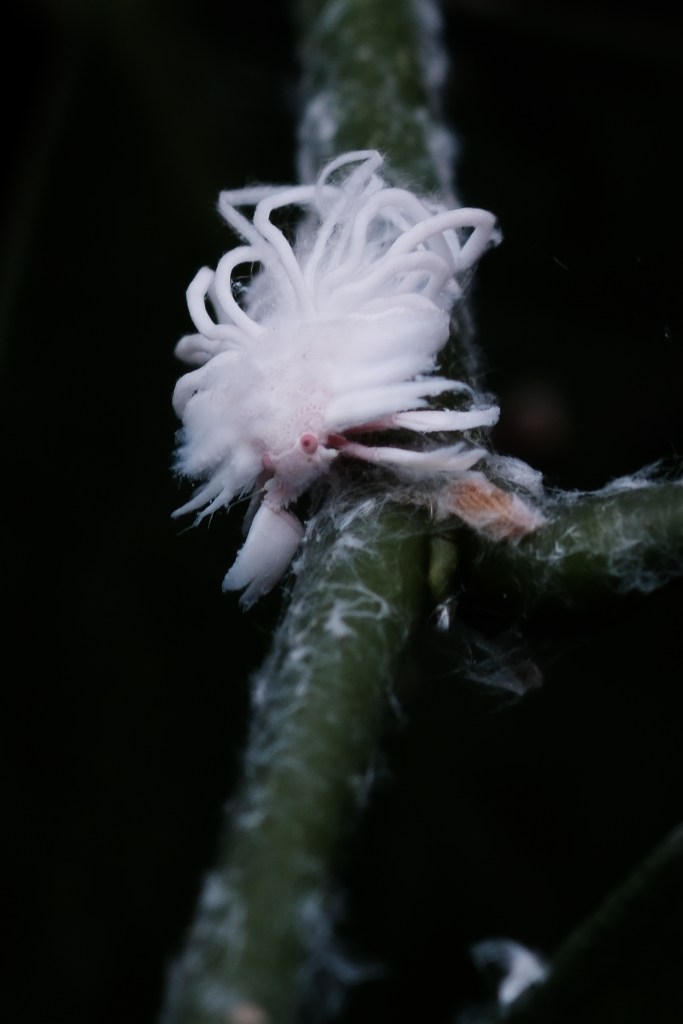
Planthoppers have antennae attached below the eyes, on the sides of the head.
Planthopper, Ricanula stigmatica.Planthopper Ricanula sublimata. Another one from the Ricanula genus that mimics moths. Probably the biggest one I have seen so far.Long-nosed planthopper, Dictyopharidae Raivuna Derbid Planthopper. This one holds its wings in a V-shaped.Planthopper nymph, likely from the Flatidae family
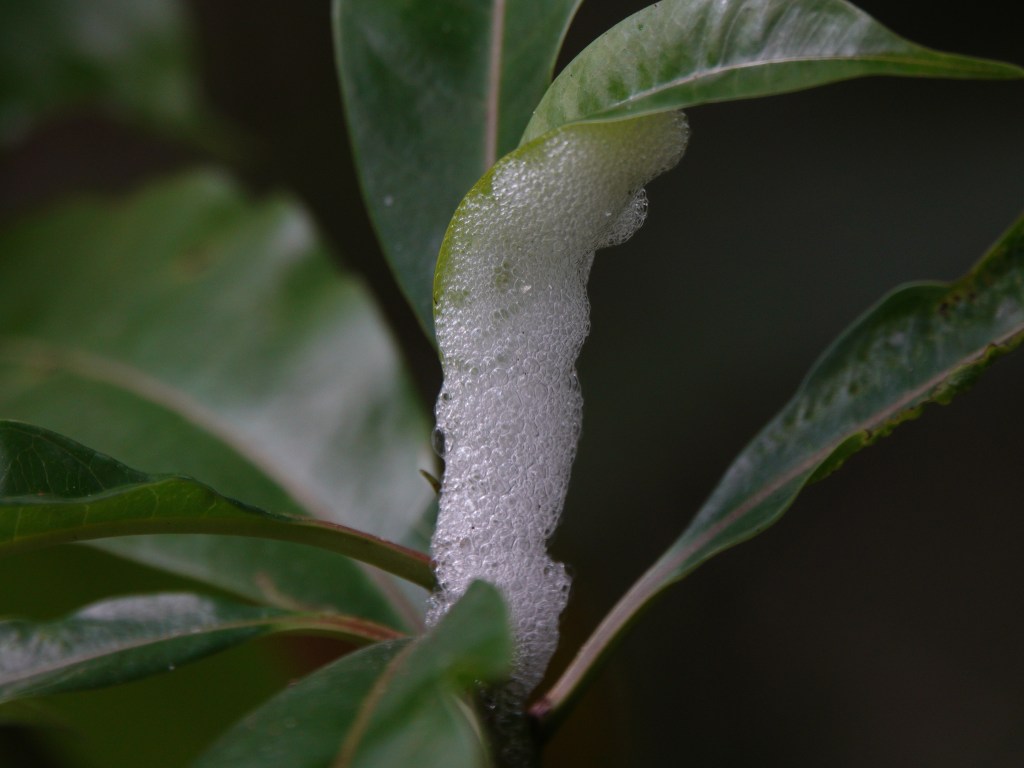
While hiking, if you notice what appears to be spit on a plant stem, gently remove some of the froth to reveal the tiny culprit: a soft-bodied, wingless nymph of a froghopper (spittlebug). As they mature, froghoppers develop a distinctive “frog-like” appearance, with a wider rear end than front, and impressive jumping ability.
Protective ‘spit’ that gives the froghoppers its spittlebug ID.Plinia ampla. Froghopper (Spittlebug)Clovia sp. Froghopper (Spittlebug)Ptyelinellus praefractus Froghopper (Spittlebug)
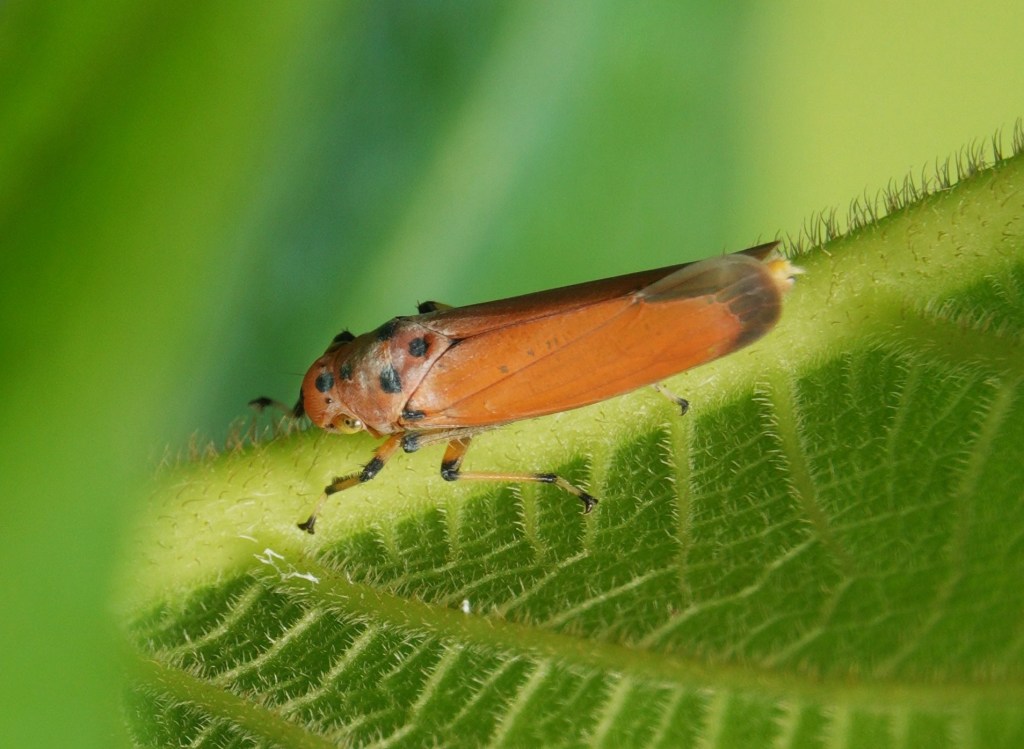
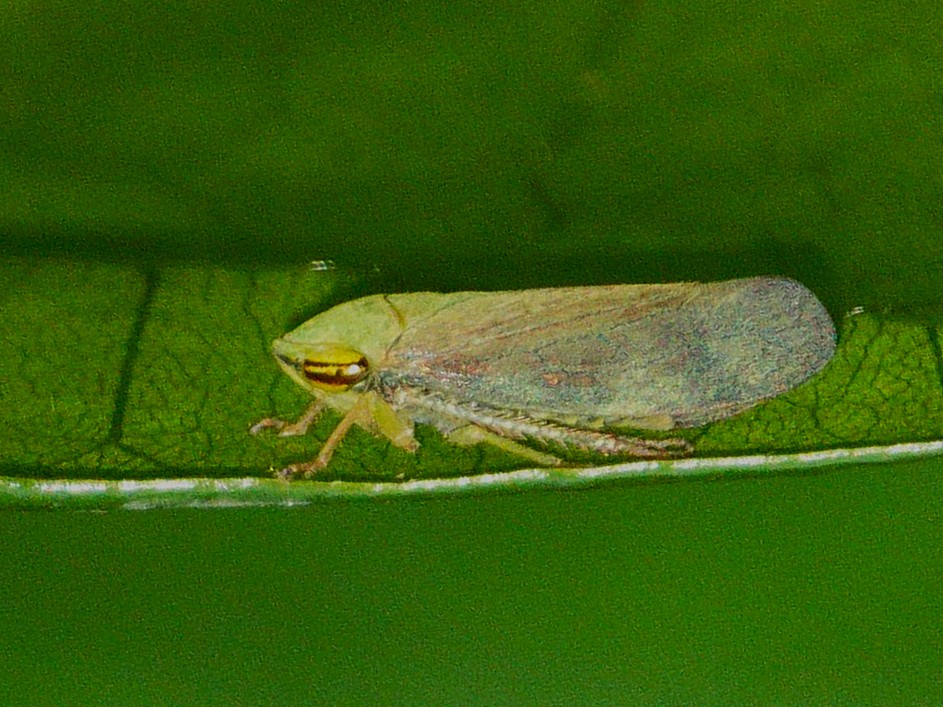
Leafhoppers may be mistaken for cicadas due to their similar body shape, but are much smaller. To identify them, look for the distinctive rows of tiny spines on the hind legs, specifically on the shin area. Their bodies tend to be straight-sided or tapered toward the rear.
Bothrogonia addita, also known as ‘Orange Sharpshooter’, is another leafhopper that is longish with a tapered end. Unknown leafhopper. Photo taken in Singapore, Dairy Farm Nature Park. A top view of the leafhopper to appreciate its tapered back.
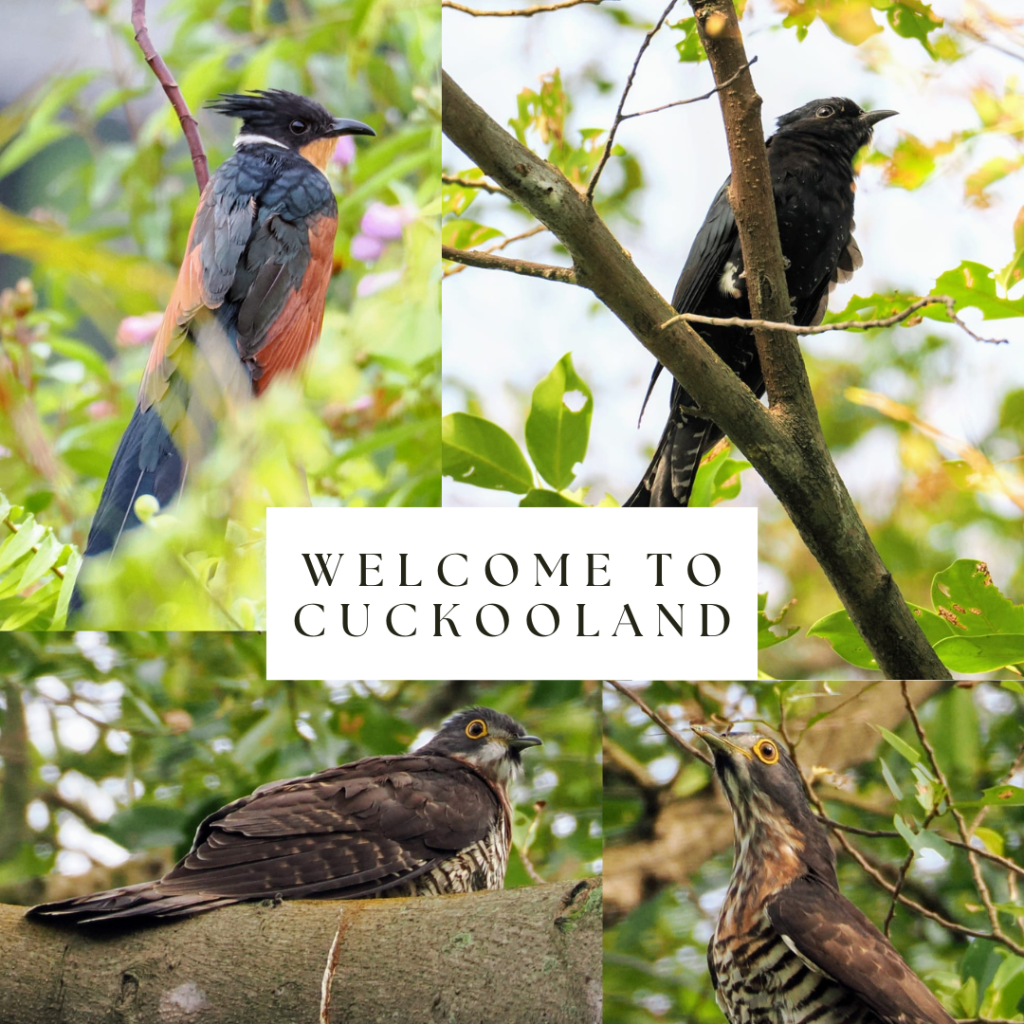
Over the last month, a “Cuckooland” was discovered by the Singapore birding community in Jurong Lake Gardens, much to the delight of birders living in the West. Several species of migratory and resident cuckoos have congregated in the area, attracting wildlife photographers who adore these birds for their beautiful plumage and elegant silhouette. The diverse array of cuckoo species includes the Squared-Tailed Drongo-Cuckoo, Large-Hawk Cuckoo, Indian Cuckoo, Sunda Brush Cuckoo, Himalayan Cuckoo, Plaintive Cuckoo, Banded Bay Cuckoo, Asian Koel and the handsome Chestnut-Winged Cuckoo.
From the top in clockwise directions: Chestnut-Winged Cuckoo, Square-Tailed Drongo Cuckoo, Large-Hawk Cuckoo. (Credit: Lee Ching Yong, 2024)
The Parasitic Brooding Behaviour of Cuckoos
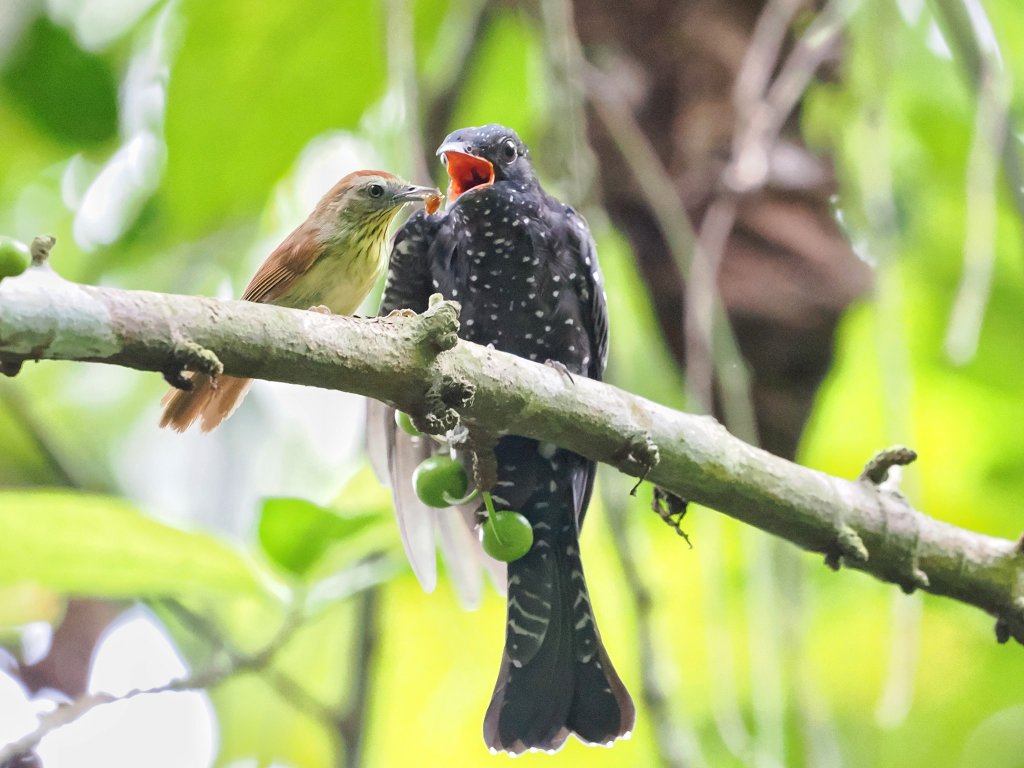
Cuckoos are particularly interesting due to their parasitic brooding behaviour, which birders have had the pleasure of observing and photographing. Singaporean birders have brilliantly captured images of various host species, such as Golden-bellied Gerygones, Ashy Tailorbirds, Pin-Striped Tit-Babblers, and Malayan Pied Fantails, feeding cuckoo fledglings that are often larger than themselves, belonging to species like the Little Bronze Cuckoo, Square-Tailed Drongo, Rusty-breasted Cuckoo, Plaintive Cuckoo, and even the well-known Asian Koel (which is also a member of the Cuckoo family)
A Pin-Striped Tit Babbler feeding its oversized Square-Tailed Drongo Cuckoo. (Credit: Anderson Ng, 2024)
Cuckoos – Our Pest Controllers
This unique gathering in Jurong Lake Gardens has also provided an excellent opportunity for bird enthusiasts to witness and document the feeding habits of beautiful cuckoos, which I’ll focus on in this post.
During a recent birding excursion with my friend Gabriel, we explored the area around Fusion Spoon, a known cuckoo hotspot. Despite not spotting any cuckoos that morning, we enjoyed sightings of migratory Warblers, Flowerpeckers, Tailorbirds, Sunbirds, and Pied Trillers as we strolled past the ficus trees.
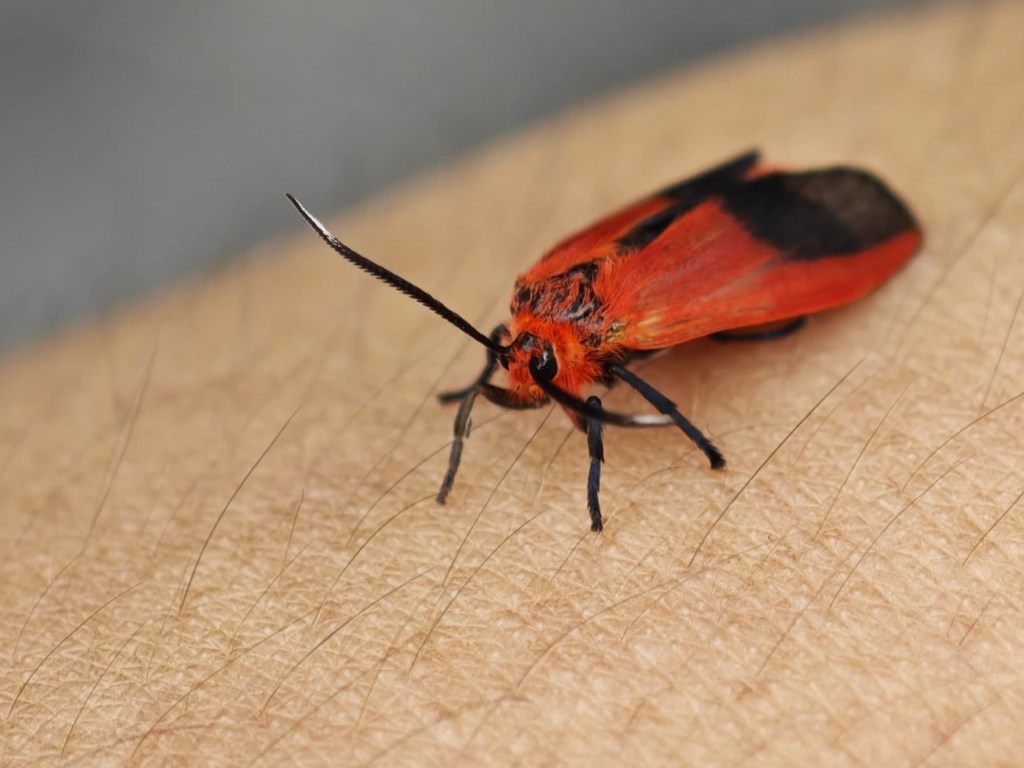
A moment of delight came when a beautiful moth unexpectedly landed on Gabriel’s arm, adding a sudden splash of colour to our walk. Though familiar, we couldn’t immediately identify it. Our friend Ching Yong later joined us, sharing photos of caterpillars he’d spotted in the same area over the past few days. These caterpillars, found on the pavement, were likely dislodged by foraging cuckoos or heavy rain, hinting at the intricate ecological interactions unfolding around us.
The deceptively harmless-looking Phauda flammans moth, a notorious pest species, perched on Gabriel’s arm (Credit: Gabriel Kang, 2025)
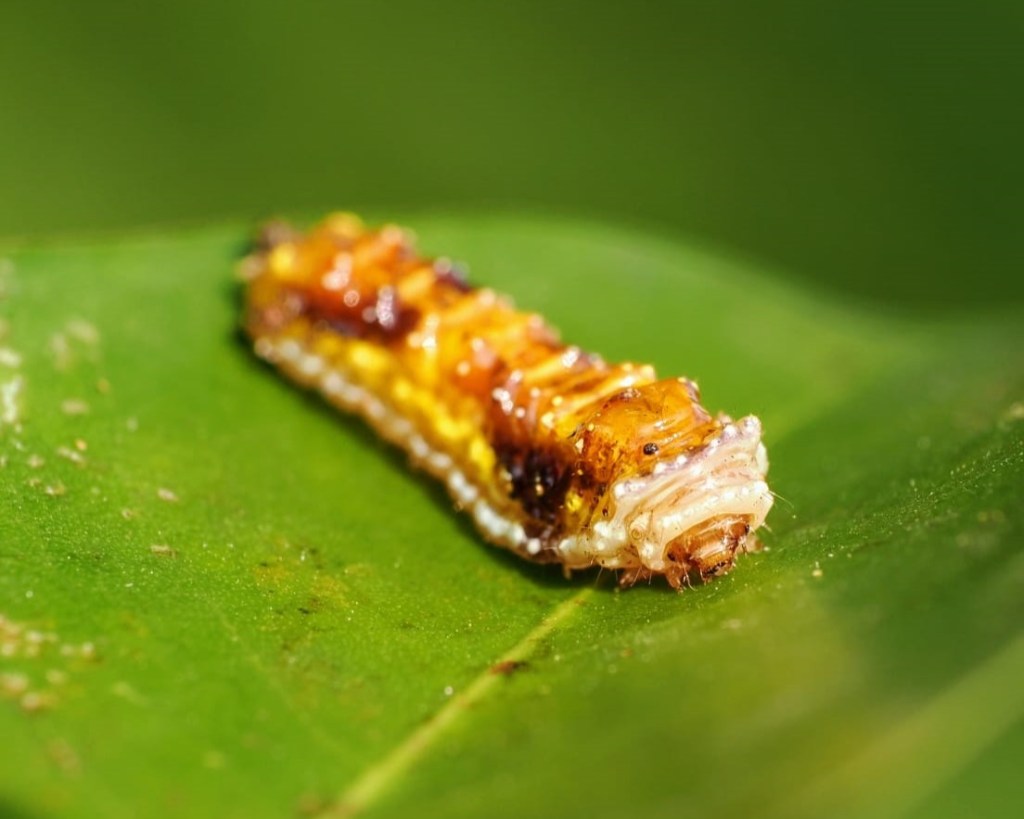
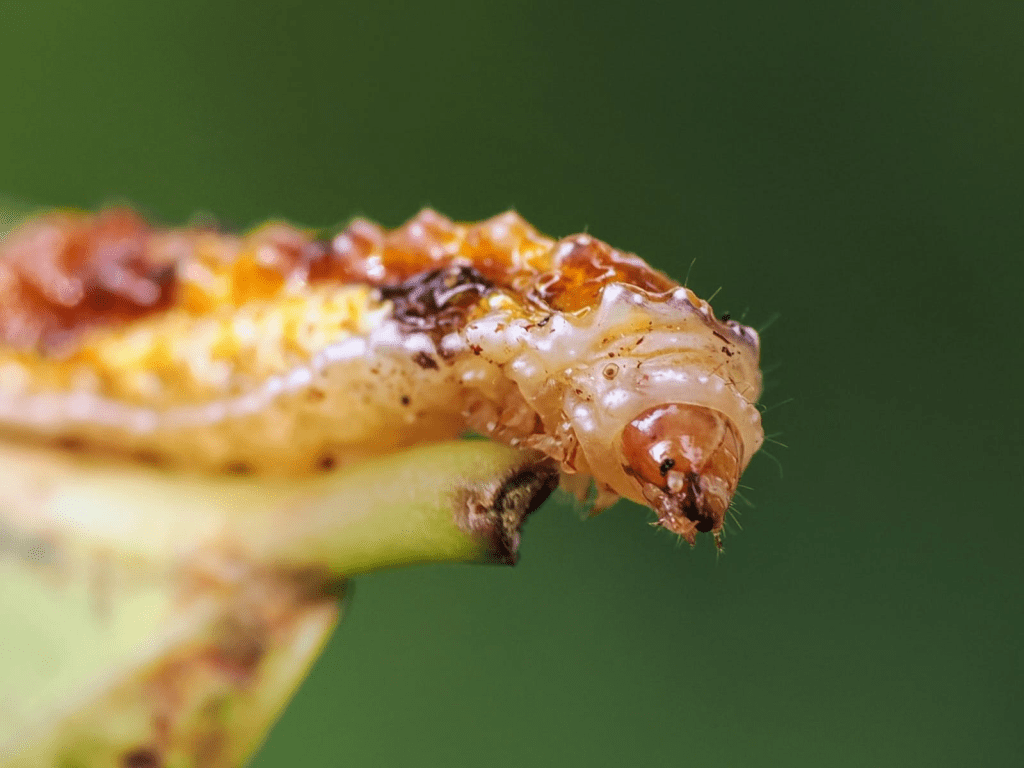
Intrigued by our encounter, I later ‘Google-lensed’ the moth’s identity and made a fascinating connection: the moth that landed on Gabriel’s arm was the adult form of the caterpillar that Ching Yong had photographed. It turned out to be the notorious Phauda flammans, a species known for its destructive impact on specific Ficus trees, particularly Malayan Banyan (Ficus microcarpa) and Weeping Fig (F. benjamina), while leaving the other commonly seen Ficus elastica unscathed (see article).
On the left is a rather sparse looking unmatured Malayan Banyan (Ficus microcarpa) where the cuckoos love to perch and feed. Thanks Teo Siyang for the ID. A close-up view of the Phauda flammans caterpillar, a favourite delicacy of the cuckoos. The intricate pattern on this caterpillar’s body is reminiscent of the layered, rippled texture of the iconic Viennetta ice cream cake from the 1990s. (Credit: Lee Ching Yong, 2024)Another macroshot of the caterpillar’s head. (Credit: Lee Ching Yong, 2024)
This moth has gained infamy in recent years, particularly in Hong Kong, where it has been responsible for significant damage to various Ficus species (You may read about the article here), causing complete defoliation. Eggs are laid on leaves in the top of the trees and the larvae (caterpillars), upon hatching will start consuming right from the top. In Singapore, you may have noticed some canopy branches of Ficus trees losing their foliage. It’s highly likely that Phauda flammans is the culprit behind this damage.
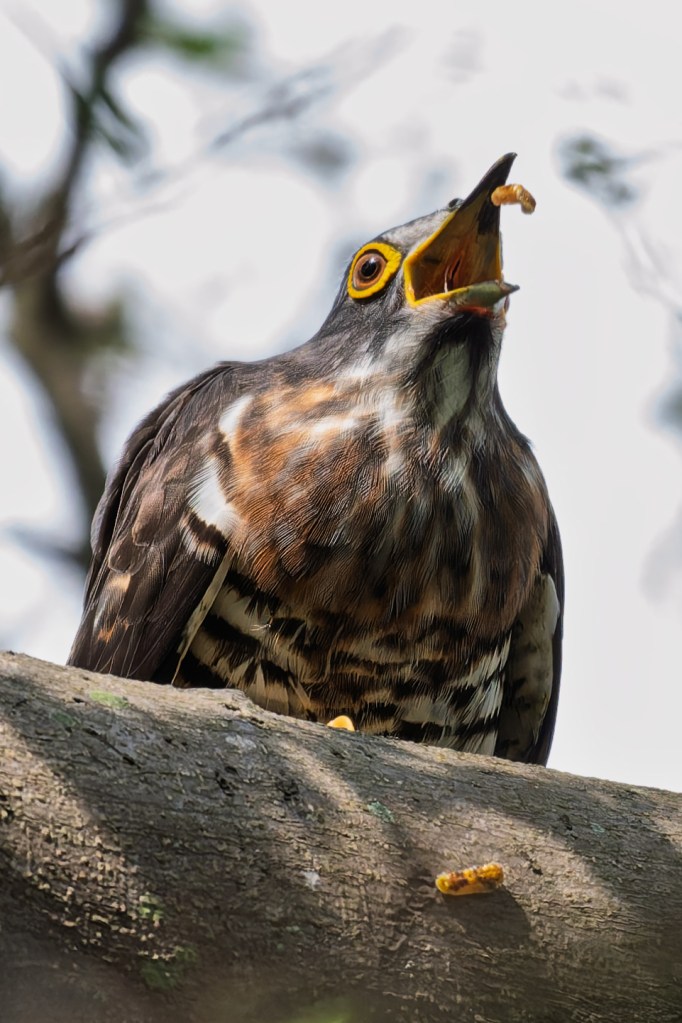
The presence of these moths and caterpillars in the area not only explains the damage to the local Ficus trees but also sheds light on the reason behind the cuckoos’ congregation. These birds are capitalising on the abundant caterpillar population, which includes Phauda flammans and some tussock moth (Lymantriinae) caterpillars, as evidenced in other publicly shared photographs. This effectively transforms a potential pest problem into a bountiful feeding opportunity for the cuckoos. This ecological interaction has been visually confirmed by a fellow birder, Bai Qw’s photograph, which brilliantly captured a Large-Hawk Cuckoo (Hierococcyx sparverioides) feasting on these specific Phauda flammans caterpillars.
A Large-Hawk Cuckoo feasting on a Phauda flammans caterpillar with another one trying to escape its fate. (Credits: Bai Qw, 2024)
Ain’t Many of These Caterpillars Venomous and/or Poisonous?
Yes, many caterpillars are indeed venomous and poisonous. However, this fact doesn’t deter cuckoos from making these hairy creatures a significant part of their diet. In fact, cuckoos worldwide are well-known for specifically targeting hairy caterpillars that possess venomous spikes/bristles.
In New Zealand, Shining Bronze Cuckoos were documented feeding on venomous Gum-leaf Skeletoniser Caterpillars, Woolly-Bear caterpillars, Magpie Moth Caterpillar etc (refer to article for the New Zealand’s reference).
The secret lies in the cuckoo’s unique digestive system:
Protective Gizzard: The cuckoo’s gizzard is lined with a thick, protective mucous membrane.
Hair Trapping: This membrane traps the venomous hairs of the caterpillars.
Shedding Mechanism: As a defense mechanism, the bird periodically sheds patches of this membrane.
Regurgitation: The shed membrane, along with the toxic hairs, is regurgitated as a pellet.
Interestingly, the Bird Ecology Study Group has documented another intriguing behaviour: some cuckoos have been observed rubbing caterpillars against rough tree bark. This action likely serves to remove or reduce the number of irritating hairs on the caterpillar before consumption, further minimising the risk to the bird (see link).
Back in the Jurong Lake Gardens, the cuckoos were photographed to have consumed hairy caterpillars such as the Clearwing Tussock Moth Caterpillar (Perina nuda).
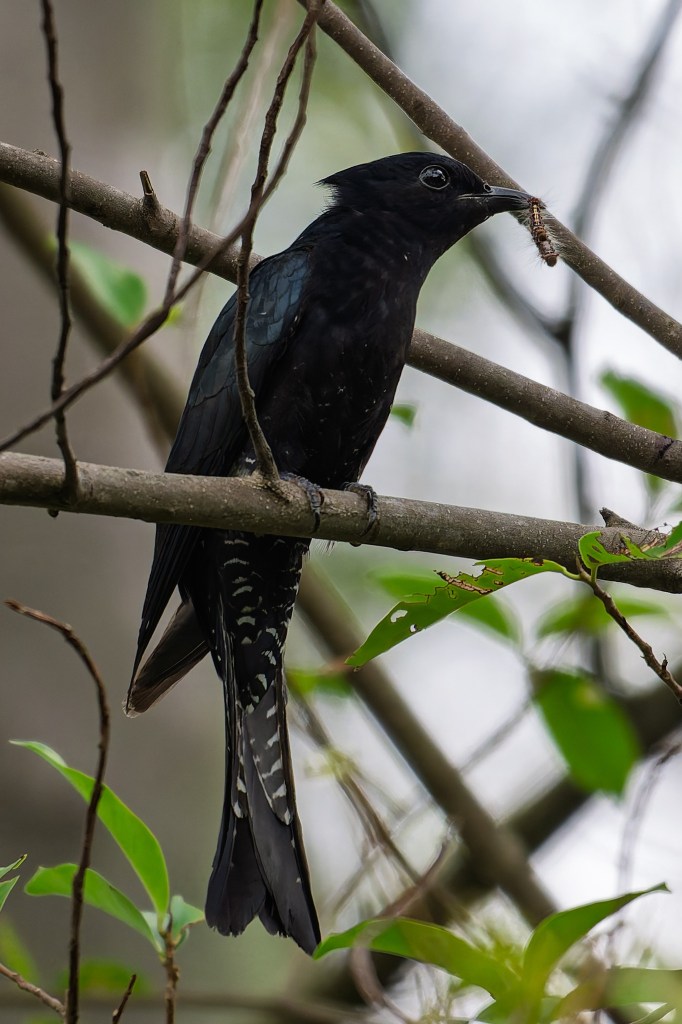
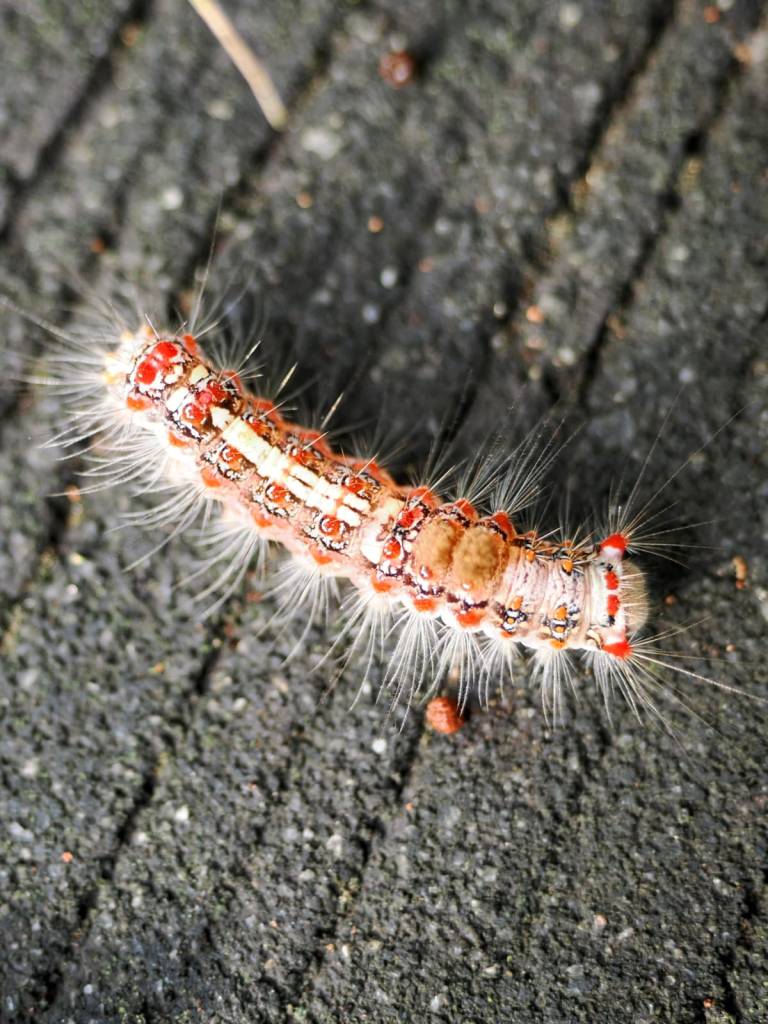
A Square-Tailed Drongo Cuckoo feasting on a Clear-Winged Tussock Moth (Credit: Bai Qw)A close-up shot of the Clear-Winged Tussock Moth discovered by Ching Yong near Fusion Spoon (Credit: Lee Ching Yong)
As for toxic caterpillars well-known for their aposematic colouring, photographers have caught images and videos of cuckoos thrashing the caterpillars such that the toxic guts spilled out before consuming them.
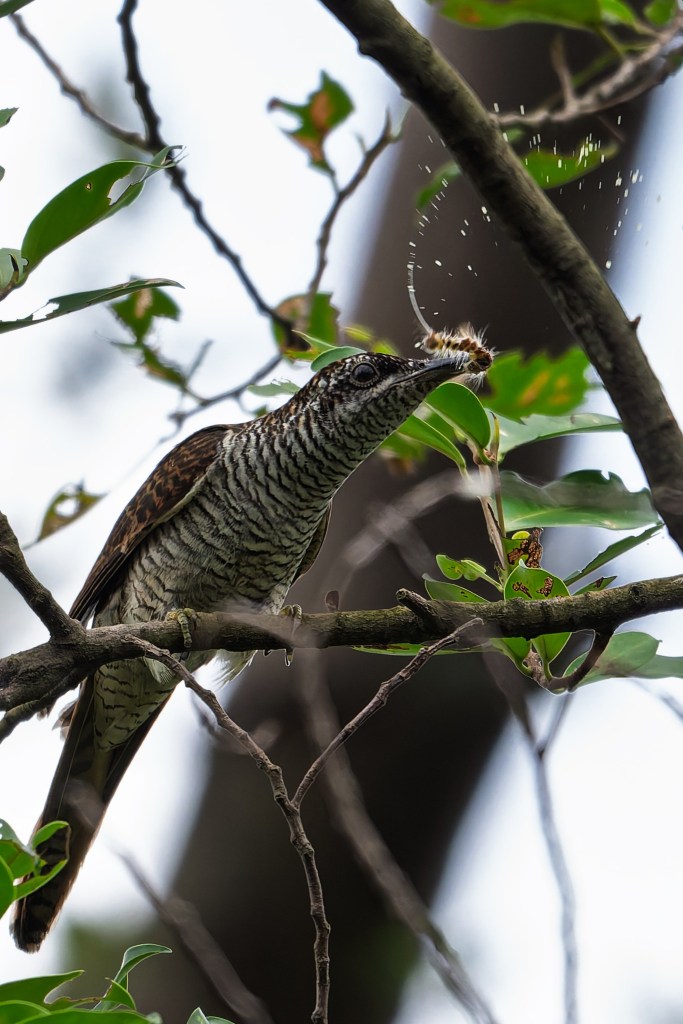
A Banded-Bay Cuckoo bashing and thrashing the caterpillar to remove the toxic guts and some of the hairs. (Credit: Bai Qw, 2024)
Thank You Cuckoos for Your Service
Before penning this post, I harboured doubts about Singapore’s ecosystem’s capacity to sustainably support the influx of migratory birds. Now, having witnessed this intricate dance between the Ficus trees, Phauda flammans caterpillars, and cuckoos, I’m positive about what our “city-in-a-garden” can offer to these beautiful visitors. It’s clear that our urban landscape offers more than meets the eye, providing a rich and complex habitat that can indeed sustain and attract diverse wildlife.
A heartfelt thank you to our feathered friends for their pest control services! Special appreciation goes to Anderson Ng, Bai Qw, and Lee Ching Yong for their stunning photographs.
My fascination with seashore creatures began in my childhood, rooted in frequent visits to Pasir Ris beach with my father in the 1980s and 1990s. His mother and sister lived nearby, giving us the perfect excuse to explore this coastal haven.
Those trips left indelible memories:
The elusive mudskippers, tiny and impossibly quick, always evading our grasp
Baby squids, their defense mechanism on full display as they turned white after expelling their ink (a stress response to our curious prodding)
Black Eeltail catfish (Plotosus canius), camouflaged among the ‘sea litter’ – dried leaves, seaweed and even rubbish, waiting to be discovered. Dad warned us against the venomous spines.
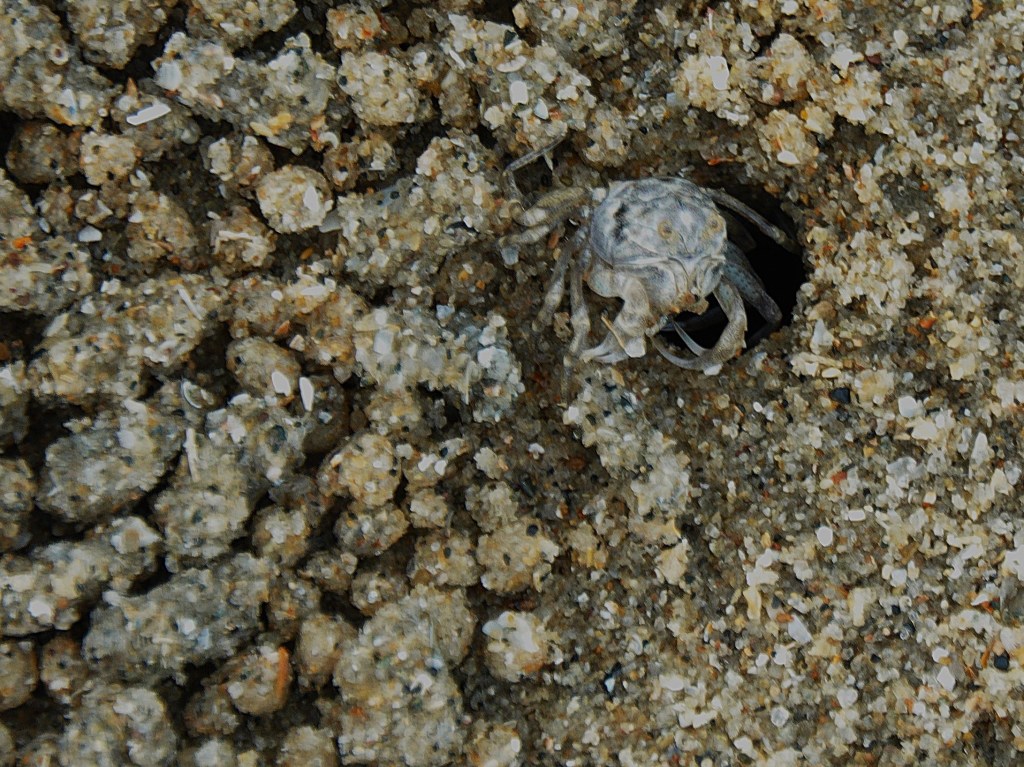
The harmless Sand Bubbler Crabs (Scopimera and Dotilla spp.), which left holes on the sandy beaches.
A Sand Bubbler Crab filtering for food from the balls of sand.
Armed with the beloved $5 guidebook – “A Guide to Seashore Life” published by the Singapore Science Centre – I embarked on a journey of discovery. This pocket-sized treasure trove became my trusted companion, helping me decipher the identities of various sea creatures.
In those carefree days, our curiosity often led us to capture fascinating marine creatures and bring them home. Sadly, most perished within days, with only the hardy catfish surviving for months. Looking back with regret, it’s striking how different our mindset and approach were then:
• Wildlife conservation wasn’t yet a widespread concept • Our interactions with nature were driven primarily by personal curiosity and fun • We didn’t fully grasp the impact of removing creatures from their natural habitats
This reflection serves as a poignant reminder of how our understanding and relationship with nature have evolved. While those experiences sparked a lifelong interest in marine life, they also highlight the importance of conservation and responsible interaction with ecosystems.
A Return to the Shore: Guided Intertidal Walk at Changi Beach
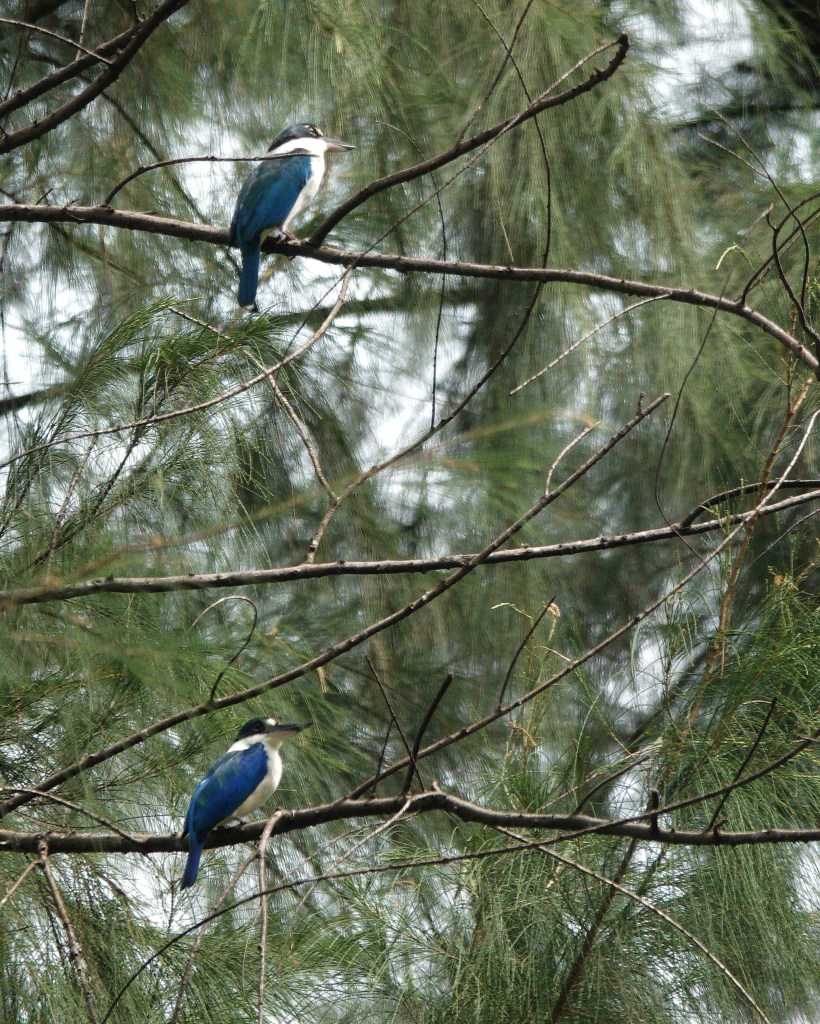
Fast forward to last week, and I found myself embarking on my first guided intertidal walk. Organised by “Just Keep Thinking” and led by the renowned MJ Biogal, this excursion took place at Changi Beach, right beside the Ferry Terminal to Pulau Tekong. Arriving early, my friend and I seized the opportunity for some impromptu bird watching. We spotted White-Bellied Sea Eagles, Long-Tailed Parakeets, and Collared Kingfishers, along with the Common Mynas, Javan Mynas and House Crows.
White-Bellied Sea Eagle (Icthyophaga leucogaster) Clutches a Catfish in its TalonsA pair of collared kingfishers (Todiramphus chloris) perched on the Casuarina tree (Casuarina equisetifolia)
MJ Biogal, our guide, proved to be a passionate advocate for environmental conservation, truly walking the talk. Her approach to the intertidal walk was a stark contrast to my childhood experiences. She enforced firm guidelines, prohibiting the digging out of creatures and touching, especially venomous species like fire worms and bristle worms. Throughout the walk, MJ actively educated the public, reminding other beachgoers to leave creatures undisturbed.
MJ Biogal with one of her fans.
During the Covid-19 pandemic in 2021, MJ raised awareness about the mistreatment of marine life, notably calling out those skewering through Sand Dollars (Clypeasteroida), like meat chunks on a satay stick, killing them right in front of her eyes. It was a powerful reminder of the need to balance our curiosity with respect for marine life and their habitats and there is a lot more to be done to educate the public.
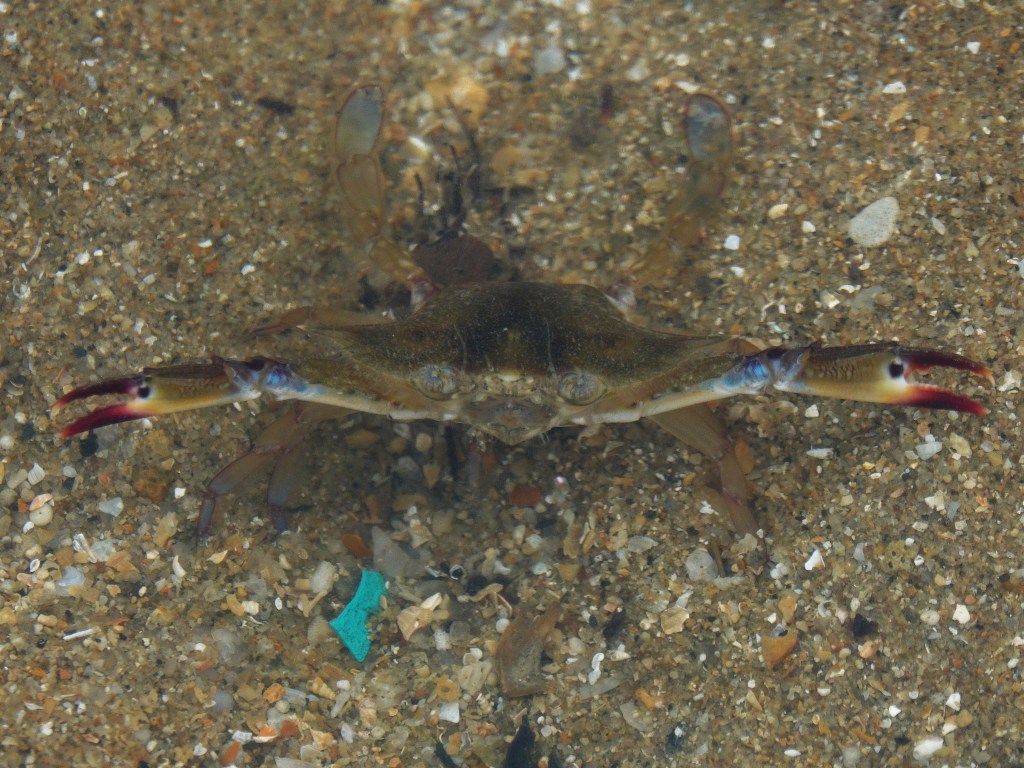
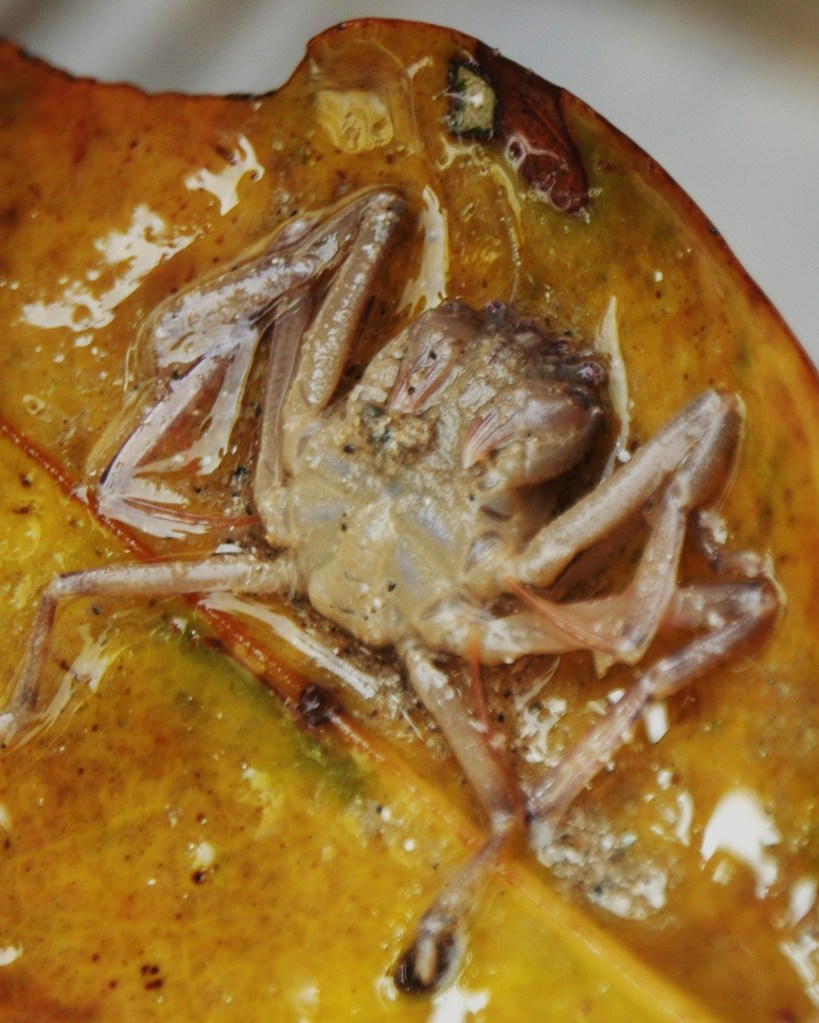
During our guided walk, our group of 36 was divided into smaller clusters, each led by an experienced guide. I found myself in a group led by Jerryl, an avid diver with aspirations of becoming a marine biologist. Our exploration began with a molted flower crab shell. When a young boy in our group mistook it for a dead crab, Jerryl seized the opportunity for an impromptu learning session.
Defensive Dance: A Flower Crab (Portunus pelagicus) Raises Its Claws in a Bold Stand-off
Using engaging questioning techniques, Jerryl sparked curiosity among the group, particularly exciting two enthusiastic boys. “What are the tell-tale signs that this isn’t a dead crab?” he asked, encouraging critical thinking and observation. This interactive approach not only corrected misconceptions but also kindled a deeper interest in marine life among the participants.
As we gathered around, Jerryl revealed the fascinating details that distinguish a molted shell from a dead crab:
The Missing Eyes: In a freshly dead crab, the eyes are still visible. However, on a molted shell, you won’t find any eyes. This absence is a clear sign that what we’re looking at is just the discarded outer layer of the crab.
The Gap: A key indicator is the noticeable gap between the molt. This separation occurs as the crab sheds its old exoskeleton to grow.
Tidal Retreat: Anemone’s Tentacles Withdraw as Waters Recede
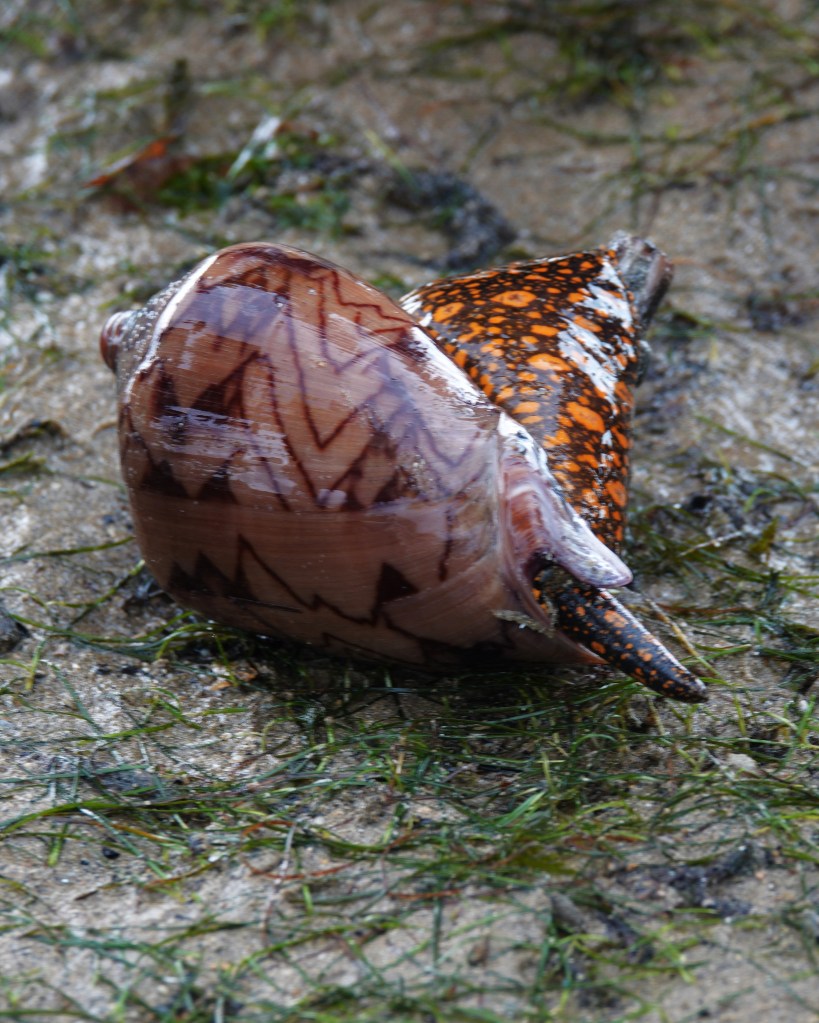
Our first ‘wow’ moment arrived with the discovery of a large hermit crab, snugly ensconced in the shell of a Noble Volute (Cymbiola nobilis). The sight initially sent a jolt of excitement through me, as I mistook the shell for that of the venomous cone snail, infamous for its harpoon-like shooting mechanism. Moments later, another guide brought us a live Noble Volute! It was the prettiest thing I have seen that day. This is a large carnivorous snail that used to be hunted for its beautiful shell and even its edible flesh.
The colours and patterns on the Noble Volute change daily due to the pigment cells constantly infecting its neighbouring cells
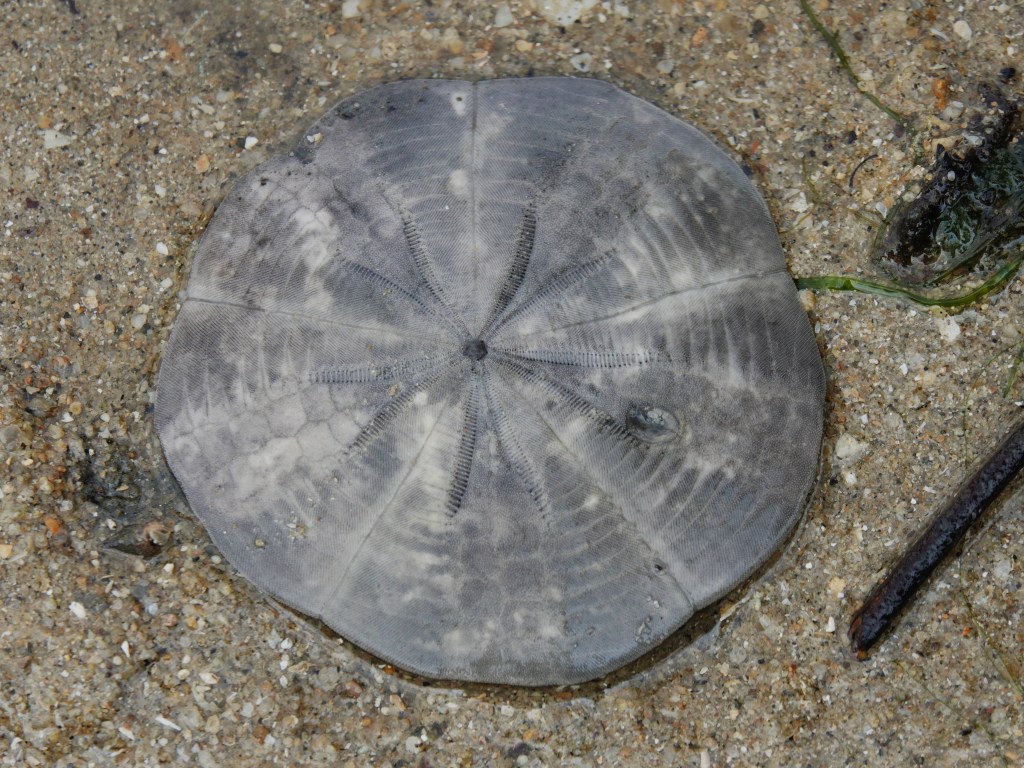
Our exploration led us to a fascinating discovery: Cake Sand Dollars (Arachnoides placenta). It was hard to believe these peculiar discs were living animals. Jerryl, our knowledgeable guide, turned this find into an engaging guessing game, challenging us to identify the top and bottom sides of these flat, clayey-looking creatures.
After a few attempts, Jerryl revealed the secret: the top side typically displays a subtle ‘flower pattern’ and is slightly convex, while the bottom side prominently showcases the pentaradial symmetry characteristic of most echinoderms (a group including sea cucumbers, sea stars, and sea urchins).
Jerryl’s sharing sparked my curiosity, leading me to further research. I learnt that the sand dollar’s unique disc-like shape is an evolutionary adaptation, optimised for efficiently consuming detritus on the ocean floor. It has tube feet on both surfaces to help breathe, navigate and feed.
Anatomy Unveiled: The middle hole is its central mouth on its underside (oral side). Guess where is its anus? It is right at the 10-11’o clock position near the edge.The top side (also known as the petaloid) with the flower petal pattern.
Written by Lucas
Midway through our guided tour, a heavy downpour forced us to seek shelter, despite the absence of lightning risk. We prioritised the well-being of the many young children in our group, not wanting them to catch a cold. Fortunately, it was merely a passing shower, and as we resumed our walk around the intertidal zone, we were greeted with a beautiful rainbow as our backdrop. This natural spectacle added an extra layer of wonder to our already fascinating excursion.
Police boat patrolling between Pulau Tekong and Changi against the colourful backdrop.
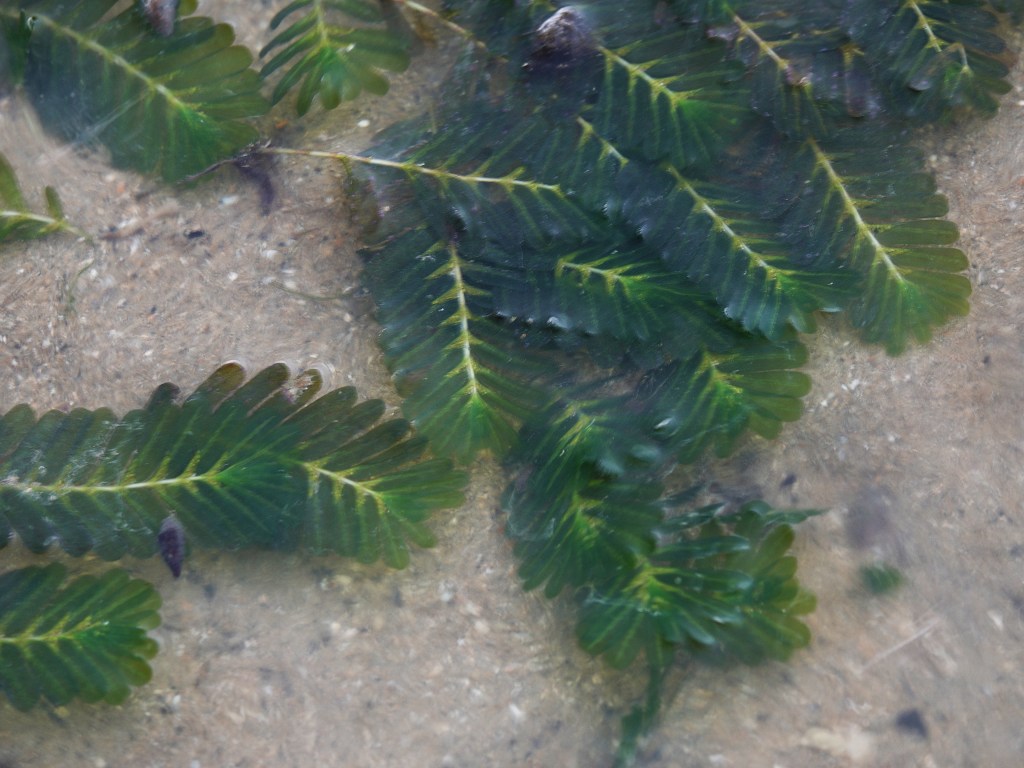
As a plant enthusiast, I found myself drawn to the seagrasses, particularly a species resembling a cross between mimosa and fern – aptly named fern seagrass (Halophila spinulosa). Unlike seaweed, these are true flowering plants that produce fruits. They form a crucial ecosystem, serving as the primary habitat and food source for dugongs. I look forward to capturing photographs of these fascinating plants’ various features during my next solo intertidal walk.
Fern seagrass with snails grazing on it.
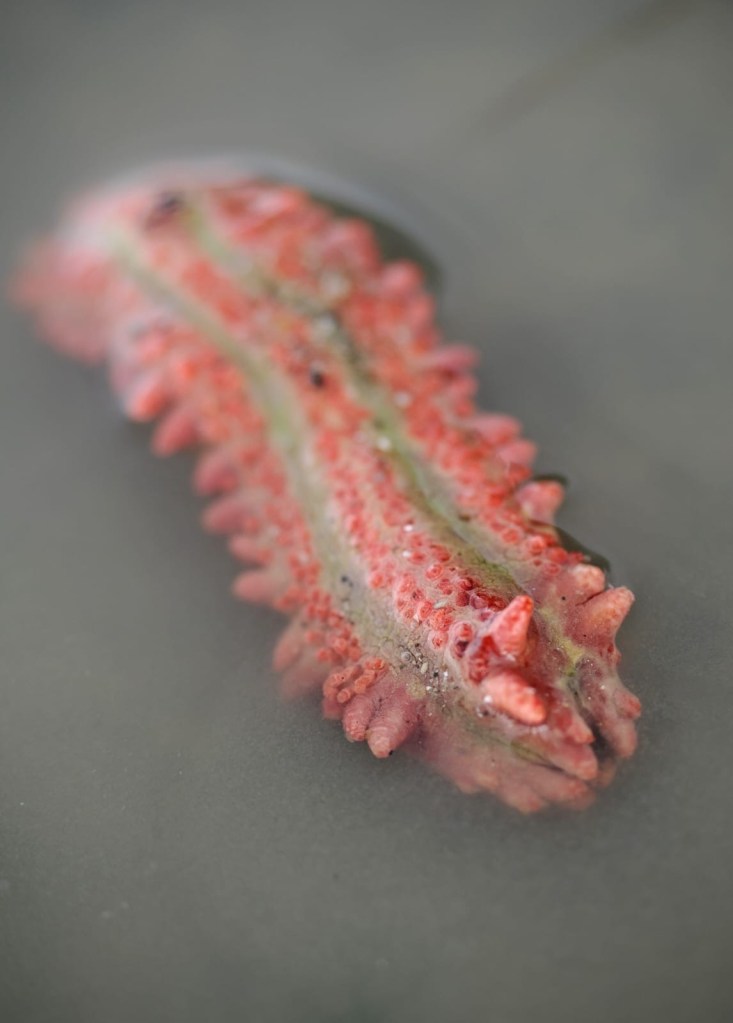
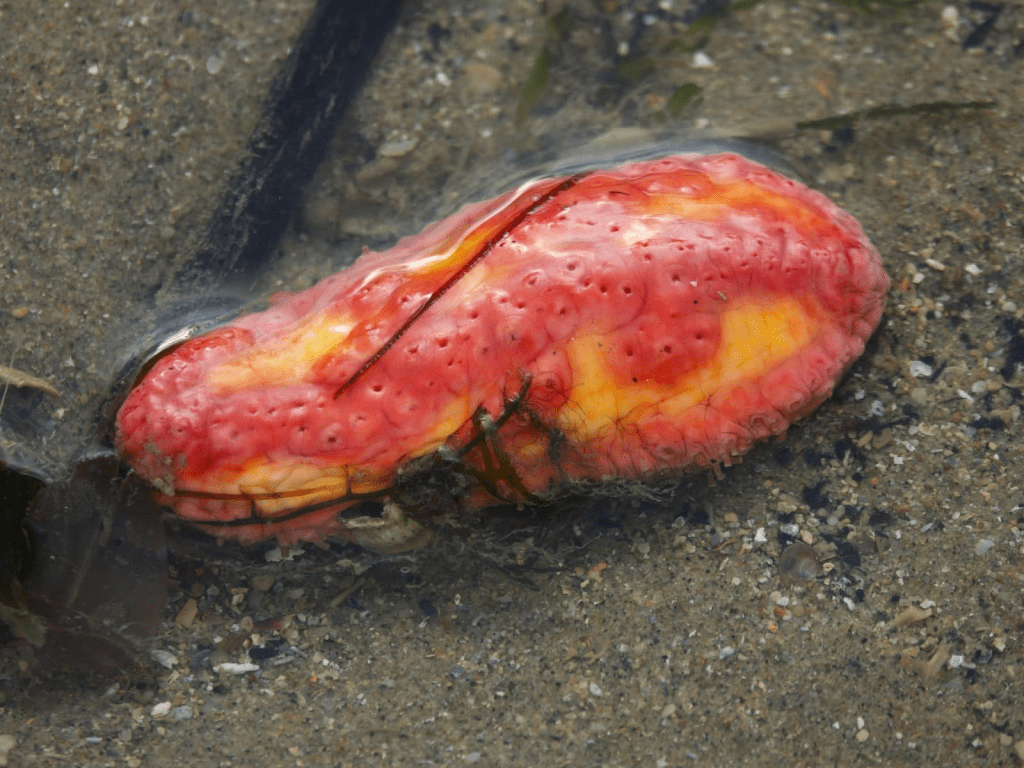
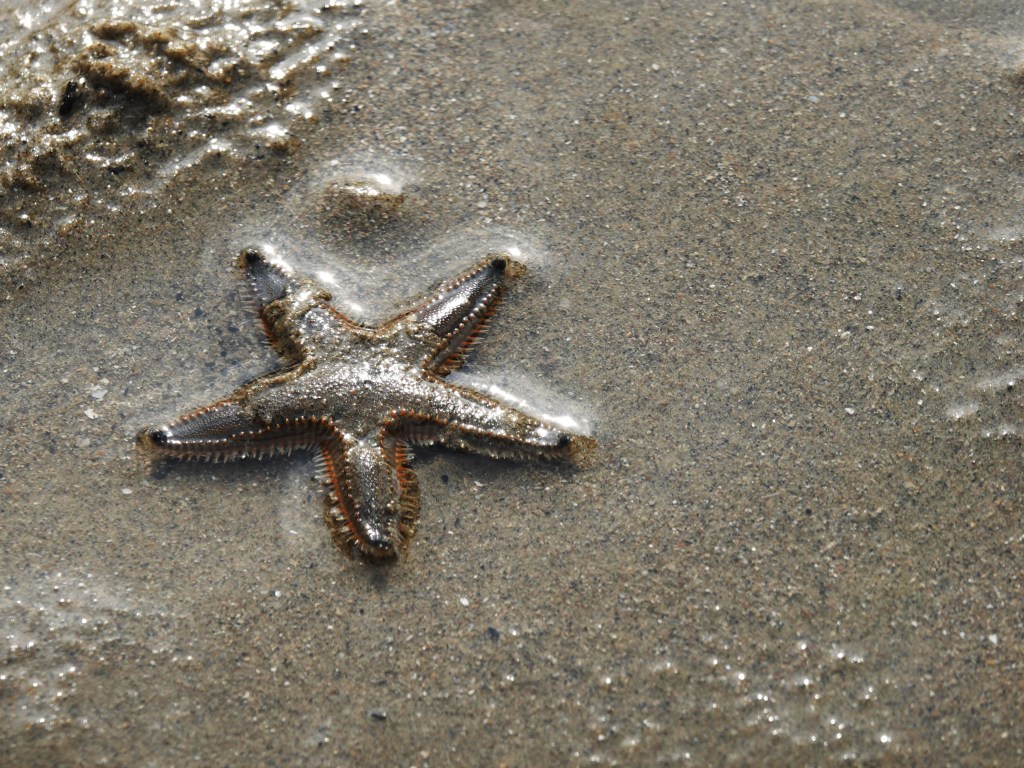
Our exploration revealed three more fascinating creatures exhibiting pentaradial symmetry: the thorny sea cucumber (Colochirus quadrangularis), the pink warty sea cucumber (Cercodemas anceps), and the plain sand star (Astropecten indicus). Both sea cucumber species display a remarkable feeding process, extending their vibrant tentacles from one end while expelling waste from their anus at the opposite end. In stark contrast, the sand star’s muted appearance likely aids in camouflage. This intriguing difference sparked curiosity about how the more flamboyant sea cucumbers manage to conceal themselves in this dynamic environment. Hmm… By aposematism?
Thorny Sea Cucumber Often Mistaken for Its Pink Warty CousinPink Warty Sea Cucumber with its psychedelic looksIn contrast, the plain looking Plain Sea Star
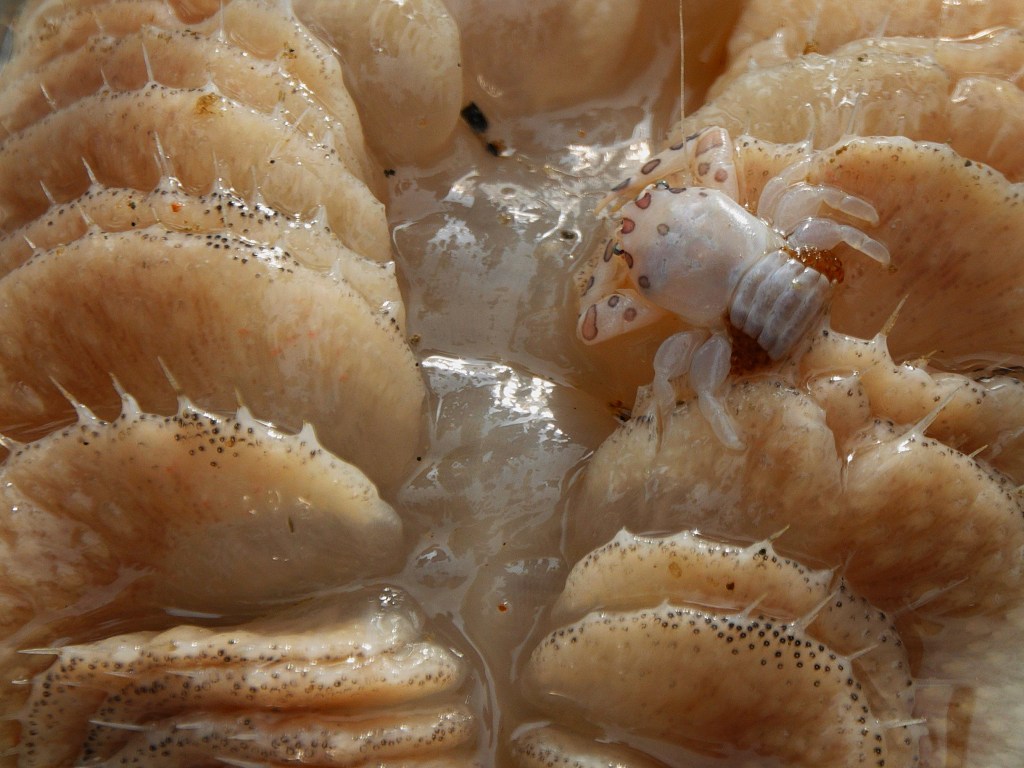
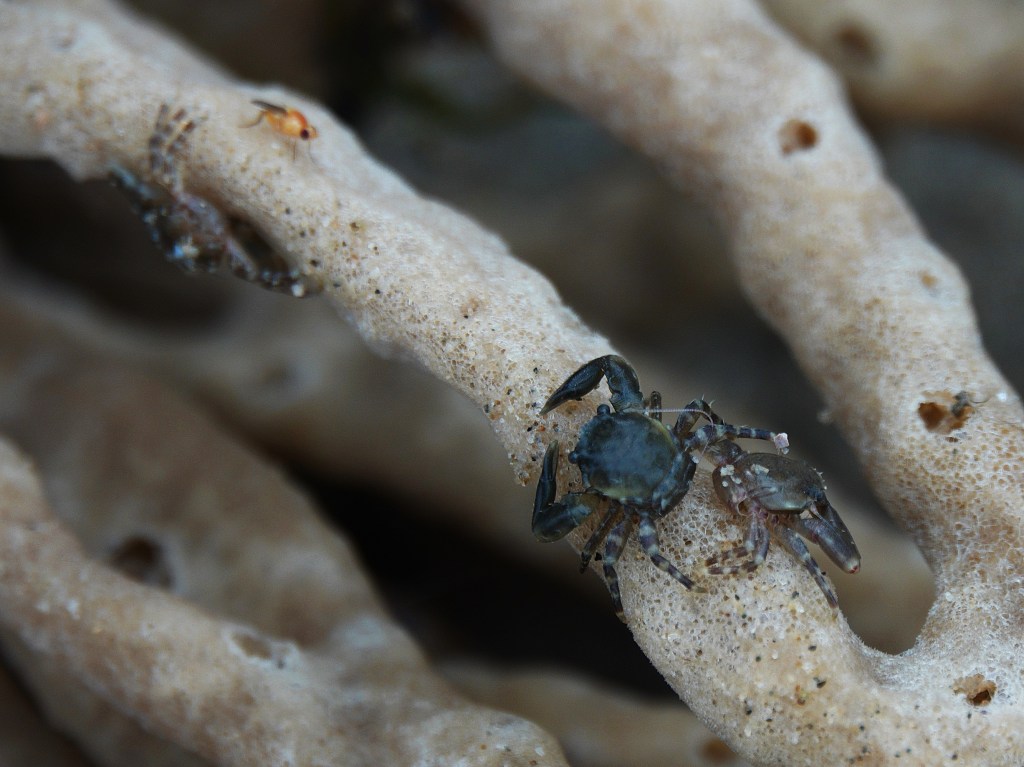
Living organisms like sea pens and sea sponges serve as vibrant habitats for a diverse array of marine life. One of our guides made an exciting discovery: a Spiky Sea Pen hosting two Painted Porcelain Crabs (one of which is carrying a load of eggs), showcasing the intricate relationships within these miniature ecosystems. We also had the opportunity to examine what appeared to be a lifeless sea sponge, yet it was teeming with life, including a brittle star, snails and several tiny crabs. These encounters highlighted the complex interdependencies within marine communities and the importance of seemingly simple organisms in supporting biodiversity.
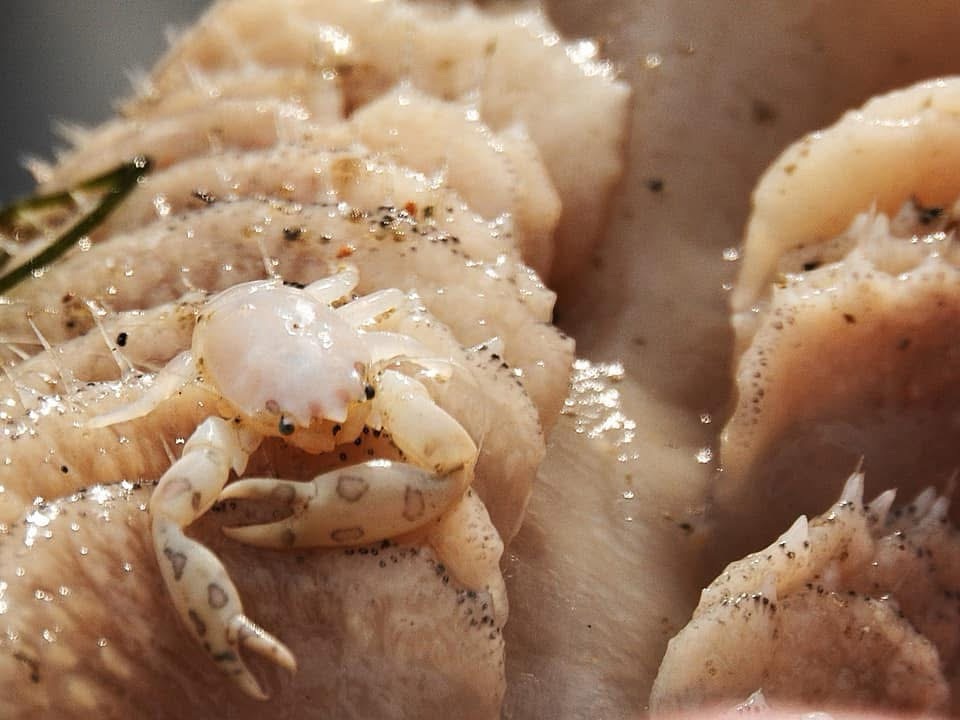
A female Painted Porcelain Crab on a Spiky Sea Pen. Unidentified tiny crabs on the sea sponge.
One of the most peculiar crustaceans I encountered, which evoked memories from the seashore life guidebook, was the Leaf Porter Crab (Family Dorippidae). This fascinating creature appears remarkably flat, including its pincers and legs. What makes it truly intriguing is its adaptive behavior: at night, it perches atop floating leaves, taking advantage of the darkness to evade predators from above. During daylight hours, it cleverly conceals itself beneath these same floating leaves, demonstrating a remarkable survival strategy in its marine habitat.
“I surrender!” – This particular image appears to depict someone cornered against a wall.
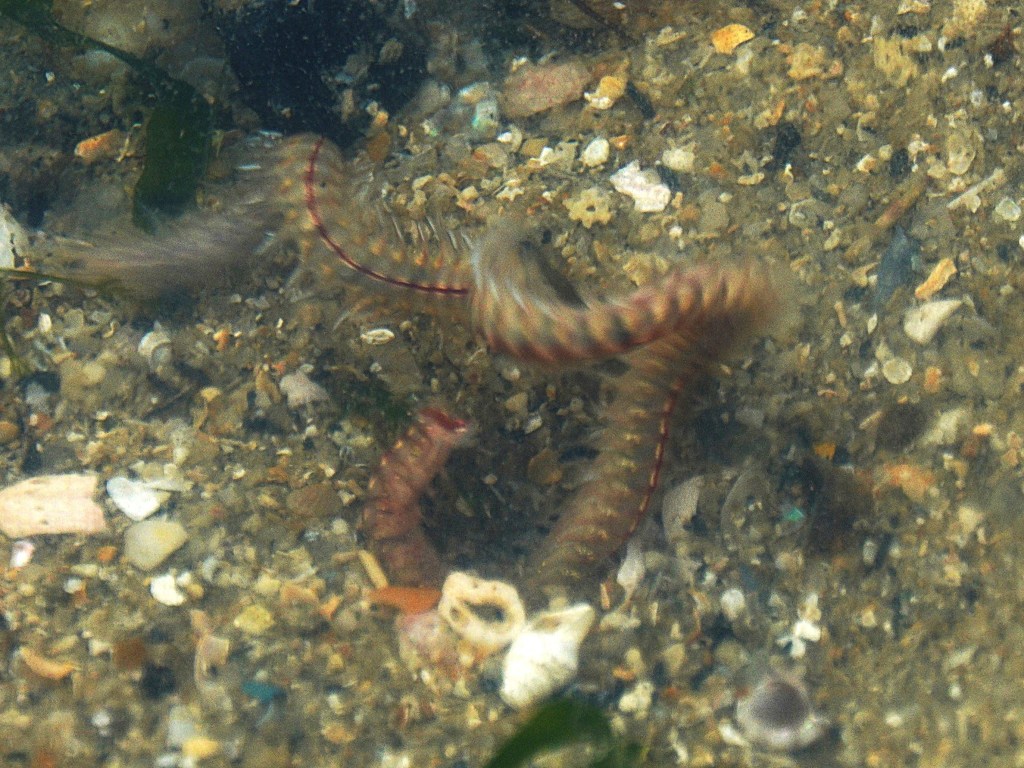
During our exploration, a participant noticed a worm-like creature in a small tidepool, prompting our guide to issue a stern warning against touching any such organisms. Although the guide didn’t identify the species, it bore a striking resemblance to a bristle worm. While this particular specimen appeared to have been decapitated, bristle worms are renowned for their remarkable regenerative abilities, often capable of regrowing body parts lost to predators – including, astonishingly, their heads!
Bristle worms are traditionally used as bait for fishing.
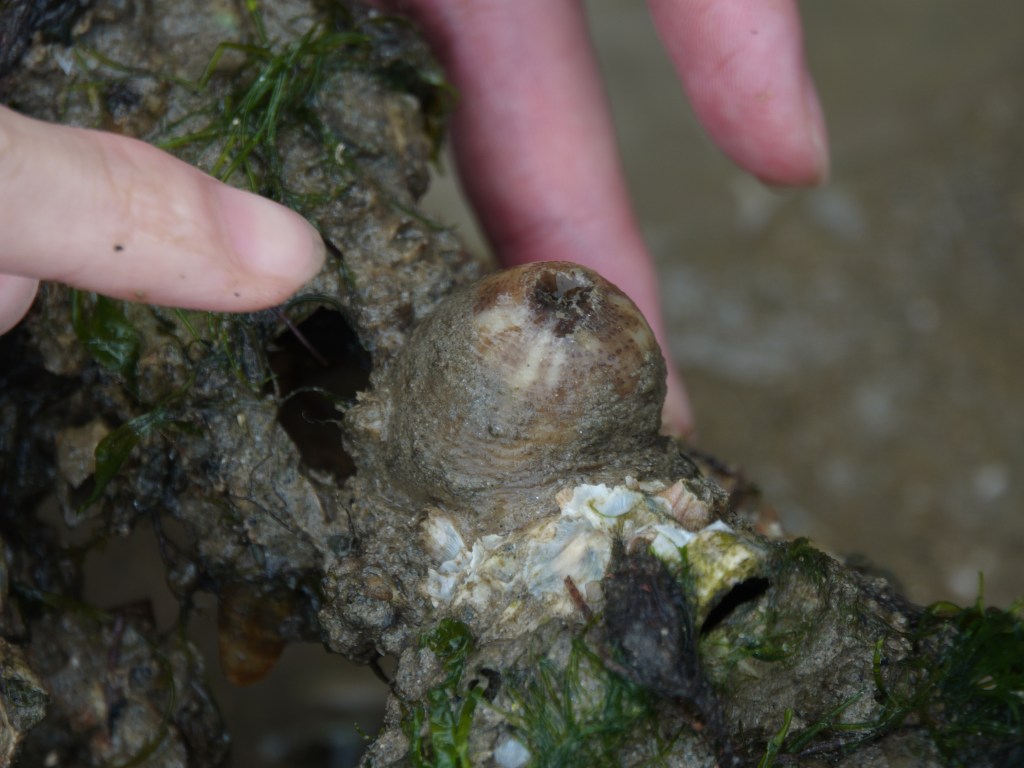
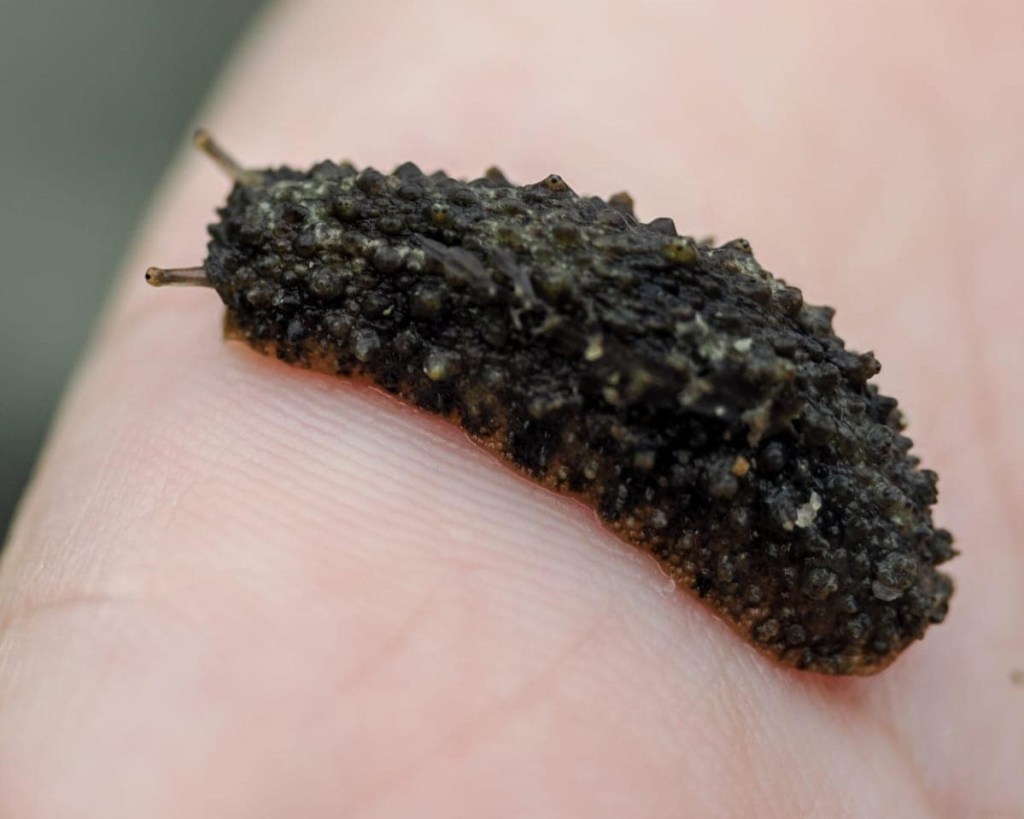
As we approached the canal area where our drainage system discharges, we encountered a vibrant ecosystem thriving on the walls. Algae, barnacles, and periwinkle snails adorned both sides. Jerryl, our guide, picked up some small black objects and offered to place them on our palms. Initially mistaking them for limpets, I was surprised to learn they were Onch Slugs (Family Onchidiidae), grazing on the algae. As one rested on my palm, it began leaving a trail of mucus and excrement while observing me with its distinctive elongated eyes, providing an unexpectedly intimate encounter with these fascinating intertidal creatures.
Onch slugs that breathe air unlike nudibranch (sea slugs)
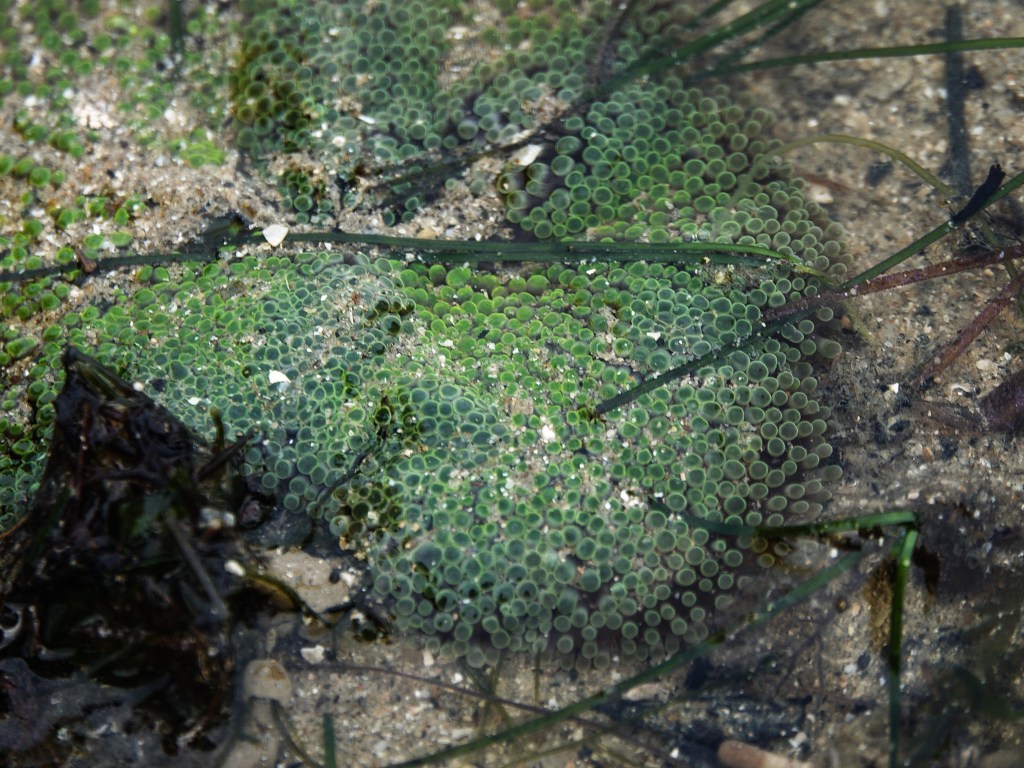
As our guided walk neared its conclusion, we encountered a stunning carpet anemone, its vibrant green hue catching our eyes. Jerryl, our knowledgeable guide, encouraged us to gently touch its stinging tentacles, explaining that the subtle suction we felt was due to a small amount of toxin being released onto our skin. This fascinating experience piqued my curiosity about the various types of carpet anemones and the miniature marine life that might be dwelling among their tentacles.
Apparently, a specific type of carpet anemone may have different kinds of colours
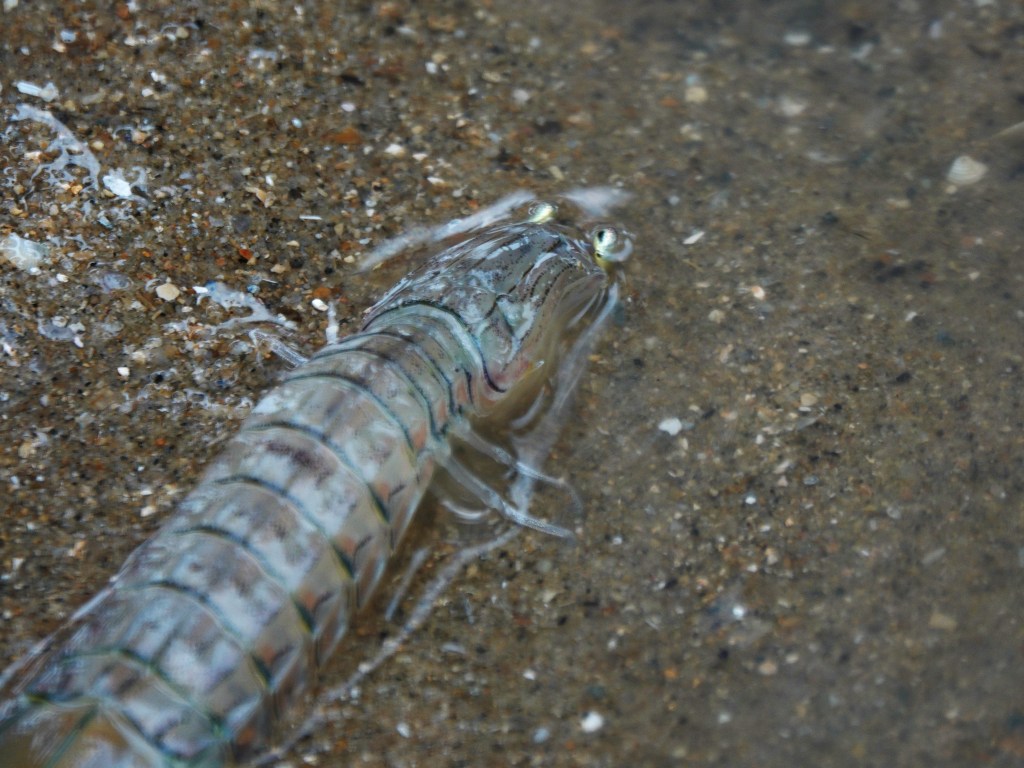
Our excursion concluded with a spectacular sighting: a Spearer Mantis Shrimp (Family Squillidae), spotted by my friend. The creature’s striking appearance drew eager participants who were tempted to touch it. However, our vigilant guides swiftly intervened, warning against such interaction.
Spearer Mantis Shrimp as opposed to the Smasher Mantis Shrimp
The excursion concluded on a high note with a group photograph featuring MJ and her expert guides. As a delightful parting gift, MJ distributed cutesy, beautifully-illustrated stickers to all participants. These stickers depicted the various sea creatures we had encountered during our intertidal adventure, serving as both a memento and an educational tool to reinforce our newfound knowledge of the marine ecosystem.
Thank you MJ Biogal and the guides for such an enriching intertidal walk.










 birdbrainsg