The mango tree at 125 Bukit Merah Lane 1 is a renowned hotspot among Singapore’s birding community, attracting a variety of species such as the Coconut Lorikeet (Trichoglossus haematodus), Blue-Crowned Hanging Parrot (Loriculus galgulus), Black-Naped Oriole (Oriolus chinensis), Asian Glossy Starling (Aplonis panayensis), Javan Myna (Acridotheres javanicus) etc.
I challenge all birders and nature enthusiasts to explore fruiting mango trees in their area – these birds might be living right on your doorstep! Here’s an example from Bukit Panjang, right beside a shopping mall.
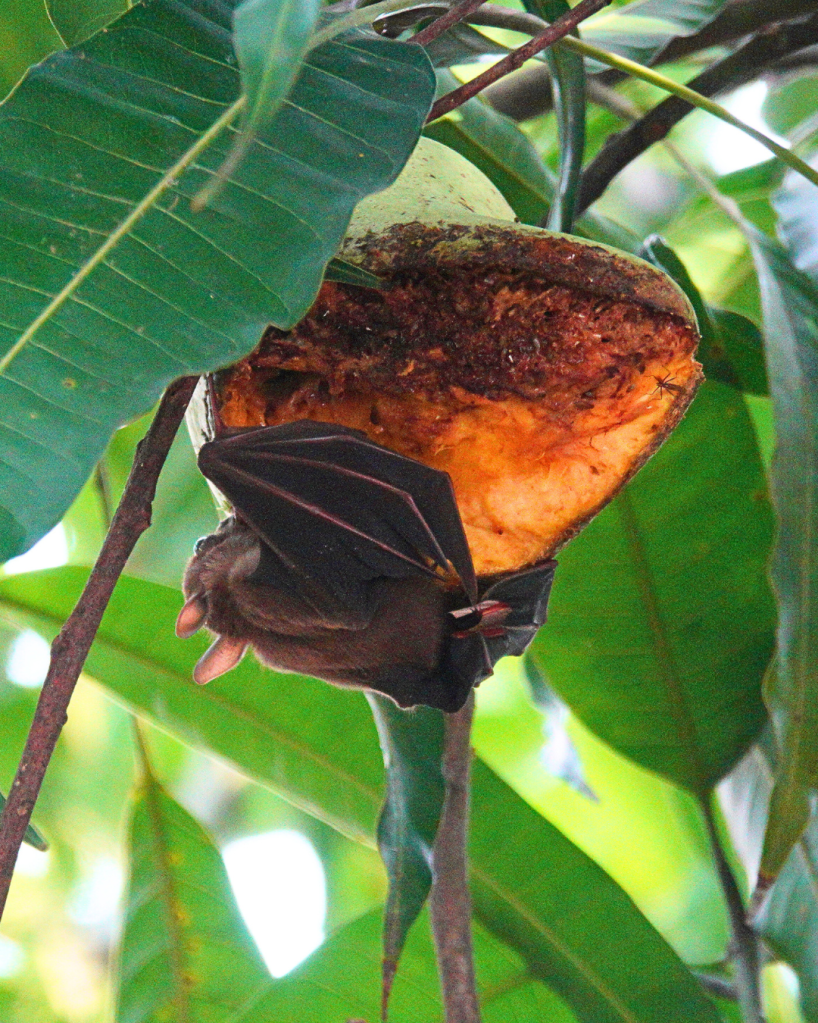
Just yesterday, as I walked by the tree, I caught a whiff of sweet scent and spotted half-eaten fruits. As it was already 6:00 pm and birds were scarce, I was surprised to find a Lesser Dog-Faced Fruit Bat (Cynopterus brachyotis) feasting on a mango.
This species of bat is highly adaptable to urban spaces and is, in fact, the most commonly spotted bat species in Singapore.
A few months back, when the mangoes were ripe, many birds flocked to this particular mango tree to feast, particularly in the mornings. On one such morning, I recorded the following bird species visiting the same tree in Bukit Panjang.
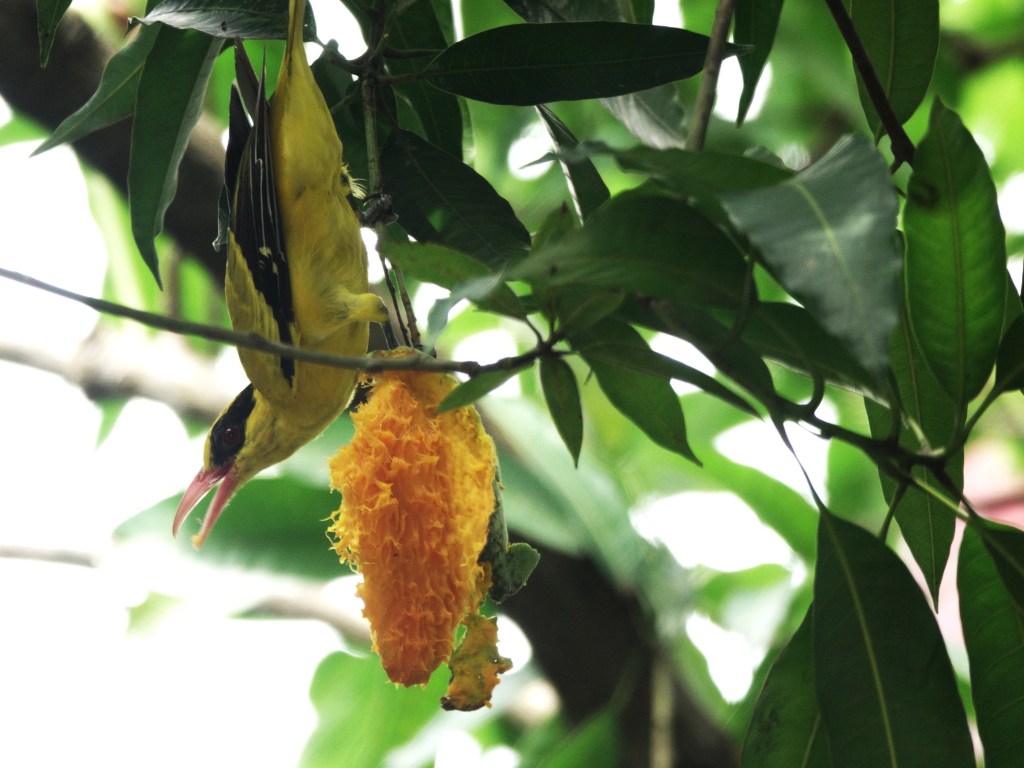
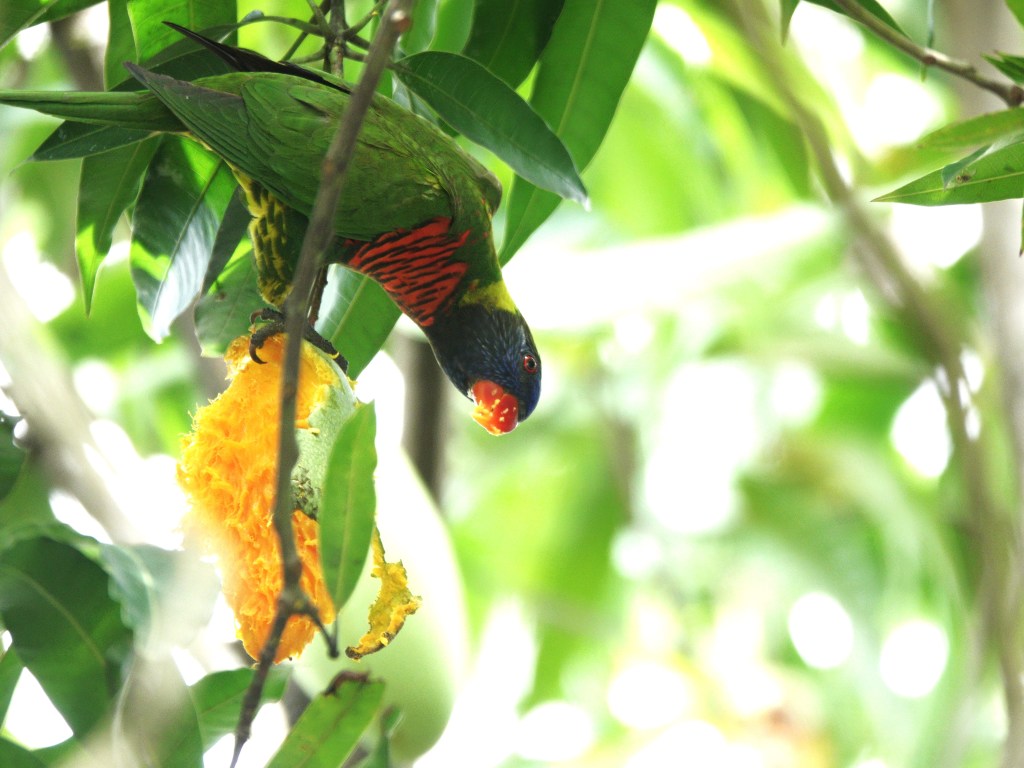
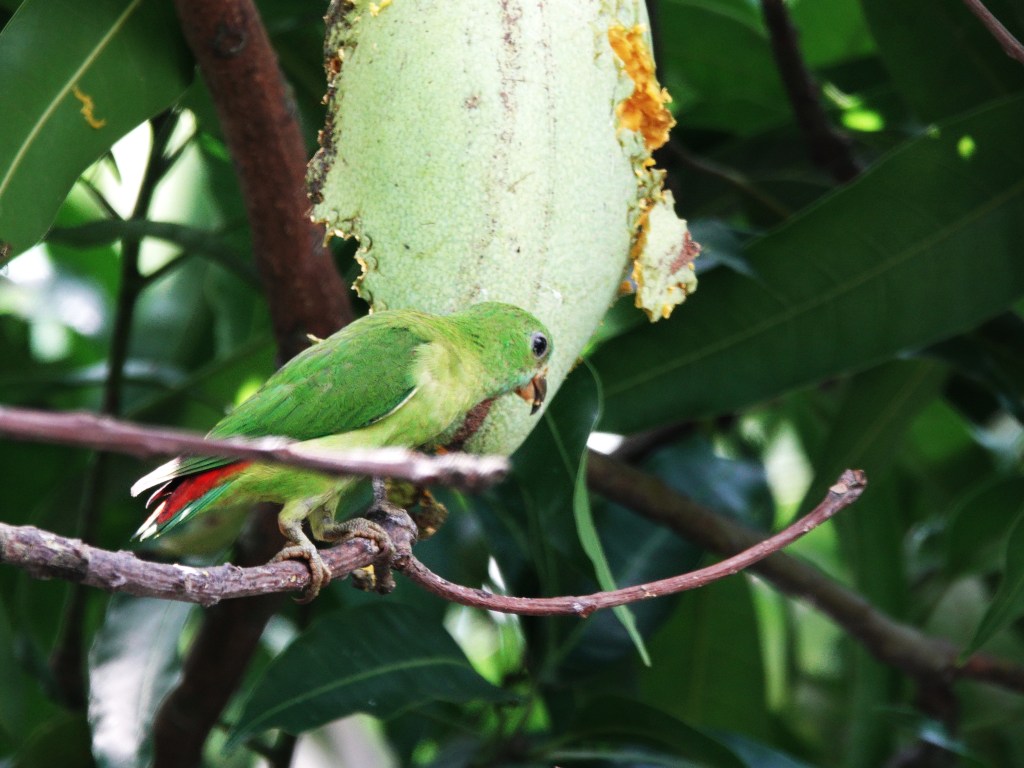
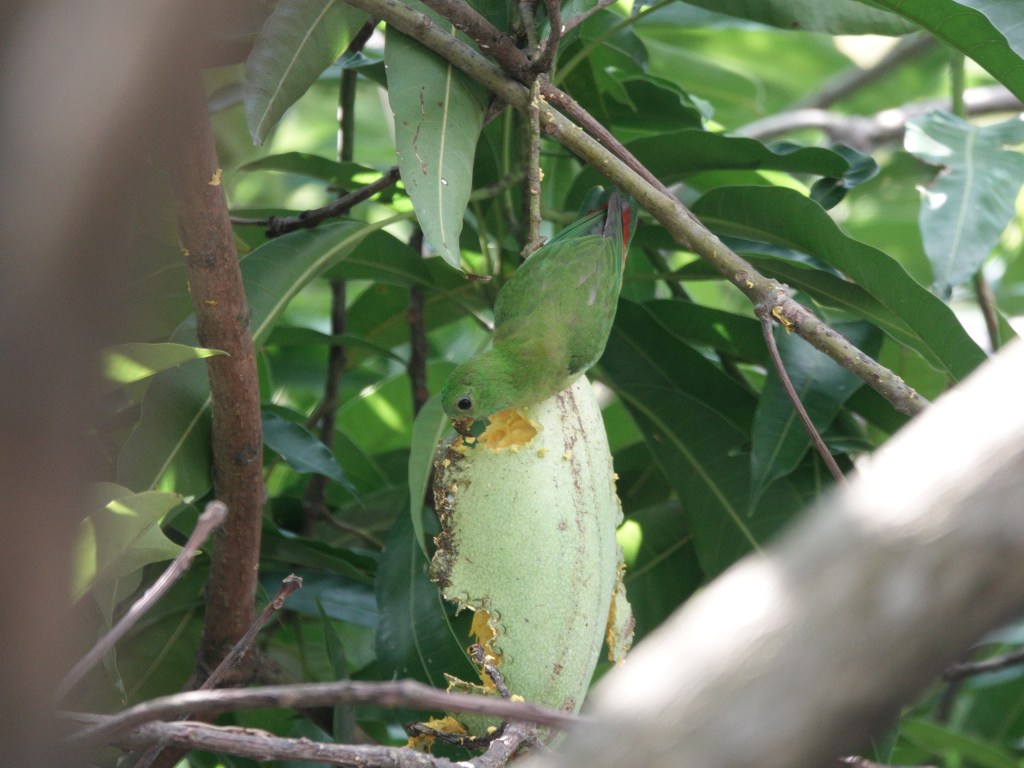
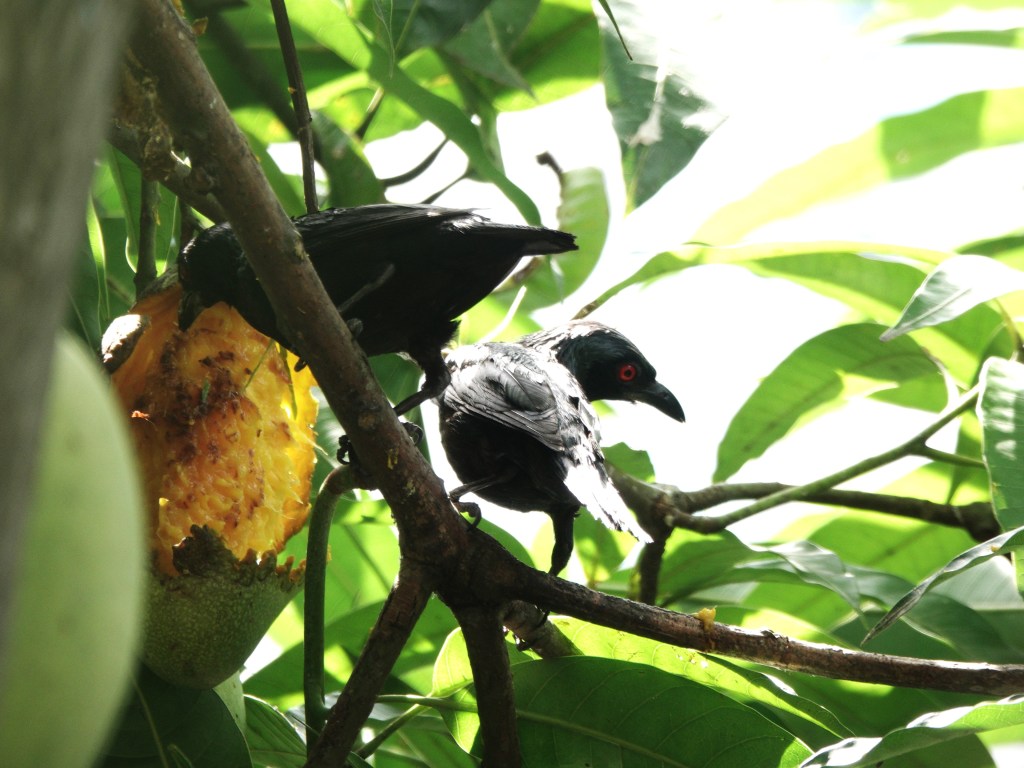
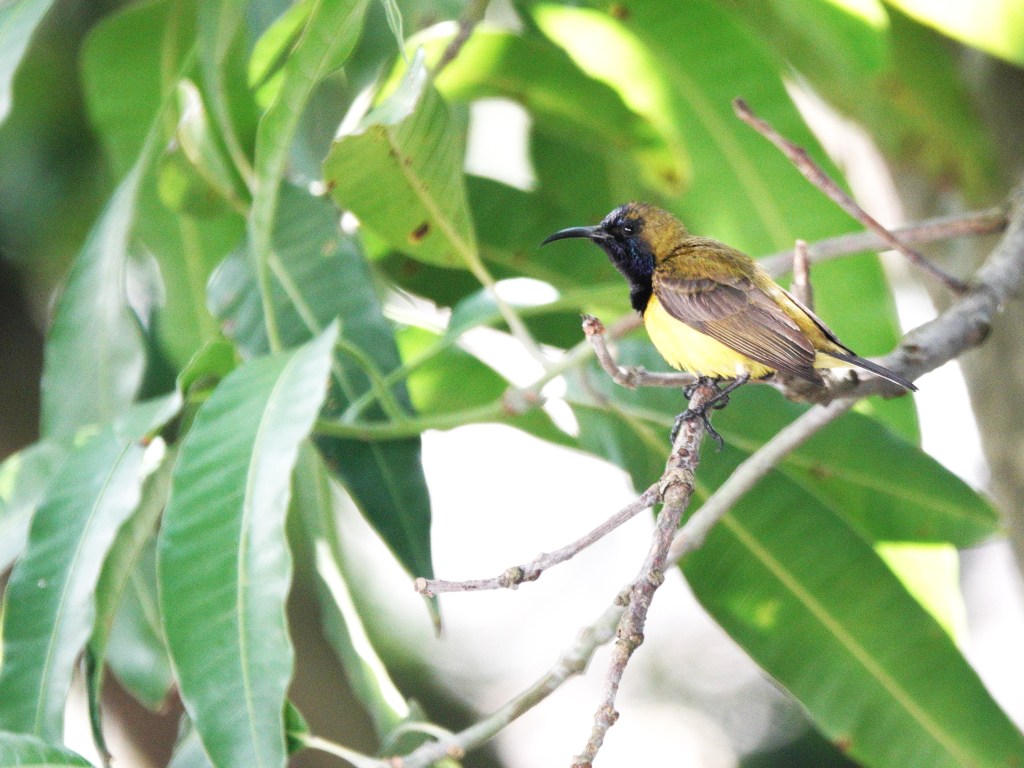
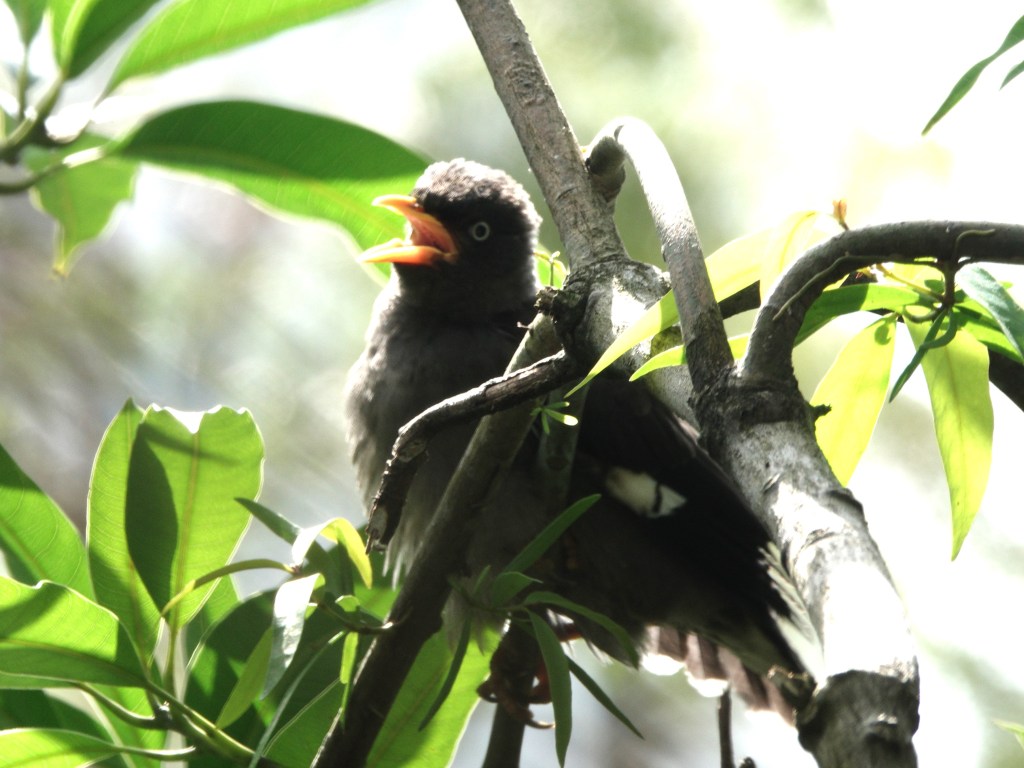
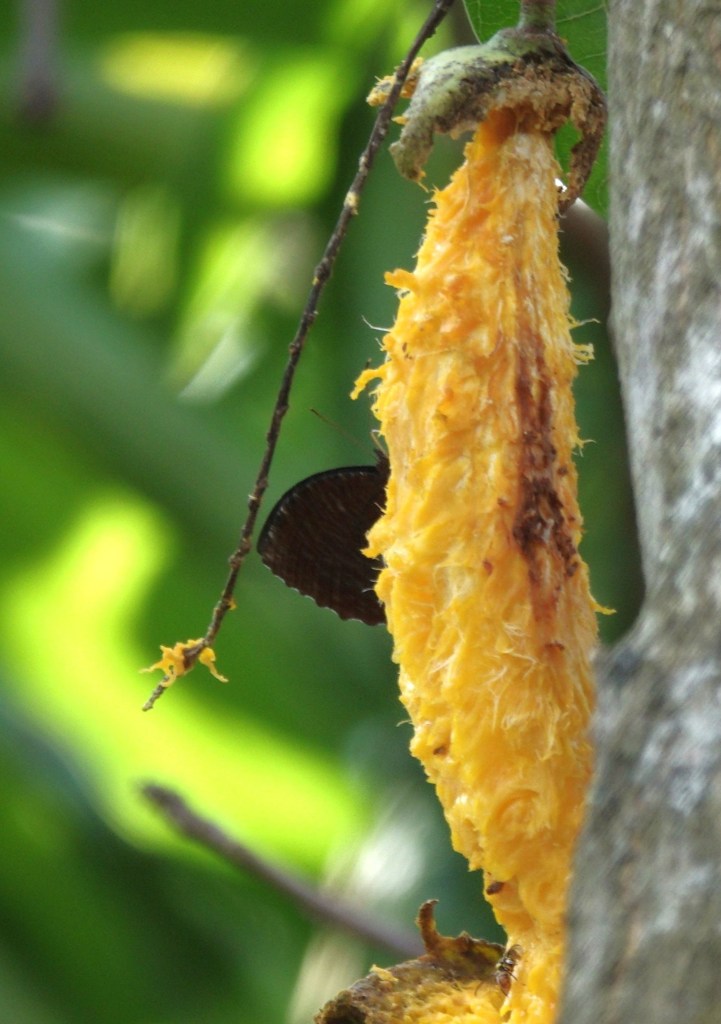
Black-Naped Orioles have a clear fondness for mangoes! I’ve affectionately nicknamed them the “Wolverine” due to their striking yellow plumage, which reminds me of the iconic X-Men character’s costume.I spotted two Coconut Lorikeets regularly visiting this mango tree, and here’s one of them in action! Looks like it’s time for a cleanup – this bird is definitely a messy eater!Here’s a lovely female Blue-Crowned Hanging Parrot! While they’re often heard flying between spots, the best opportunities for photography are usually near mango trees located close to carparks or HDB corridors. In more natural settings, I tend to find them high up in the canopies of ficus trees, feasting on tiny figs.The Blue-Crowned Hanging Parrot gets its name from the distinctive blue crown found on males – which this one lacks. So, it’s pretty clear that this is a female!A Spotted Dove waiting for its turn to feast on the mangoes.Catching the sun’s rays, Asian Glossy Starlings can reveal their stunning iridescent green feathers (not in this case though) – and their love for mangoes is undeniable!When I first started birding, this species was still referred to as the Olive Sunbird – now it’s known as the Ornate Sunbird. Interestingly, I did spot one in the same tree, although it wasn’t feeding on the mangoes this time.The Javan Myna is another common sight on our local mango trees. Hey! Where is our own native Common Myna? In this case, it looks like a curious juvenile might be waiting for its parents to bring it some mango treats!And how can we forget the Yellow-Vent Bulbuls? They’re definitely enjoying their share of mangoes at this buffet!Well! Our winged friends also love the remains of the mango. An unidentified butterfly and possibly a wasp/hornet at the bottom of the picture. A special guest joins the party! This Sunda Pygmy Woodpecker isn’t here for the mangoes, but rather to lend a beak in pest control – a welcome helper for the mango tree! One of my favorite woodpeckers in Singapore, for sure!And of course, a common sight to see the weaver ants’ nest on mango trees!
In fact, when my friend visited the same tree the next morning, he spotted even more species, including a Common Iora (Aegithina tiphia) and a Pied Triller (Lalage nigra), in addition to all the birds I previously mentioned.
Let’s open our senses to the world around us! Notice the mango trees in your neighborhood – are they fruiting? Can you catch the sweet scent wafting from them? And do you hear the lively, screeching calls of the birds?
I challenge you to find your own mango tree teeming with life – I’m sure it’s waiting to be discovered!
While conducting nature guiding walks, one of the biggest concerns is often ‘Will the birds show up?’ After gaining a deeper understanding of relationships among the flora and fauna species within any ecosystems, I have come to realise that if birds are elusive, I can instead look for the tree species they tend to frequent. Trees, after all, provide a more reliable presence (barring events like lightning strikes or removal by authorities for various reasons).
One of the tree species I often look out for bird sightings is the Albizia Tree, specifically Falcataria falcata (see link from uforest for more detailed documentation of its physical features). Typically seen from a distance from boardwalks in nature parks or park connectors within secondary forests, these trees are notable for being among the world’s fastest-growing species (can reach maturity within 5 years), which has led to their popular use in reforestation projects.
So why are Albizia trees often located away from areas with high human traffic? It’s because they belong to the softwood species, characterised by low-density wood and a shallow root system. These features make them vulnerable, especially in a tropical equatorial climate with frequent lightning, heavy rainfall, and strong winds that can cause breakage of branches and uprooting due to soil erosion. Thus, many of those grown nearer to human traffic may have already been removed over the years. In fact, after googling more about the tree species, I found an article regarding NParks removing a patch of Albizia trees at the Bukit Batok Nature Park in 2017 due to safety concerns (See link). And specifically 10 years earlier in 2007, a Singaporean was crushed to death by a toppled Albizia tree, with two others injured (see link).
The two ways to identify an Albizia tree is its small compound leaves, smooth greyish bark. The other prominent features will be the tree cavities and broken branches. Read more to find out why.
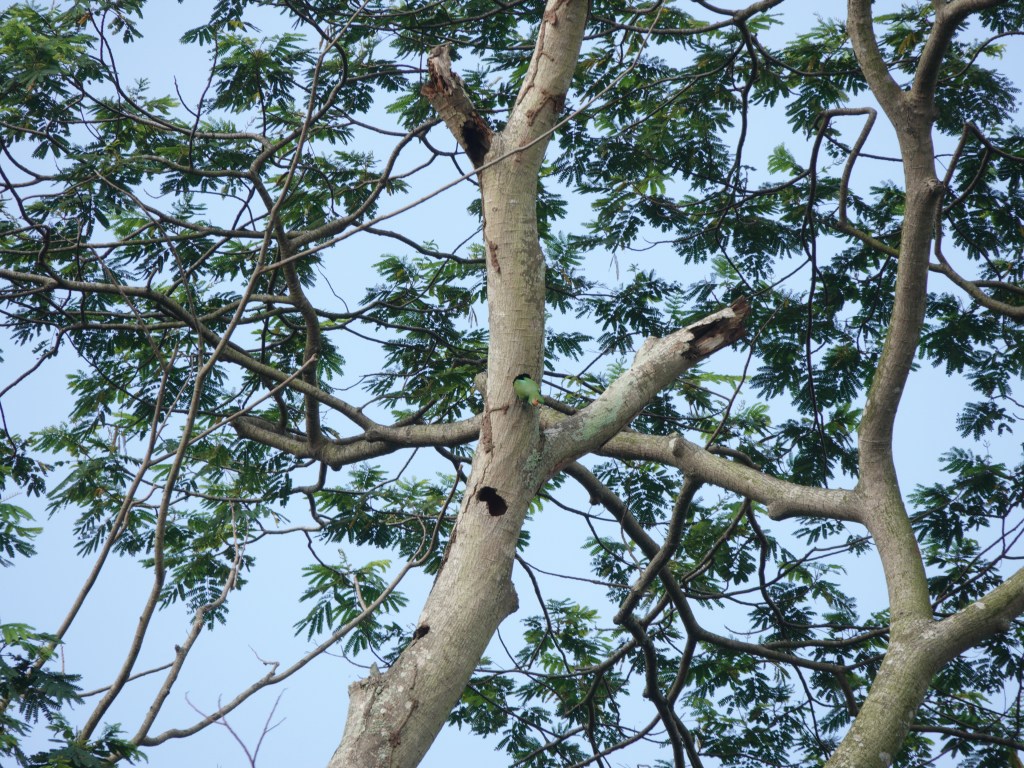
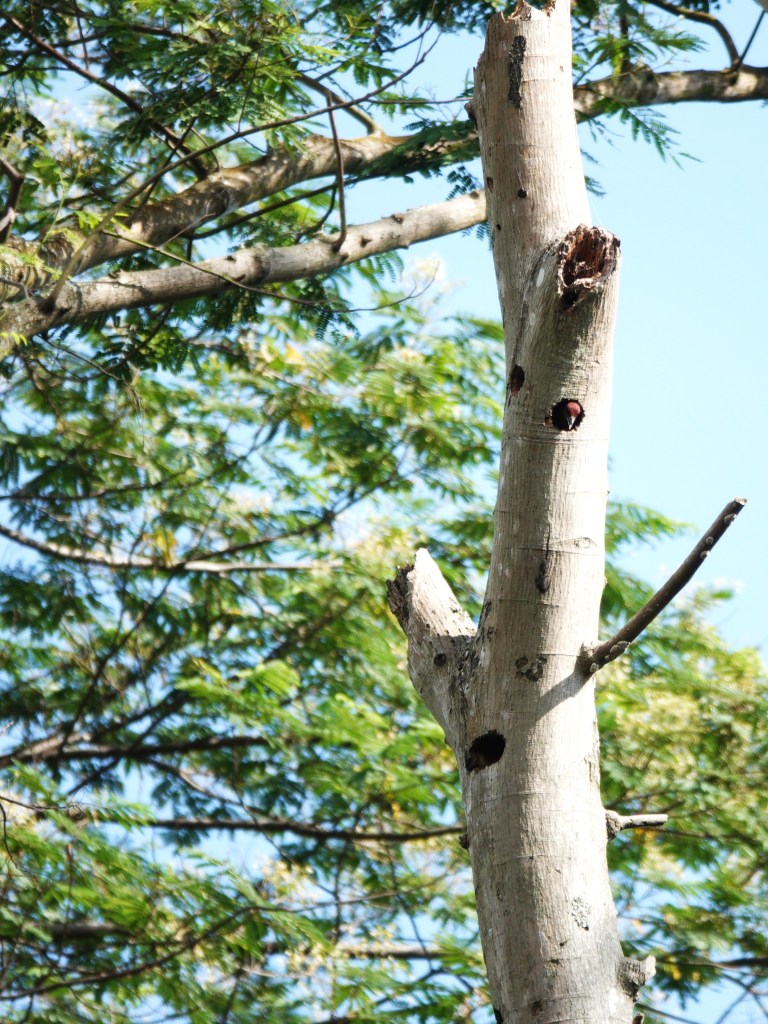
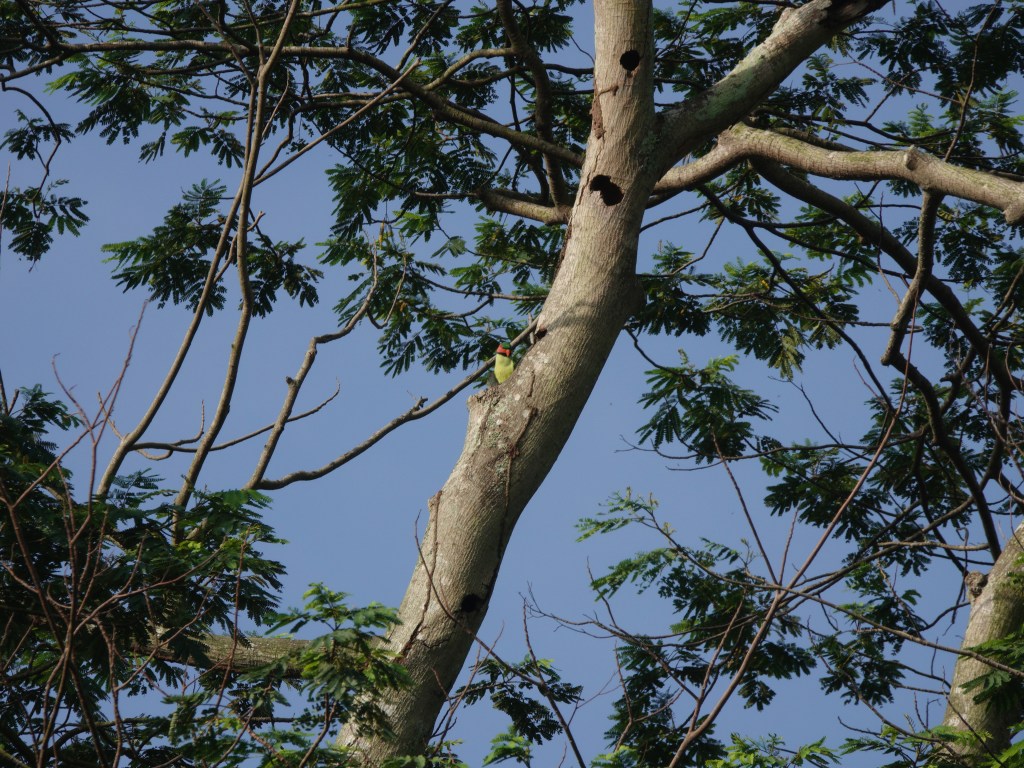
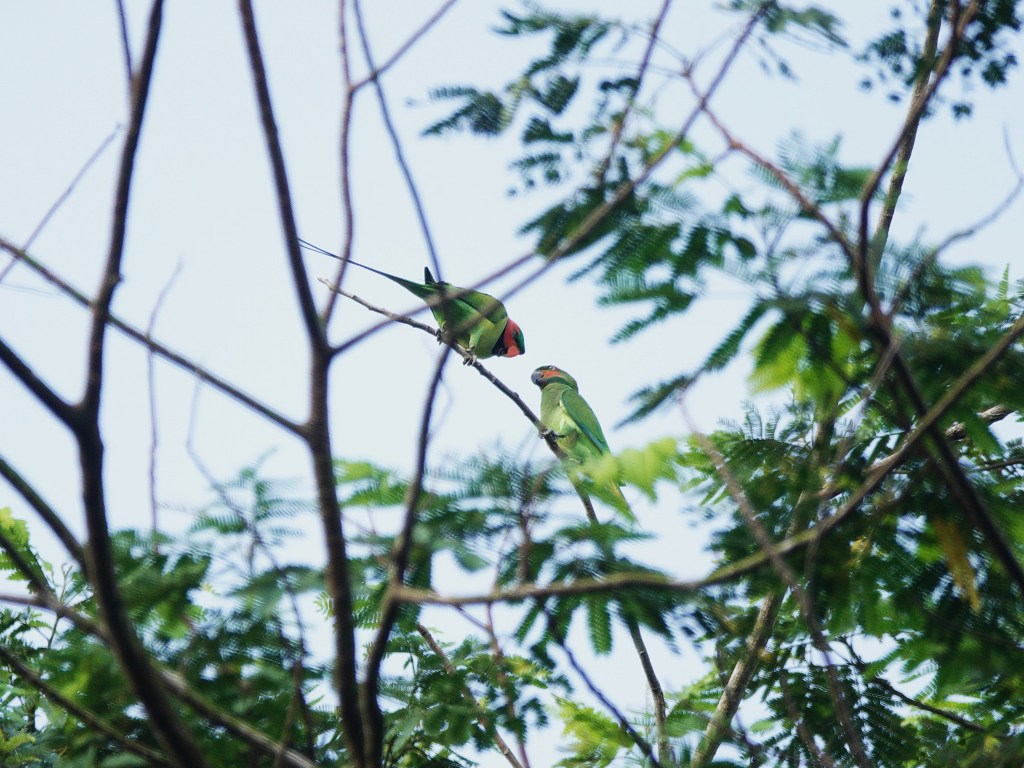
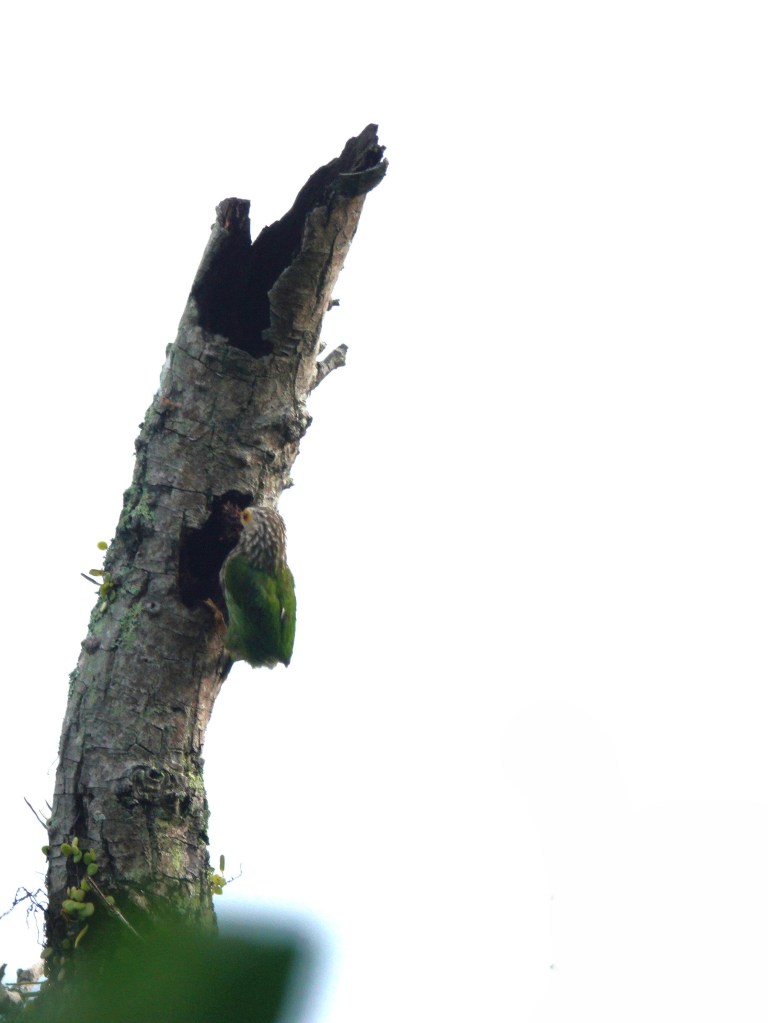
Interestingly, the same characteristics that make Albizia trees potential safety hazards for humans also make them attractive to certain bird species, such as Lineated Barbets, Banded Woodpeckers, Long-Tailed Parakeets, Hill Mynas and Oriental Pied Hornbills (there may be many others which I have yet observed). The reason lies in the tree’s softer, lower-density wood, which is easier for woodpeckers to excavate cavities for nesting. Barbets may also exploit the more brittle or damaged areas with portions of dead wood to create their own cavities. In contrast, mynas, parakeets and hornbills often rely on existing cavities, using those vacated by other birds for nesting though they do have strong beaks to further shape the holes. Thus, the mynas, parakeets and hornbills are known as “secondary cavity nesters” i.e. they utilise cavities that have already been created by birds with strong beaks that are built for such purposes.
A Banded Woodpecker looking out of the cavity along Daily Farm Nature Park (between Singapore Quarry and MOE Dairy Farm Outdoor Adventure Learning Centre).A Long-Tailed Parakeet peering out from its home. There are so many other cavities above it. This explains why the integrity of the tree structure may be weak and hence a safety hazard.Two Long-Tailed Parakeets on an Albizia tree in either Rifle Range Nature Park or Hindhede Nature Park (I have forgotten where exactly I took this photograph).A Lineated Barbet further excavating a hole at Bidadari Park. It is not known if this is a dead Albizia that have been left there for birds to perch and nest (the bark seems too rough to be one). Bidadari used to have many Albizia trees before the park was opened (You may refer to one of the photographs from uforest)
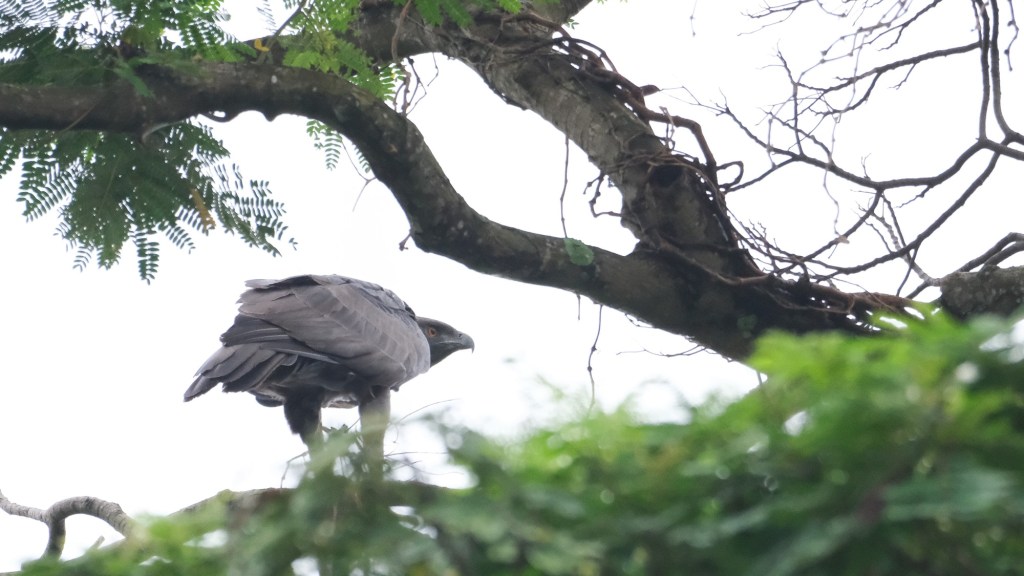
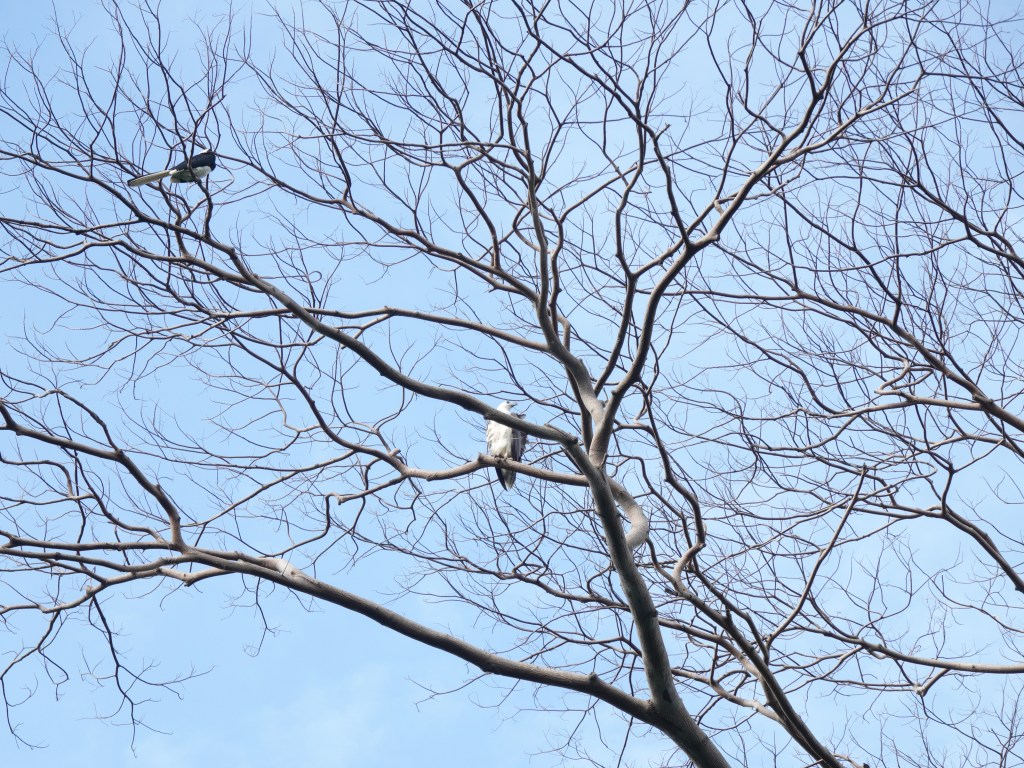
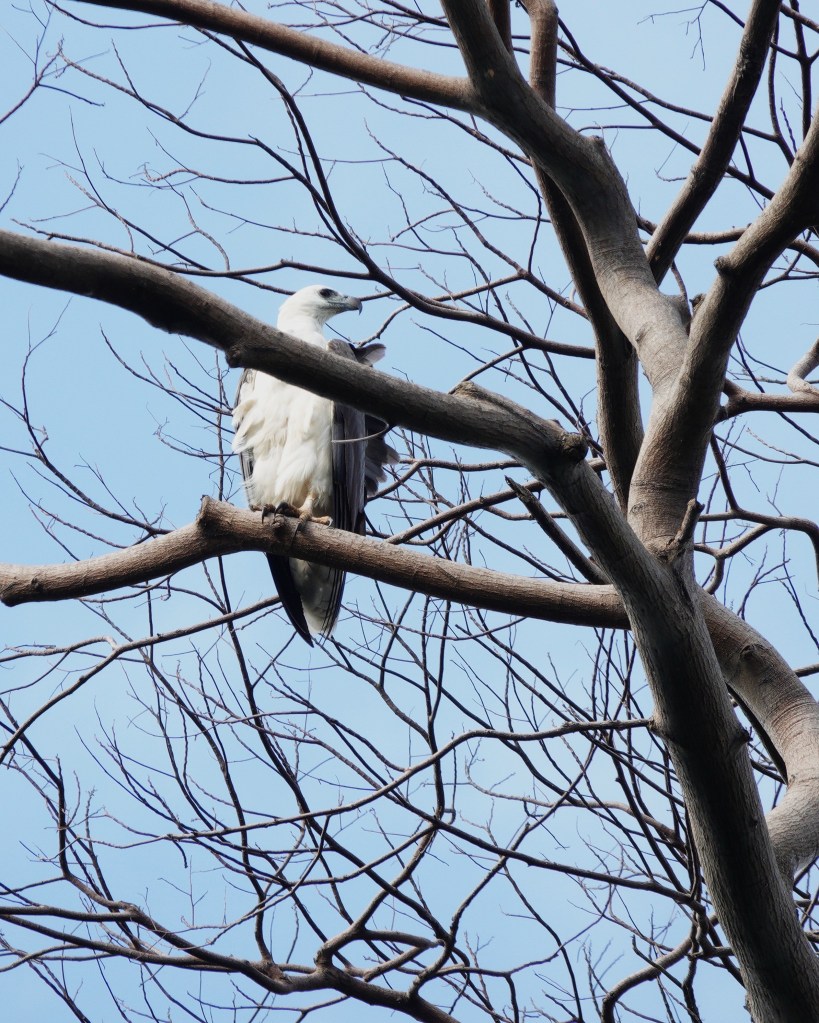
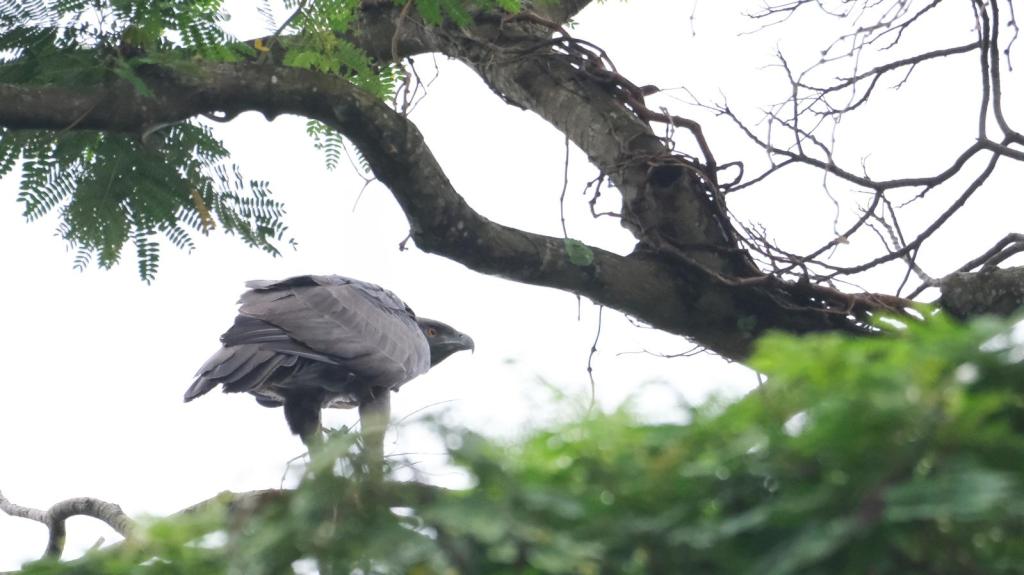
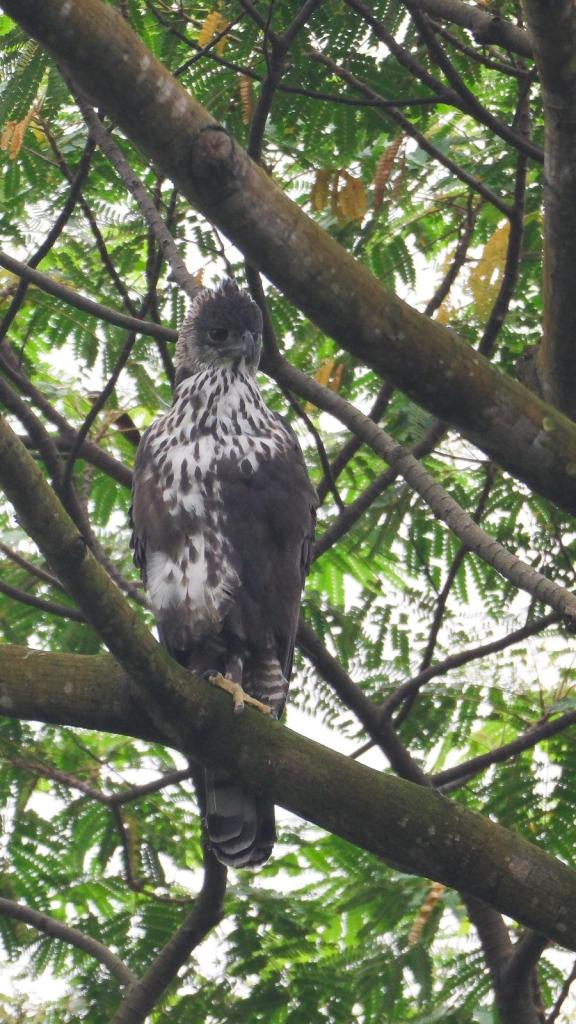
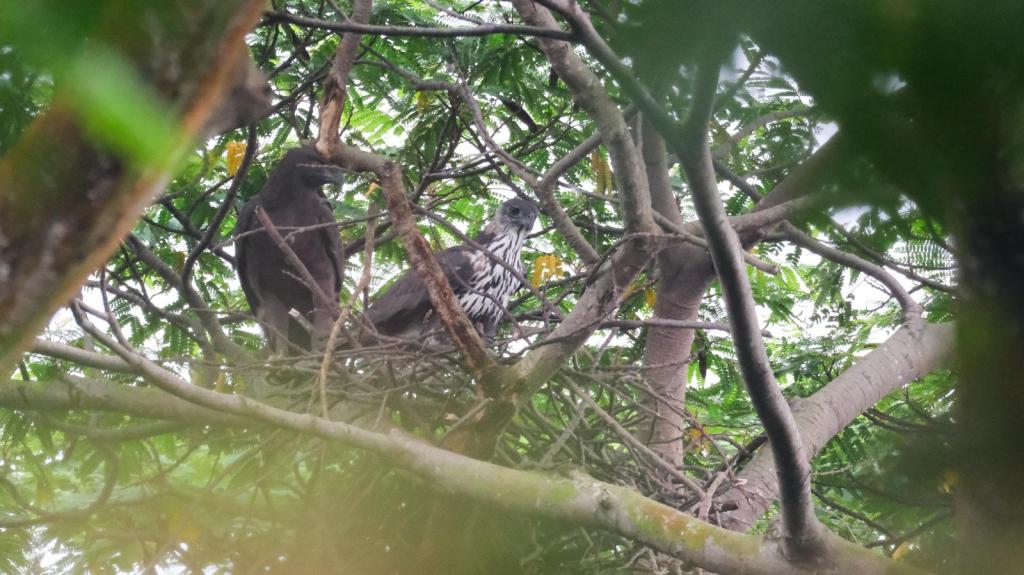
The sparse foliage at the canopy of the Albizia tree also makes it an ideal spot for birders to look for raptors, which often perch on the tree’s horizontally stretching branches. This vantage point likely provides the raptors with an unobstructed view of potential prey from a significant height, a luxury not afforded by trees with denser canopies where leaves and branches would block their line of sight. In fact, the height, shape and structure of the branches also encourage raptors to construct their eyries on the Albizia canopy. This has been well-documented by many others. Below are some of the photographs taken by Gabriel and I that illustrate the above points.
An Oriental Pied Hornbill and a White-Bellied Sea Eagle perched on a dead Albizia tree in Punggol. Although the smooth grey bark hints at the tree’s identity, confirmation would ideally require the presence of leaves.A closer view of the smooth bark.A Changeable Hawk Eagle (dark-morphed) perched on an Albizia in Chua Chu Kang. (Photo by Gabriel Kang)The majestic pose of the Changeable Hawk Eagle. You can see the small leaflets of the Albizia in the background. (Photo by Gabriel Kang)Indeed, the Albizia tree is a favourite nesting place for raptors. You can see the eyrie (raptor’s nest) on this particular one in Chua Chu Kang. (Photo by Gabriel Kang)
I have also found a well-documented article from the journal publication “Nature in Singapore”, published by NUS whereby the Changeable Hawk Eagles and the Oriental Pied Hornbills nested on the Albizia in the Dover Forest. It is an enjoyable read for those who would like to find out more. (Click here to access the article)
In conclusion, the Albizia tree presents a complex trade-off between supporting biodiversity and posing safety risks to humans. Effective management of this dilemma requires a collaborative approach, with NParks working closely with the community and various stakeholders to make informed decisions that balance human safety with environmental conservation. Education plays a crucial role in this process, helping people understand the reasons behind tree removal and the importance of prioritising safety while supporting species biodiversity. For nature guides and birders, I hope this post provides valuable insights and fosters a deeper appreciation for the importance of flora in supporting the fauna we admire. Don’t forget your binoculars, as these trees are often located at a distance from walking paths for reasons already mentioned.
Thank you Siyang for providing information about the Albizia trees and Gabriel for the wonderful photos of the Changeable Hawk Eagles.
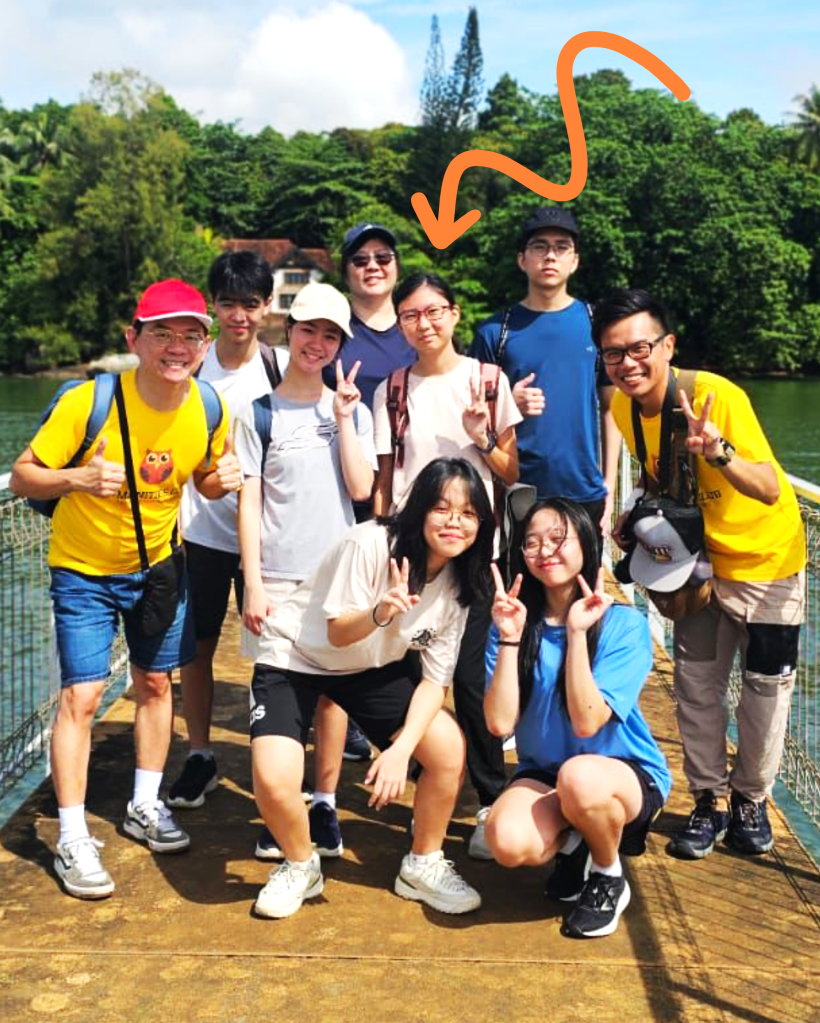
When we encounter young people with a deep passion for nature, we aim to nurture their meaningful pursuits. This blog post introduces Claire, a 16-year-old birding enthusiast I met during my guided nature walk in Pulau Ubin with the Humanities Club tuition centre. Her enthusiasm for birds is truly inspiring, and I hope her story will spark a similar appreciation for nature in others.
Mr. Joshua Lawrence and I, in yellow, with the rest of the wonderful participants for the guided nature walk in Pulau Ubin. Claire is indicated by the arrow pointing at her.
Claire has developed a particular affinity for birds, with a special fondness for Oriental Pied Hornbills. Her father, recognising her interest, has supported her passion by organising birdwatching trips to various locations, including Lorong Halus-Coney Island and Singapore Botanic Gardens.
As our group assembled at the Changi Village jetty, waiting to board our boat, Mr. Joshua Lawrence, the boss of the Humanities Club tuition centre, introduced me as the nature guide and a fellow birding enthusiast. Claire’s eyes immediately brightened, and she eagerly shared her birding experiences. She even showed me impressive footage she had captured of Golden-Backed Weavers constructing their nests in the Lorong Halus area.
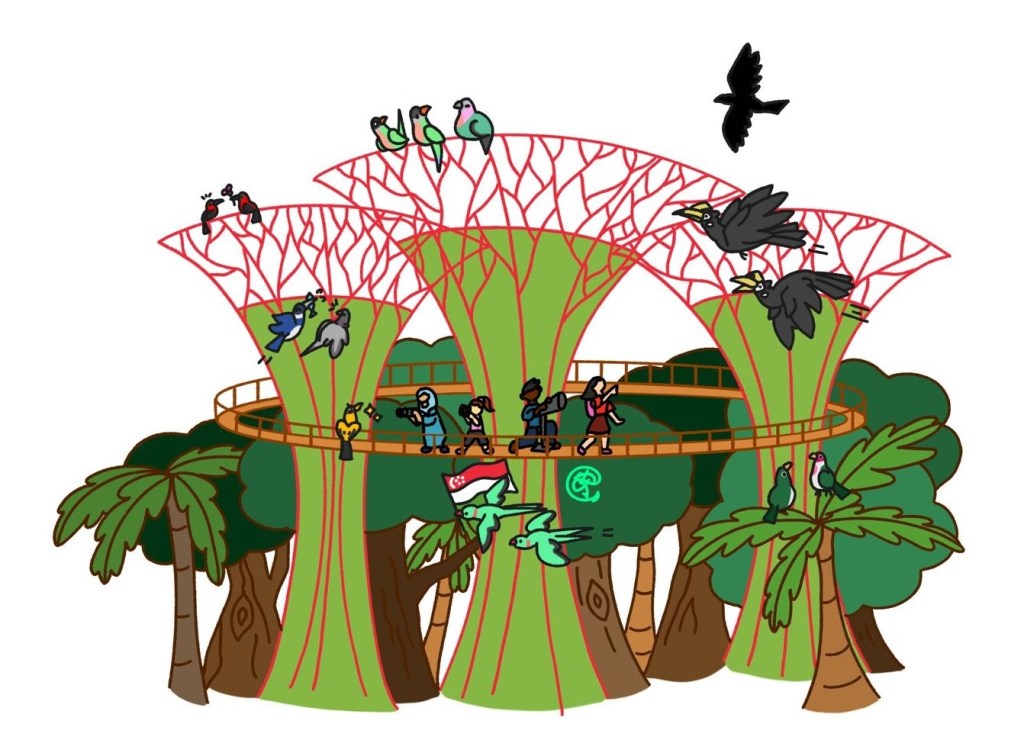
Yesterday, I received a beautiful drawing from Claire, which she had submitted for the SG60 Design Pompipi competition. While her work didn’t make it to the final, I believe it deserves a wider audience, especially from our local birding community! I love how she deliberately included the silhouette of a mystery bird – as it reminds me of “Who’s that Pokémon?”. Claire shared with me, “Sometimes, I see the silhouette of big birds in the sky and I wonder what they are. So I just drew it in relation to that.”
Here it is, along with Claire’s description:
Title: “Birding at Gardens by the Bay”
Singapore has been developing for over 60 years, focusing on integrating nature into urban architecture. A prime example is the Supertrees at Gardens by the Bay, which mimic mature rainforest trees. These structures not only resemble trees but also host various live plants, including orchids and ferns.
My drawing illustrates how successfully we’ve incorporated nature into our urban landscape. It depicts birds at Gardens by the Bay, showcasing the harmony between our built environment and wildlife. As someone who is fond of birdwatching, I’ve included people engaging in birdwatching activities and featured various bird species found in Singapore. Can you name all the birds?
This artwork represents the successful blend of urban development and nature conservation in Singapore, highlighting how our city has become a haven for both people and wildlife.
I hope you enjoy Claire’s artwork as much as I have. It’s a testament to the passion and talent of our young nature enthusiasts.
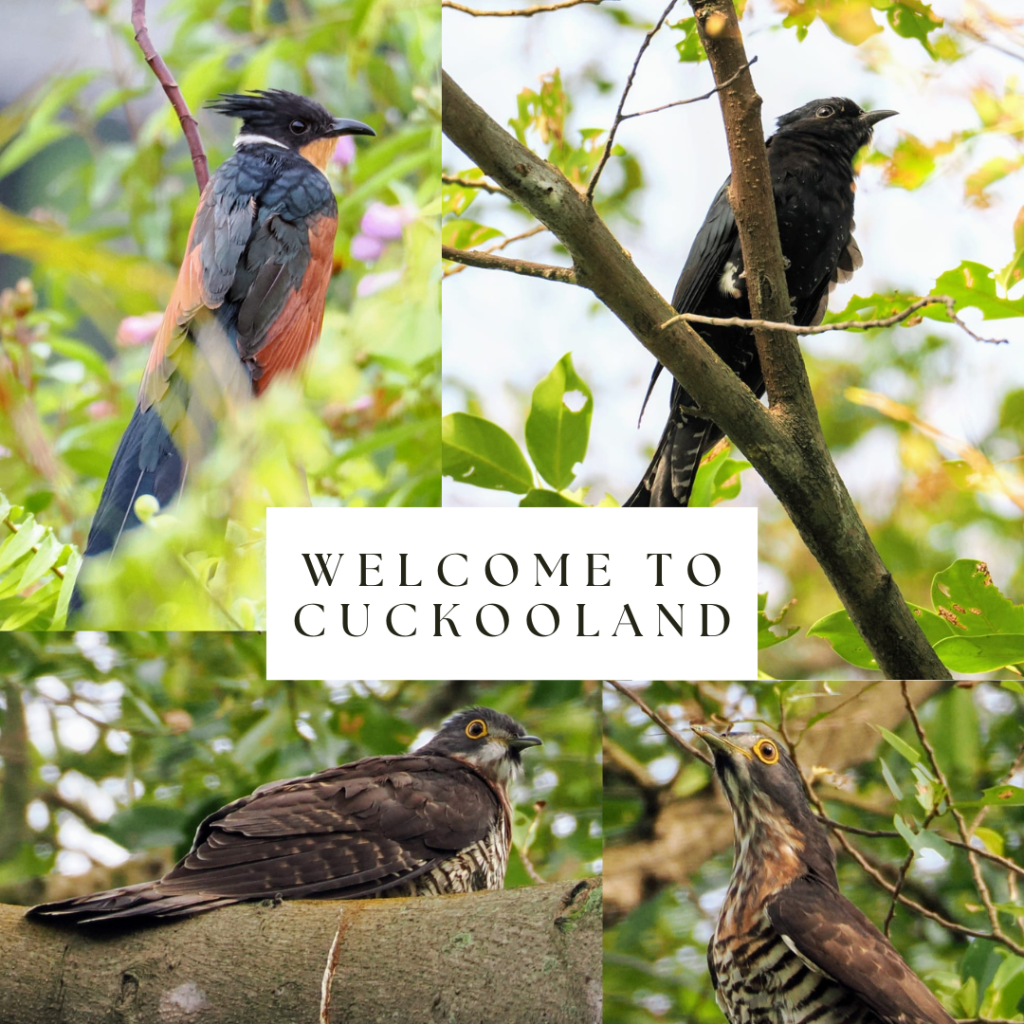
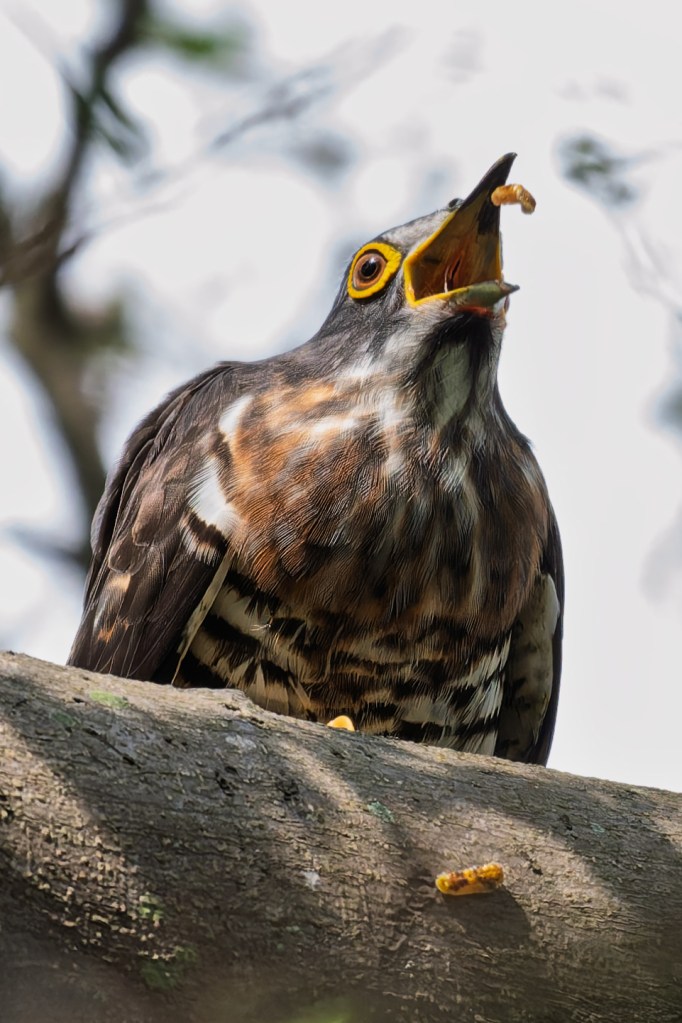
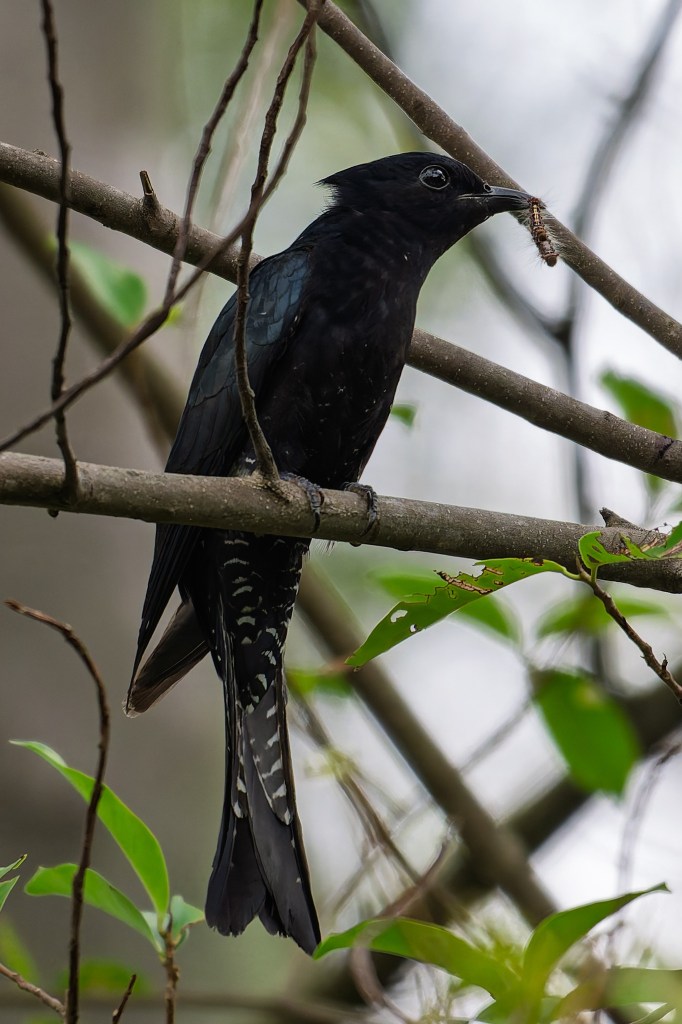
Over the last month, a “Cuckooland” was discovered by the Singapore birding community in Jurong Lake Gardens, much to the delight of birders living in the West. Several species of migratory and resident cuckoos have congregated in the area, attracting wildlife photographers who adore these birds for their beautiful plumage and elegant silhouette. The diverse array of cuckoo species includes the Squared-Tailed Drongo-Cuckoo, Large-Hawk Cuckoo, Indian Cuckoo, Sunda Brush Cuckoo, Himalayan Cuckoo, Plaintive Cuckoo, Banded Bay Cuckoo, Asian Koel and the handsome Chestnut-Winged Cuckoo.
From the top in clockwise directions: Chestnut-Winged Cuckoo, Square-Tailed Drongo Cuckoo, Large-Hawk Cuckoo. (Credit: Lee Ching Yong, 2024)
The Parasitic Brooding Behaviour of Cuckoos
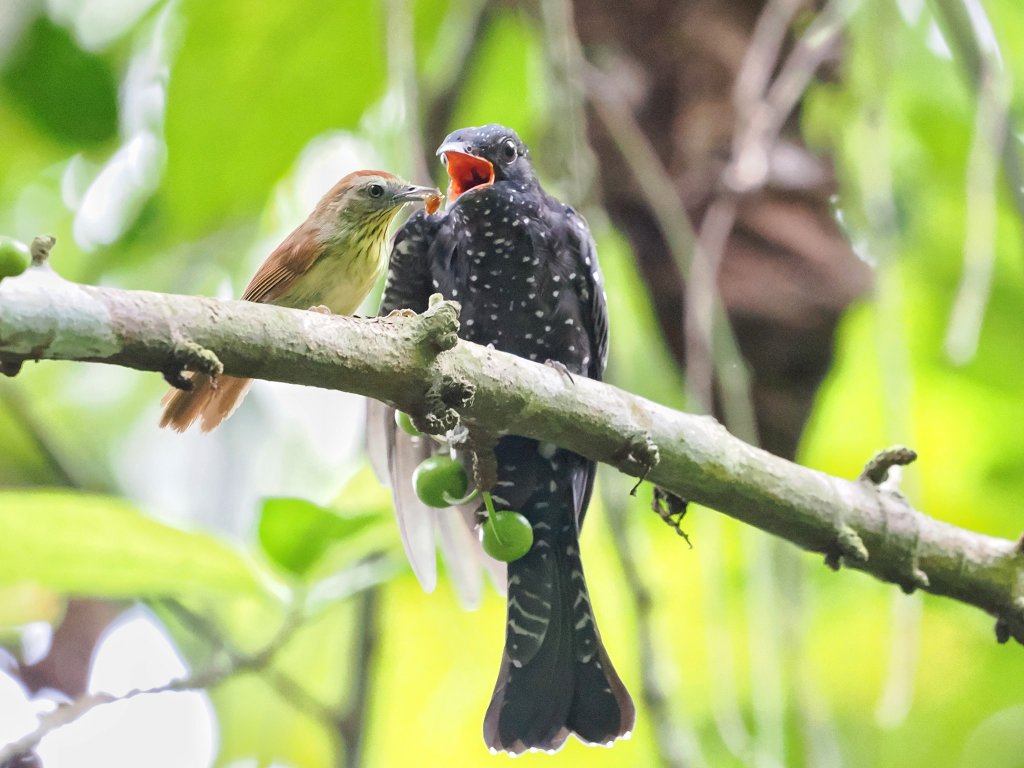
Cuckoos are particularly interesting due to their parasitic brooding behaviour, which birders have had the pleasure of observing and photographing. Singaporean birders have brilliantly captured images of various host species, such as Golden-bellied Gerygones, Ashy Tailorbirds, Pin-Striped Tit-Babblers, and Malayan Pied Fantails, feeding cuckoo fledglings that are often larger than themselves, belonging to species like the Little Bronze Cuckoo, Square-Tailed Drongo, Rusty-breasted Cuckoo, Plaintive Cuckoo, and even the well-known Asian Koel (which is also a member of the Cuckoo family)
A Pin-Striped Tit Babbler feeding its oversized Square-Tailed Drongo Cuckoo. (Credit: Anderson Ng, 2024)
Cuckoos – Our Pest Controllers
This unique gathering in Jurong Lake Gardens has also provided an excellent opportunity for bird enthusiasts to witness and document the feeding habits of beautiful cuckoos, which I’ll focus on in this post.
During a recent birding excursion with my friend Gabriel, we explored the area around Fusion Spoon, a known cuckoo hotspot. Despite not spotting any cuckoos that morning, we enjoyed sightings of migratory Warblers, Flowerpeckers, Tailorbirds, Sunbirds, and Pied Trillers as we strolled past the ficus trees.
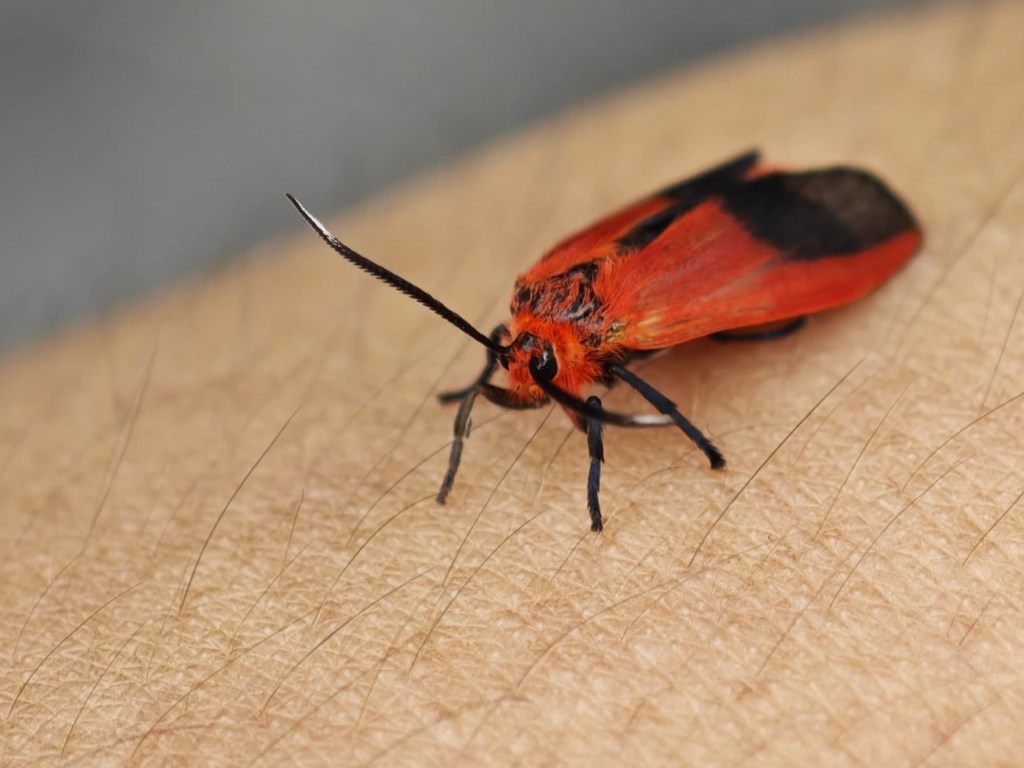
A moment of delight came when a beautiful moth unexpectedly landed on Gabriel’s arm, adding a sudden splash of colour to our walk. Though familiar, we couldn’t immediately identify it. Our friend Ching Yong later joined us, sharing photos of caterpillars he’d spotted in the same area over the past few days. These caterpillars, found on the pavement, were likely dislodged by foraging cuckoos or heavy rain, hinting at the intricate ecological interactions unfolding around us.
The deceptively harmless-looking Phauda flammans moth, a notorious pest species, perched on Gabriel’s arm (Credit: Gabriel Kang, 2025)
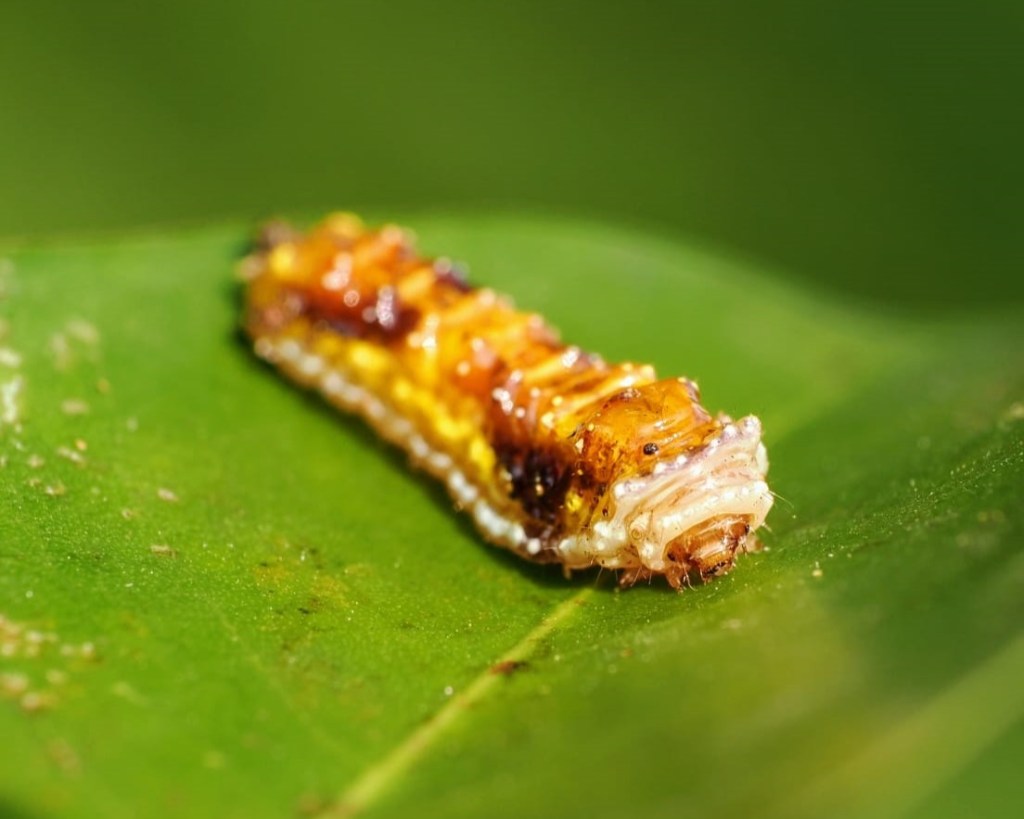
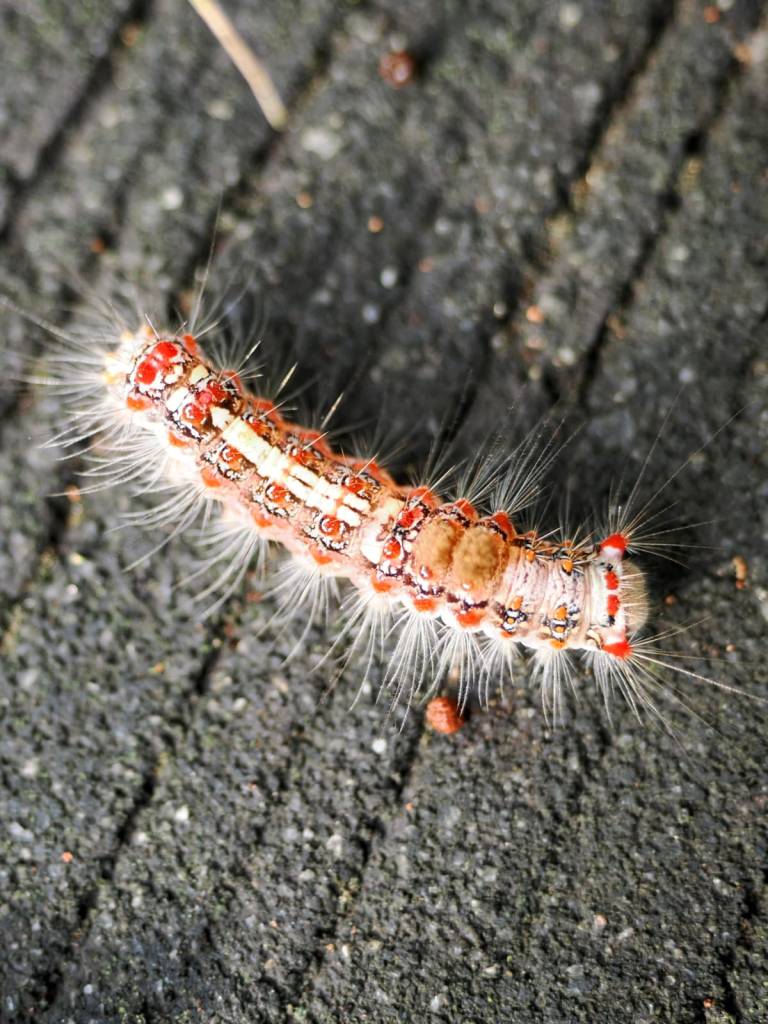
Intrigued by our encounter, I later ‘Google-lensed’ the moth’s identity and made a fascinating connection: the moth that landed on Gabriel’s arm was the adult form of the caterpillar that Ching Yong had photographed. It turned out to be the notorious Phauda flammans, a species known for its destructive impact on specific Ficus trees, particularly Malayan Banyan (Ficus microcarpa) and Weeping Fig (F. benjamina), while leaving the other commonly seen Ficus elastica unscathed (see article).
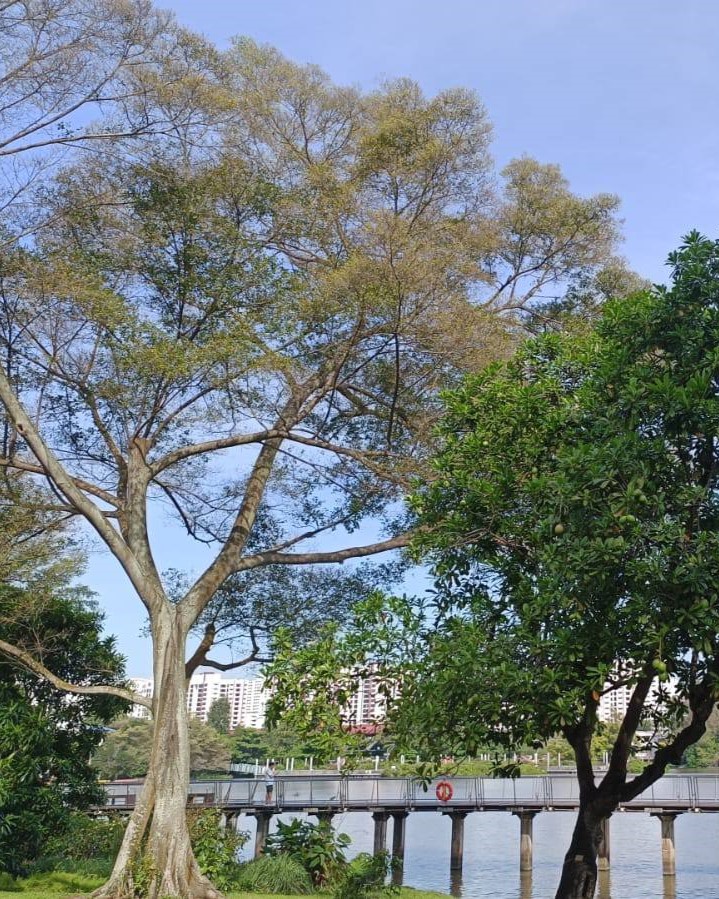
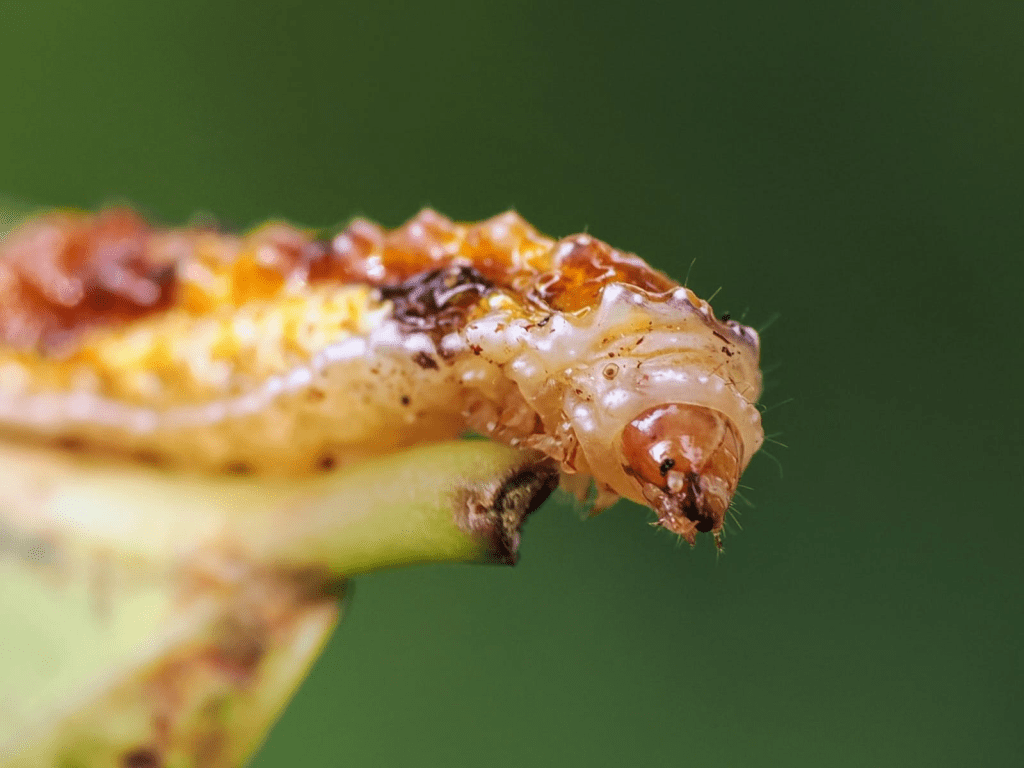
On the left is a rather sparse looking unmatured Malayan Banyan (Ficus microcarpa) where the cuckoos love to perch and feed. Thanks Teo Siyang for the ID. A close-up view of the Phauda flammans caterpillar, a favourite delicacy of the cuckoos. The intricate pattern on this caterpillar’s body is reminiscent of the layered, rippled texture of the iconic Viennetta ice cream cake from the 1990s. (Credit: Lee Ching Yong, 2024)Another macroshot of the caterpillar’s head. (Credit: Lee Ching Yong, 2024)
This moth has gained infamy in recent years, particularly in Hong Kong, where it has been responsible for significant damage to various Ficus species (You may read about the article here), causing complete defoliation. Eggs are laid on leaves in the top of the trees and the larvae (caterpillars), upon hatching will start consuming right from the top. In Singapore, you may have noticed some canopy branches of Ficus trees losing their foliage. It’s highly likely that Phauda flammans is the culprit behind this damage.
The presence of these moths and caterpillars in the area not only explains the damage to the local Ficus trees but also sheds light on the reason behind the cuckoos’ congregation. These birds are capitalising on the abundant caterpillar population, which includes Phauda flammans and some tussock moth (Lymantriinae) caterpillars, as evidenced in other publicly shared photographs. This effectively transforms a potential pest problem into a bountiful feeding opportunity for the cuckoos. This ecological interaction has been visually confirmed by a fellow birder, Bai Qw’s photograph, which brilliantly captured a Large-Hawk Cuckoo (Hierococcyx sparverioides) feasting on these specific Phauda flammans caterpillars.
A Large-Hawk Cuckoo feasting on a Phauda flammans caterpillar with another one trying to escape its fate. (Credits: Bai Qw, 2024)
Ain’t Many of These Caterpillars Venomous and/or Poisonous?
Yes, many caterpillars are indeed venomous and poisonous. However, this fact doesn’t deter cuckoos from making these hairy creatures a significant part of their diet. In fact, cuckoos worldwide are well-known for specifically targeting hairy caterpillars that possess venomous spikes/bristles.
In New Zealand, Shining Bronze Cuckoos were documented feeding on venomous Gum-leaf Skeletoniser Caterpillars, Woolly-Bear caterpillars, Magpie Moth Caterpillar etc (refer to article for the New Zealand’s reference).
The secret lies in the cuckoo’s unique digestive system:
Protective Gizzard: The cuckoo’s gizzard is lined with a thick, protective mucous membrane.
Hair Trapping: This membrane traps the venomous hairs of the caterpillars.
Shedding Mechanism: As a defense mechanism, the bird periodically sheds patches of this membrane.
Regurgitation: The shed membrane, along with the toxic hairs, is regurgitated as a pellet.
Interestingly, the Bird Ecology Study Group has documented another intriguing behaviour: some cuckoos have been observed rubbing caterpillars against rough tree bark. This action likely serves to remove or reduce the number of irritating hairs on the caterpillar before consumption, further minimising the risk to the bird (see link).
Back in the Jurong Lake Gardens, the cuckoos were photographed to have consumed hairy caterpillars such as the Clearwing Tussock Moth Caterpillar (Perina nuda).
A Square-Tailed Drongo Cuckoo feasting on a Clear-Winged Tussock Moth (Credit: Bai Qw)A close-up shot of the Clear-Winged Tussock Moth discovered by Ching Yong near Fusion Spoon (Credit: Lee Ching Yong)
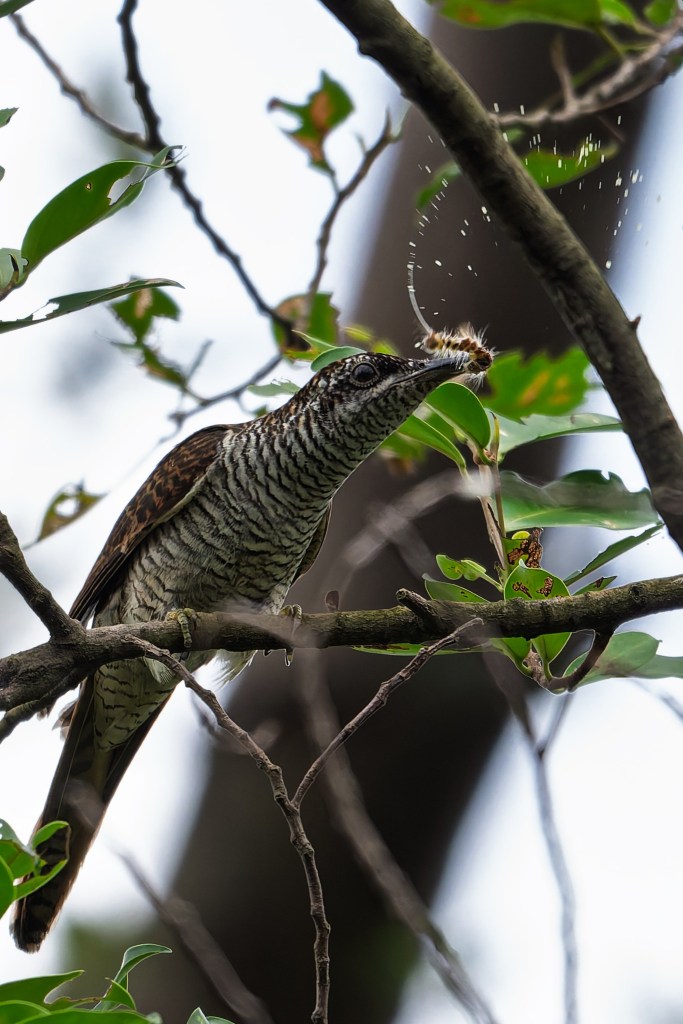
As for toxic caterpillars well-known for their aposematic colouring, photographers have caught images and videos of cuckoos thrashing the caterpillars such that the toxic guts spilled out before consuming them.
A Banded-Bay Cuckoo bashing and thrashing the caterpillar to remove the toxic guts and some of the hairs. (Credit: Bai Qw, 2024)
Thank You Cuckoos for Your Service
Before penning this post, I harboured doubts about Singapore’s ecosystem’s capacity to sustainably support the influx of migratory birds. Now, having witnessed this intricate dance between the Ficus trees, Phauda flammans caterpillars, and cuckoos, I’m positive about what our “city-in-a-garden” can offer to these beautiful visitors. It’s clear that our urban landscape offers more than meets the eye, providing a rich and complex habitat that can indeed sustain and attract diverse wildlife.
A heartfelt thank you to our feathered friends for their pest control services! Special appreciation goes to Anderson Ng, Bai Qw, and Lee Ching Yong for their stunning photographs.




 birdbrainsg