As wildlife enthusiasts and photographers, we often find ourselves in situations that test our ethical boundaries. In 2024, I have experienced several moments, which led me to reflect on my own practices as well as my own role in promoting responsible wildlife photography.
An Uncomfortable Encounter
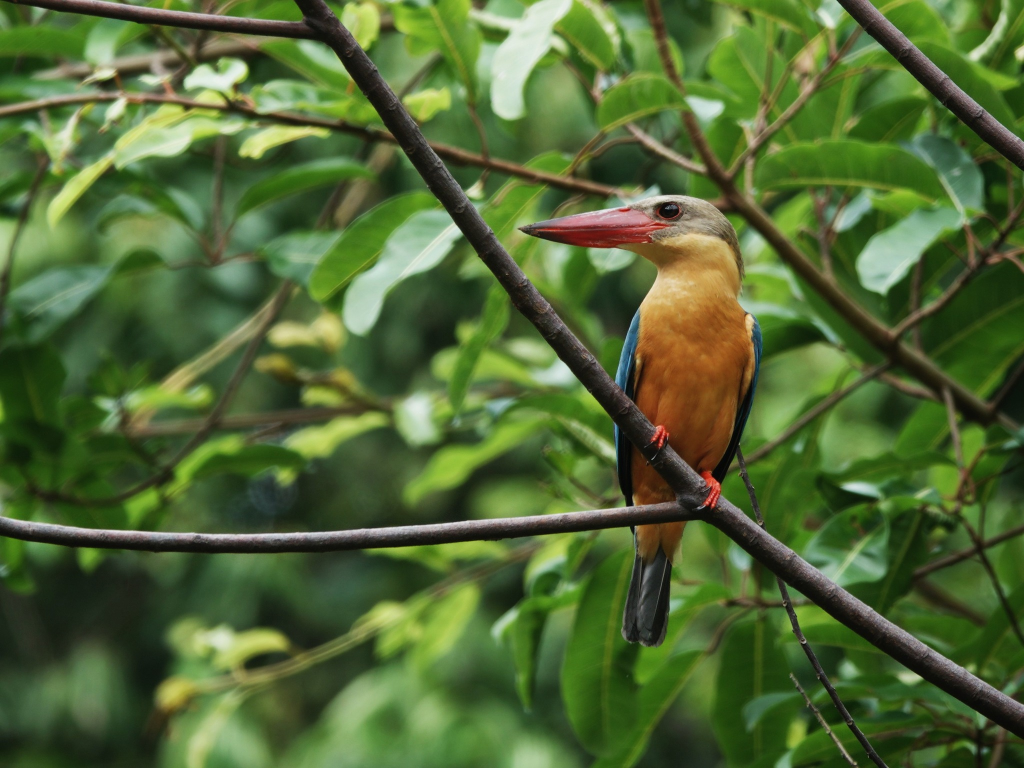
Stork-Billed Kingfisher photographed in August at the Singapore Quarry
My first clear photo of a Stork-billed Kingfisher came under circumstances that left me feeling uneasy. At the Singapore Quarry, surrounded by over 30 other birders, I witnessed behaviour that I now regret not addressing. Some individuals were tossing whole slices of bread into the water to gather the fishes to a particular spot where the photographers were aiming at. The ripples created by the fishes lured the kingfisher from a distant tree, prompting it to dive before perching right in front of us. I took a few shots, feeling conflicted – admiring the beautiful colours of the kingfisher in such a close distance but yet feeling guilt-stricken.
The act of tossing bread into the water started triggering more hunting behaviour in various birds present, including the Grey-headed Fish Eagle and Oriental Darter.
The Motivation Behind Unethical Practices
The primary objective seemed to be capturing dramatic shots: “Birds in Flight”, photographs, “Fish in Mouth” images i.e. action shots preferred over standard perched bird photos. This practice raises several concerns. Bread lacks nutritional value for wildlife, adding empty calories to their diet. Uneaten bread may pollute the water. Moreover, feeding wildlife, in general, is discouraged and often prohibited.
Feeling conflicted, I decided to act on my discomfort. I left Singapore Quarry after just 10 minutes, despite usually spending over an hour birdwatching. This decision meant missing the Oriental Darter’s and the Grey-Headed Fish Eagle’s feeding behaviours.
Unfortunately, the incident at the Singapore Quarry isn’t isolated. Similar unethical behaviours have been observed across various locations, highlighting a concerning trend in wildlife photography.
At Dairy Farm’s small pond, I’ve heard about a small group of individuals releasing feeder fish, feeder shrimps and glofish to get the Blue-Earred Kingfisher’s ‘Food-In-Mouth’ photographs. Social media has become a showcase for these questionable practices, with posts featuring blue-earred kingfishers capturing non-native fish species. Even more troubling are the discussions among photographers about which fish species to introduce next for ‘ideal’ shots.
The issue continues during this year’s migratory season when Singapore becomes a temporary home for exotic birds, drawing large crowds of eager birders. In the newly opened Bidadari Park, rumours circulated about individuals releasing American Bull Frogs – typically sold in aquarium shops as live feed – to entice one particular Ruddy Kingfisher. Over several weeks, numerous photographs emerged showing this kingfisher with non-native frogs in its mouths, raising ethical and environmental concerns. Rumour had it that someone actually broke the frogs’ legs to keep them in the patch, allowing for a clear shot of the Ruddy.
These practices not only disrupt natural ecosystems but also potentially harm the very wildlife we aim to appreciate and document. They represent a fundamental misunderstanding of our role as observers and documentarians of nature, prioritising a perfect shot over the wellbeing of the subjects we photograph.
As wildlife enthusiasts and photographers, we must recognise the far-reaching consequences of these actions. It’s crucial to foster a community that values ethical practices and respects the natural behaviours and habitats of wildlife. Only then can we truly capture the essence of nature without compromising its integrity.
I Can Do Better Myself
The enthusiasm for capturing great wildlife shots is something I understand all too well. Like many others in this field, I’ve had my own lapses in judgment, particularly when it comes to approaching birds too closely, even near their nests.
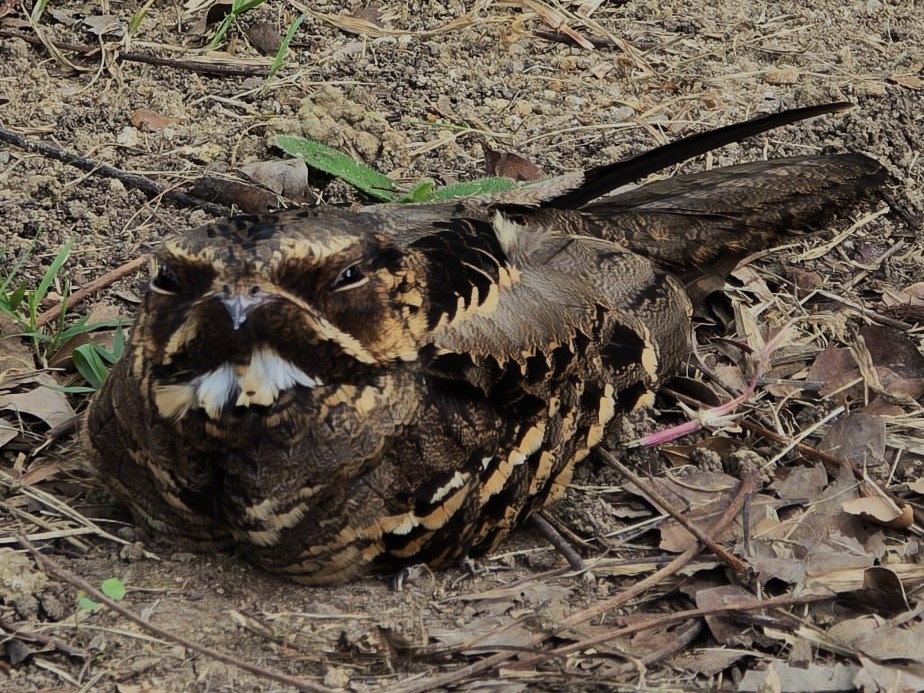
One incident from earlier this year stands out, leaving me with a profound sense of guilt and shame. While cycling with my family in Pasir Ris Park, I spotted a Large-Tailed Nightjar. Excited by the sighting and without my usual zoom camera, I approached the bird with just my smartphone, hoping for a clearer picture. My actions frightened the nightjar, causing it to fly away and expose its eggs.
A fellow birder who was following behind me, witnessing this, sternly warned me against sharing the location and reprimanded me for my close approach. Although I initially tried to justify my actions, deep down I knew I was wrong. I silently thanked her for the reminder about my actions and the greater mission we share as wildlife enthusiasts.
An unethical handphone shot of the Large-Tailed NightjarThe moment I saw the two eggs after the mum flew off, I was guilt-stricken.
Beyond the incident with the nightjar, I’ve faced other ethical challenges in my wildlife photography journey. The temptation to handle wildlife such as snakes, lizards, and frogs for that perfect shot has been a recurring struggle. However, each of these experiences has become a valuable lesson in restraint and respect for nature.
Moving Forward
As I continue to grow in this field, gaining both experience and credibility, I’ve come to realise the importance of not only improving my own practices but also gently guiding others. Educating fellow enthusiasts about responsible wildlife watching has become an integral part of my mission. It’s crucial to remember that this journey towards ethical wildlife photography is an ongoing process. All of us who share this passion for nature and wildlife photography are constantly learning, adapting, and hopefully, improving.
By openly discussing these challenges and sharing our experiences, we create a community of more conscientious observers and documentarians of the natural world. This collective effort to balance our enthusiasm for capturing wildlife with our responsibility to protect it is what will ultimately ensure that our passion contributes positively to conservation efforts rather than inadvertently causing harm.
What are your thoughts on this issue? Have you encountered similar situations?
This week in the anime world, Dragon Ball fans celebrated Vegeta’s epic Super Saiyan 3 transformation! What an exhilarating moment for the Prince of Saiyans! To commemorate this milestone, I’ve decided to draw an intriguing parallel between Dragon Ball and nature. Thanks to a local birder Leonard Kok who gave me an inspiration to write about it.
In 1994, whilst I was hospitalised for a severe medical reaction, my parents presented me with a colourful Dragon Ball manga volume to boost my spirits and encourage my recovery. The book showcased the familiar heroes like Goku, Krillin, Piccolo, and Gohan, alongside some new antagonists. I was particularly captivated by the main villain – Cooler, who is, in fact, Frieza’s elder brother.
Cooler concept art drawn by Akira Toriyama (Credit: Dragon Ball Wiki)
For nature enthusiasts, many of you may immediately find yourself connecting this character with exotic creatures you’ve encountered in the wild. For me, however, it wasn’t until more than two decades after reading that manga that I realised Cooler’s final form bears a resemblance to one of my favourite caterpillars: the Plain Nawab (Polyura hebe plautus) caterpillar or the Blue Nawab (Polyura schreiber tisamenus).
A frontal view of the Plain Nawab Caterpillar with its iconic head resting on its host tree leaves – the Saga Tree (Adenanthera pavonina)Cooler in his coolest form, which has a head structure that resembles the Nawab caterpillars. (Credit: Dragon Ball Wiki)
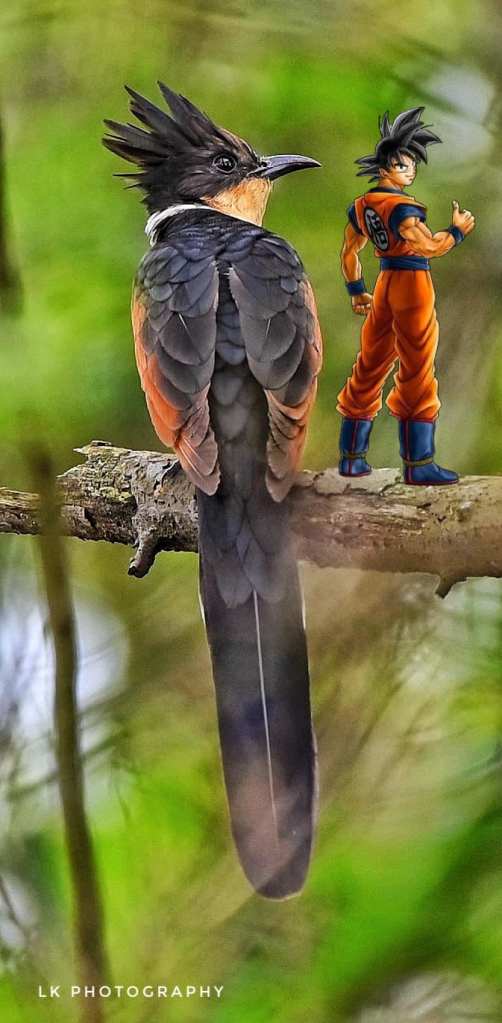
Fast forward to today: I stumbled upon an incredible connection between nature and anime on the Bird Sightings Facebook Group. The star of this unexpected crossover? The Chestnut-Winged Cuckoo (Clamator coromandus), a migratory bird that has recently graced Singapore with its presence. Several of these stunning creatures have been spotted in the newly renovated Jurong Lake Gardens, and Leonard Kok, one of the lucky and dedicated birders, managed to capture a beautiful shot of it.
What makes this sighting truly extraordinary is the uncanny resemblance Leonard noticed. Alongside the cuckoo’s photo, he cleverly juxtaposed a picture of Son Goku from Dragon Ball Z in his original form, sporting his iconic blue and orange outfit. The similarity is nothing short of striking! The cuckoo’s distinctive crest mirrors Goku’s gravity-defying black hair, while even the colour combination seems to match perfectly.
But the parallels don’t stop there. Remarkably, the bird’s posture exudes the same positive energy and confidence that Goku is known for.
Imagine this cuckoo can get into a Super Saiyan form! LOL. Now that would be a sight to behold – a golden-crested cuckoo with glowing aura.
I can’t unsee the resemblance now (Credit: LK Photography)
Interestingly, just as Goku ultimately defeated Cooler in an epic battle, nature has its own version of this showdown. The Chestnut-Winged Cuckoo, our Goku lookalike, is known to feed on various insects, including caterpillars. So, in a twist of cosmic irony, our cuckoo friend might actually prey on caterpillars similar to the Nawab that reminded us of Cooler! It’s as if the natural world is playing out its own version of Dragon Ball Z battles right before our eyes.
These delightful comparisons not only showcase the beauty of nature but also remind us of the unexpected ways pop culture and wildlife can intersect. It’s a testament to the keen eye of nature enthusiasts and the magic that can happen when we view the world around us with a touch of imagination.
It has been over a year since my last offshore fishing trip, and today I finally had the chance to join my friends for an exciting expedition in the Southern Islands area, situated between Sentosa and Saint John’s Island.
Passing by PSA on Our Fishing Boat
With Chinese New Year approaching, we embarked on our fishing trip with high hopes of landing some prized catches like Coral Trout, Golden Snapper, Red Snapper, or the Orange-Spotted Grouper for our reunion dinners. However, our enthusiasm was dampened by unfavourable weather conditions, as heavy downpours significantly impacted the bite rate, making our quest more challenging.
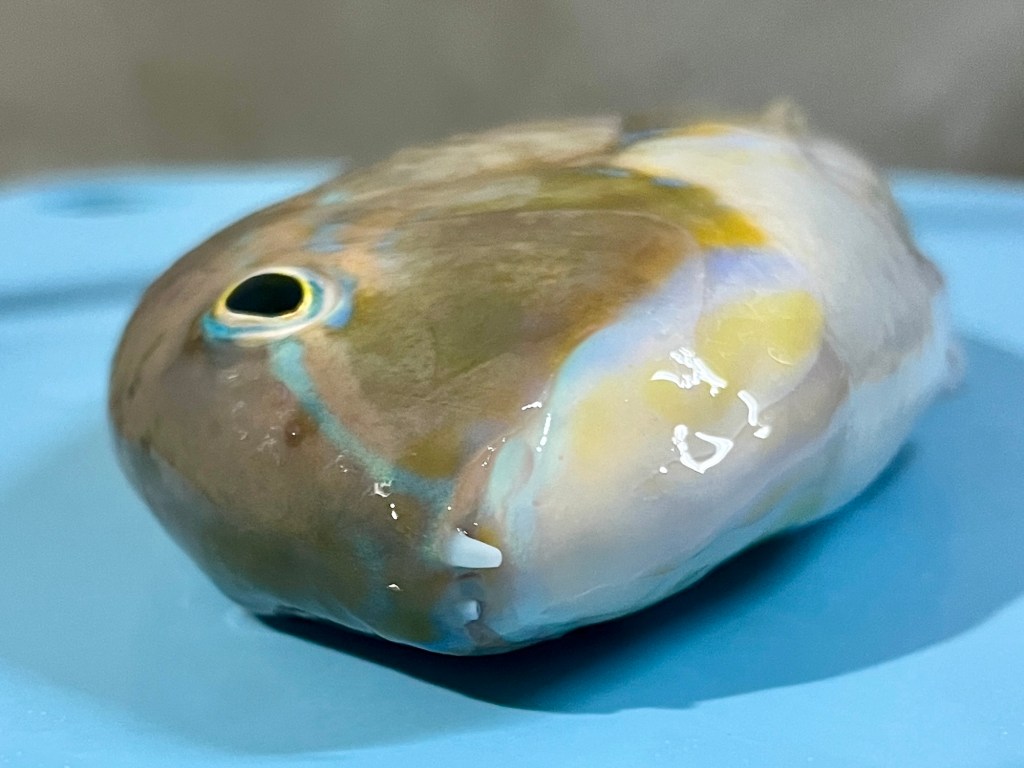
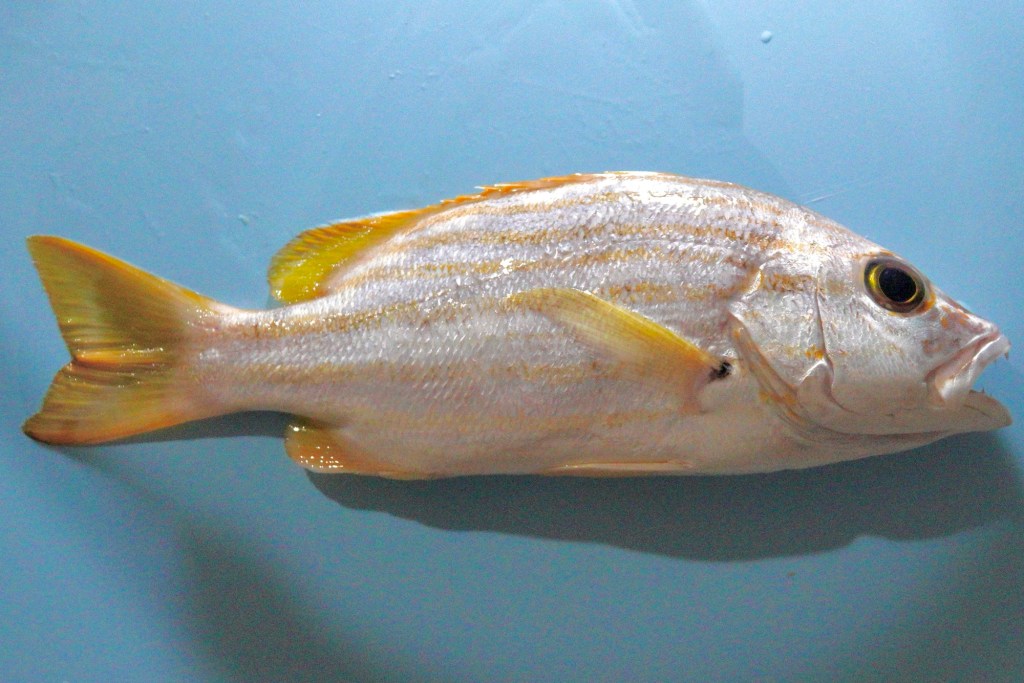
In the end, we caught a variety of other fishes instead, that included a Black Spot Tuskfish (Choerodon schoenleinii), which is often mistakenly called ‘Eng Kor’ or Parrot Fish in Hokkien, despite belonging to a different family than true parrotfish (Scaridae). We also caught a Fingermark Seaperch, commonly known as ‘Golden Snapper’ (Lutjanus johnii), and an impressively large ‘Leng Jiam’, also known as a Spangled Emperor (Lethrinus nebulosus). To round out our catch, we reeled in numerous ‘Tee Boon’, or Spanish Flag Snapper (Lutjanus carponotatus). While we may not have caught exactly what we were aiming for, we enjoyed the time spent together.
Alvin, an ex-colleague caught a beautiful Spangled EmperorA Black-Spotted Tuskfish with a broken tooth (tusk). Parrot fish, on the other hand, has strong human-liked teeth to chomp through corals with ease.
Warning: If you have entomophobia (a fear of insects) or hemophobia (a fear of blood), please do not continue with the article.
A Nightmarish and Disturbing Discovery
Our fishing adventure was filled with unexpected sights and discoveries. During our trip, we were treated to the majestic view of 5-6 White-Bellied Sea Eagles (Haliaeetus leucogaster) soaring through the sky and perching on one of St. John’s Island’s Casuarina Trees. We also exclaimed in awe at the sight of a huge turtle, most likely a Green Turtle (Chelonia mydas) given its impressive size.
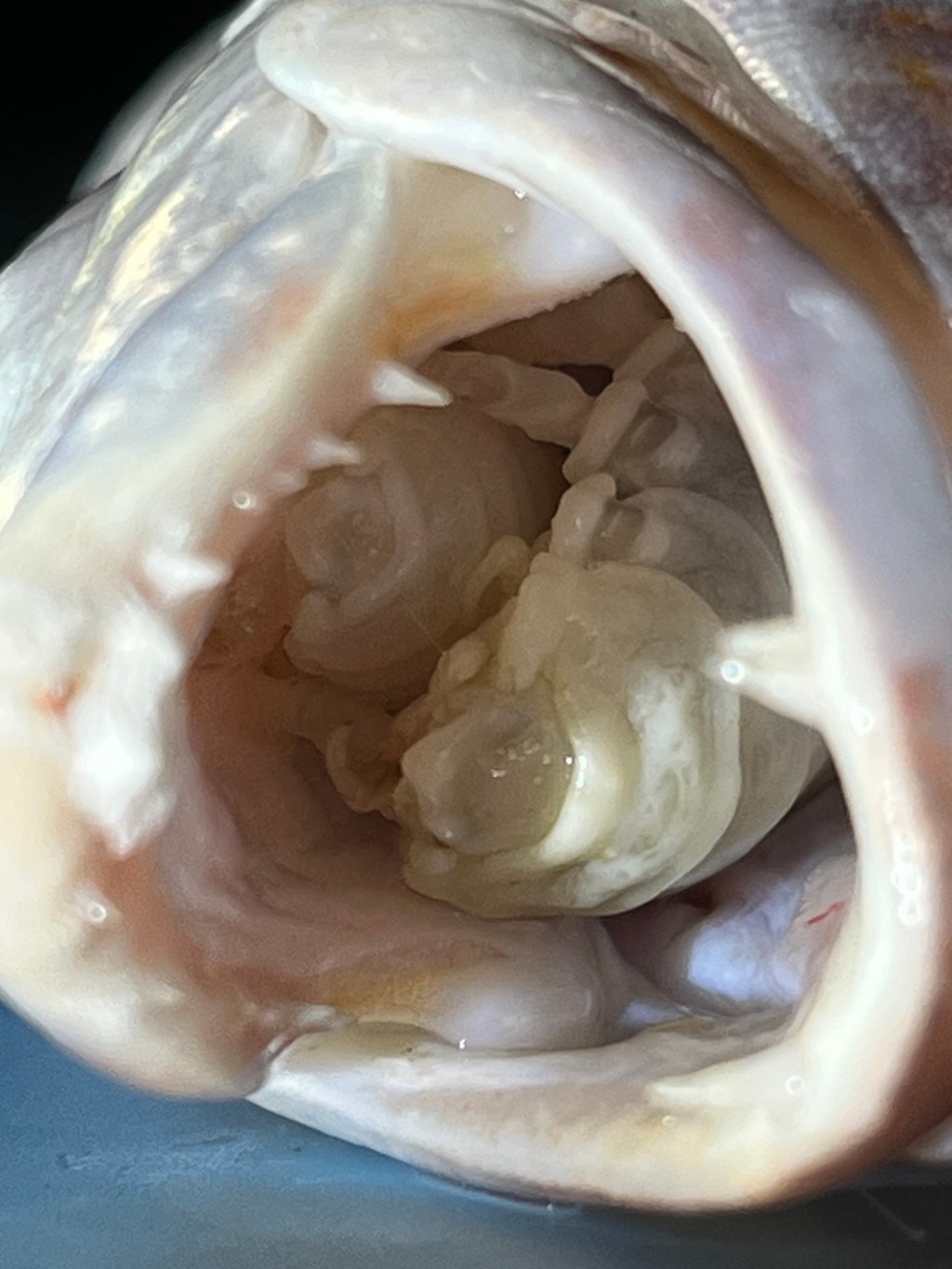
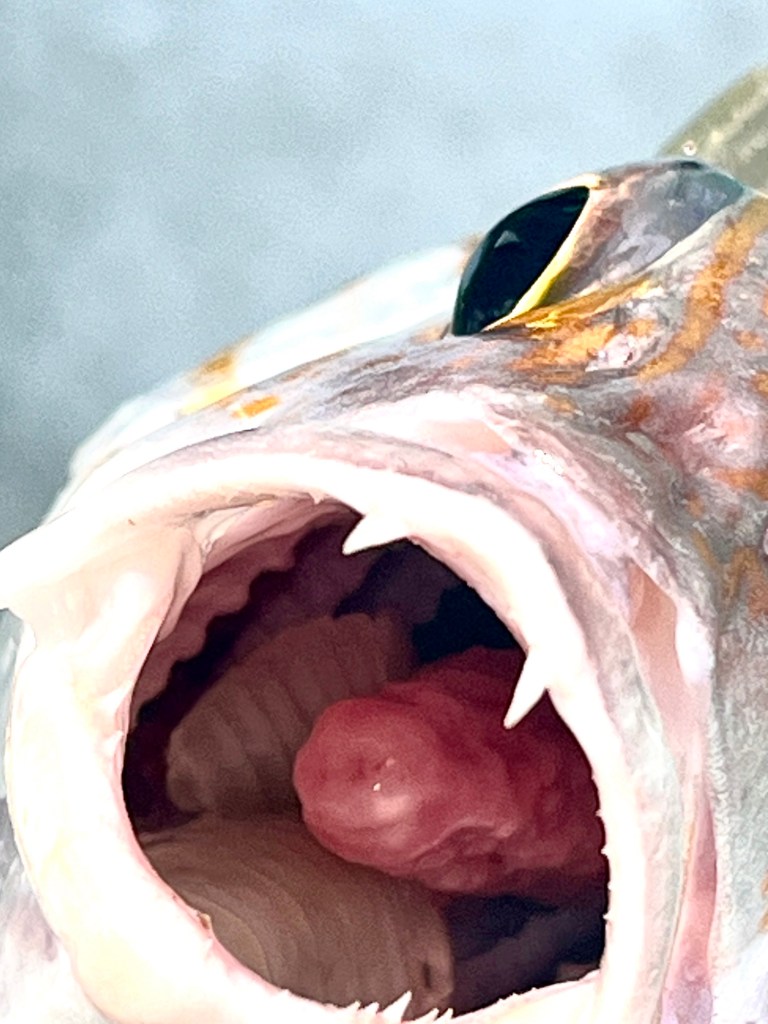
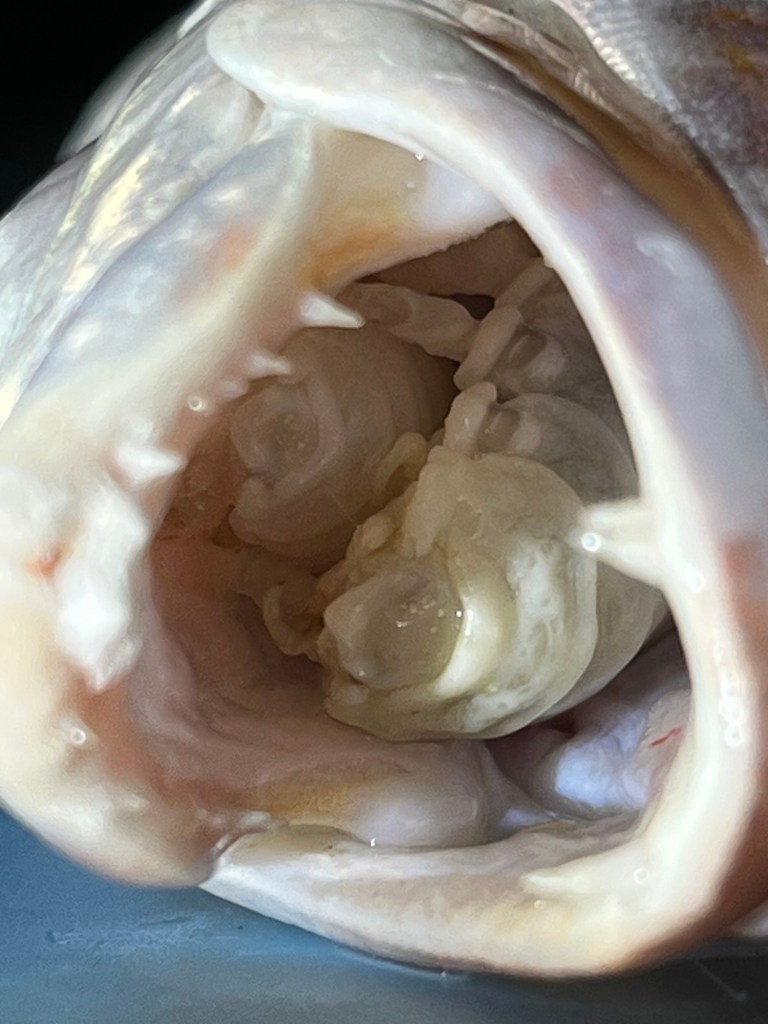
A disturbing yet fascinating discovery was the Tongue-Eating Louse (Cymothoa exigua), I mean lice, as there were two of them in the mouth of a Spanish Flag Snapper, caught by my ex-colleague, Marvin.
Inside the mouth of a Spanish flag snapper, two tongue-eating lice have yet attached themselvesWhen I reached home, the two lice have found its rightful place on the tongue.
Behaviours & Appearances of the Parasitic Isopods
During their juvenile stage, these isopods swim freely in the ocean before attaching themselves to fish. They then crawl into the fish’s mouth through the gills and make their way to the tongue, where they anchor themselves using their sharp claws. This clever manoeuvre cuts off blood circulation to the tongue, causing the tongue to eventually experience necrosis.
But that’s not the most astonishing part – the parasite then positions itself as a replacement tongue, essentially becoming a functional part of the fish’s anatomy. It survives by feeding on the host’s blood and mucus.
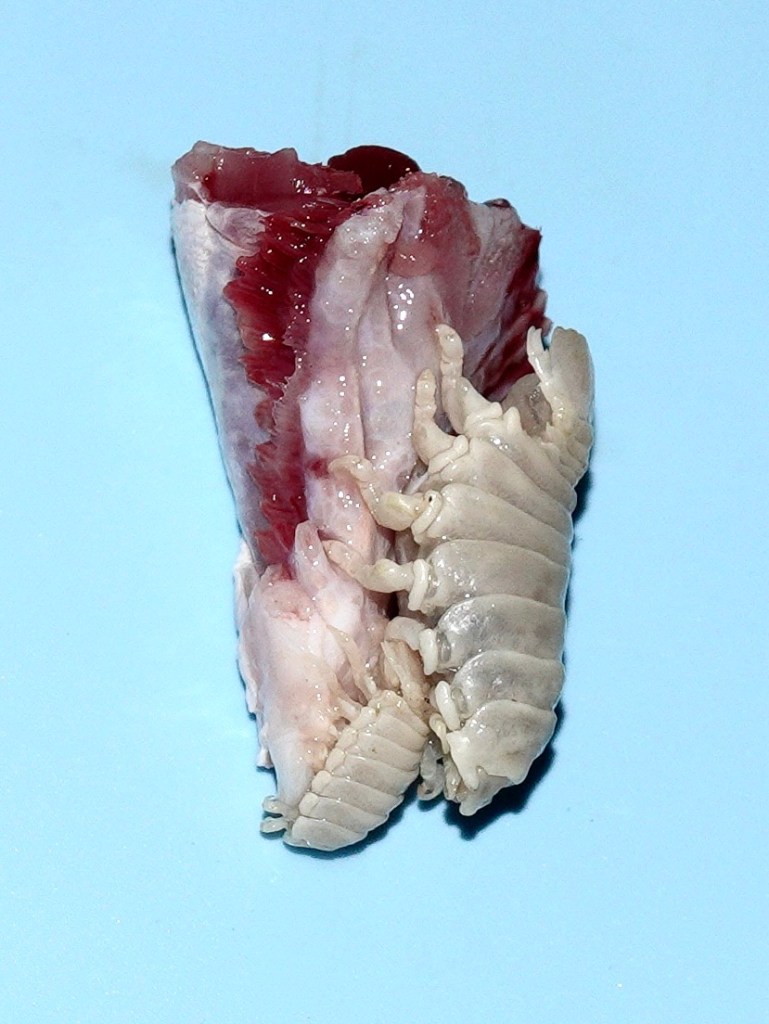
The photograph above shows two tongue-eating lice, with the larger female (approximately 20mm) taking center stage and the smaller male (about 8mm) positioned behind and slightly underneath her. Apparently, they are protandrous hermaphrodites as they begin their lives as males and mature into females. Thus, it is safe to deduce that the smaller one is not just smaller in size but younger in age as well.
As I cleaned and prepared the fish for freezing, I carefully extracted the tongue, which still had the two isopods attached. Despite my best efforts, I couldn’t separate them from the tongue, as their multiple pairs of legs were tightly lodged in place. What struck me as remarkable was that, even after being out of water for over 6 hours, the isopods were still alive and moving. This raised an intriguing question: are these tiny creatures capable of breathing air?
After gutting the fish, I removed the tongue and saw the two isopods in this particular position.Observe the back of the female. Looks like part of the body structure that allows the isopods to swim through the water. Does anyone have more information about the anatomy of this isopod crustacean?
As much as they are scary-looking creatures, these parasites do not really kill their hosts and often the latter will outlive the parasites. Nevertheless, the host may be slightly malnourished.
The host where the tongue-destroyers lived looks thinner than my usual catch of Spanish Flag Snappers.The underside of the two parasites. How many pairs of legs can you see?
After I have preserved the parasites in a bottle of 70% alcohol, the bigger female started having babies floating around. So it wasn’t bloated. It was pregnant!
Ewwwww… Goosebumps!
I’ve spent what feels like an eternity observing these two creatures, all in the pursuit of accurately documenting their behaviours and appearances. Despite being an insect enthusiast – I even keep terrestrial isopods as pets – there’s something about these particular creatures that sends shivers down my spine and leaves me covered in goosebumps.
And so, our journey into the bizarre world of tongue-eating lice comes to an end. But if you’re ready for more adventures into the uncharted territories of Earth’s biodiversity, be sure to follow birdbrain blog for a wild ride. From the fascinating to the frightening, we’ll explore it all – so, buckle up and join us, but be warned: not all of our discoveries will be for the faint of heart!
My fascination with seashore creatures began in my childhood, rooted in frequent visits to Pasir Ris beach with my father in the 1980s and 1990s. His mother and sister lived nearby, giving us the perfect excuse to explore this coastal haven.
Those trips left indelible memories:
The elusive mudskippers, tiny and impossibly quick, always evading our grasp
Baby squids, their defense mechanism on full display as they turned white after expelling their ink (a stress response to our curious prodding)
Black Eeltail catfish (Plotosus canius), camouflaged among the ‘sea litter’ – dried leaves, seaweed and even rubbish, waiting to be discovered. Dad warned us against the venomous spines.
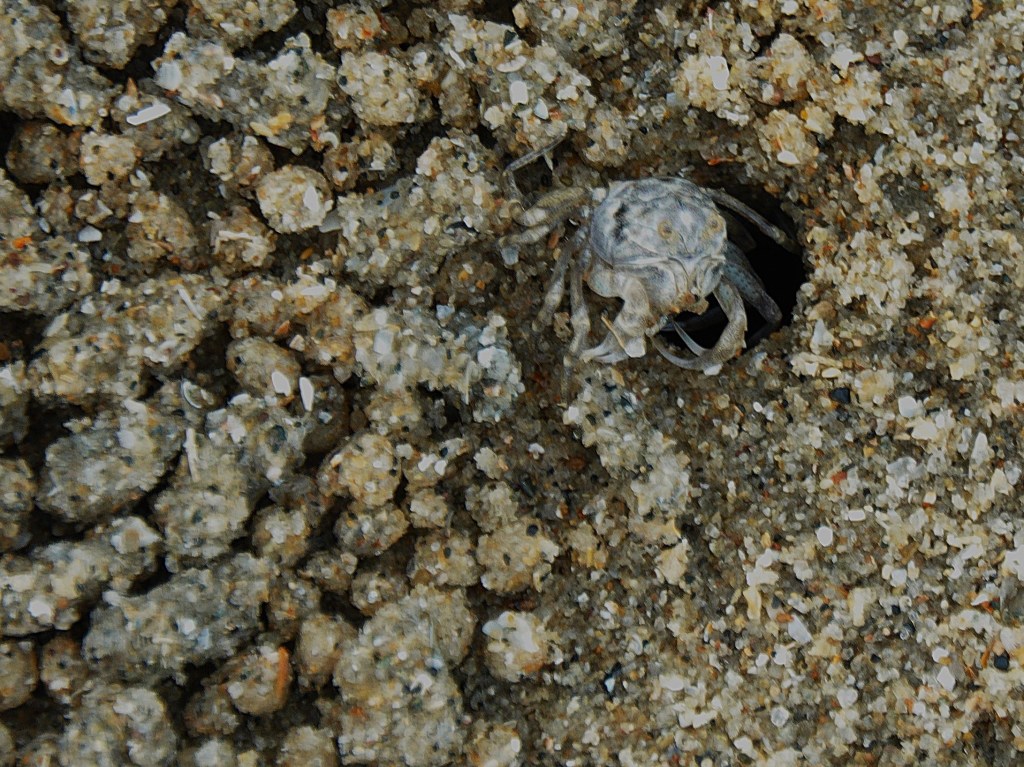
The harmless Sand Bubbler Crabs (Scopimera and Dotilla spp.), which left holes on the sandy beaches.
A Sand Bubbler Crab filtering for food from the balls of sand.
Armed with the beloved $5 guidebook – “A Guide to Seashore Life” published by the Singapore Science Centre – I embarked on a journey of discovery. This pocket-sized treasure trove became my trusted companion, helping me decipher the identities of various sea creatures.
In those carefree days, our curiosity often led us to capture fascinating marine creatures and bring them home. Sadly, most perished within days, with only the hardy catfish surviving for months. Looking back with regret, it’s striking how different our mindset and approach were then:
• Wildlife conservation wasn’t yet a widespread concept • Our interactions with nature were driven primarily by personal curiosity and fun • We didn’t fully grasp the impact of removing creatures from their natural habitats
This reflection serves as a poignant reminder of how our understanding and relationship with nature have evolved. While those experiences sparked a lifelong interest in marine life, they also highlight the importance of conservation and responsible interaction with ecosystems.
A Return to the Shore: Guided Intertidal Walk at Changi Beach
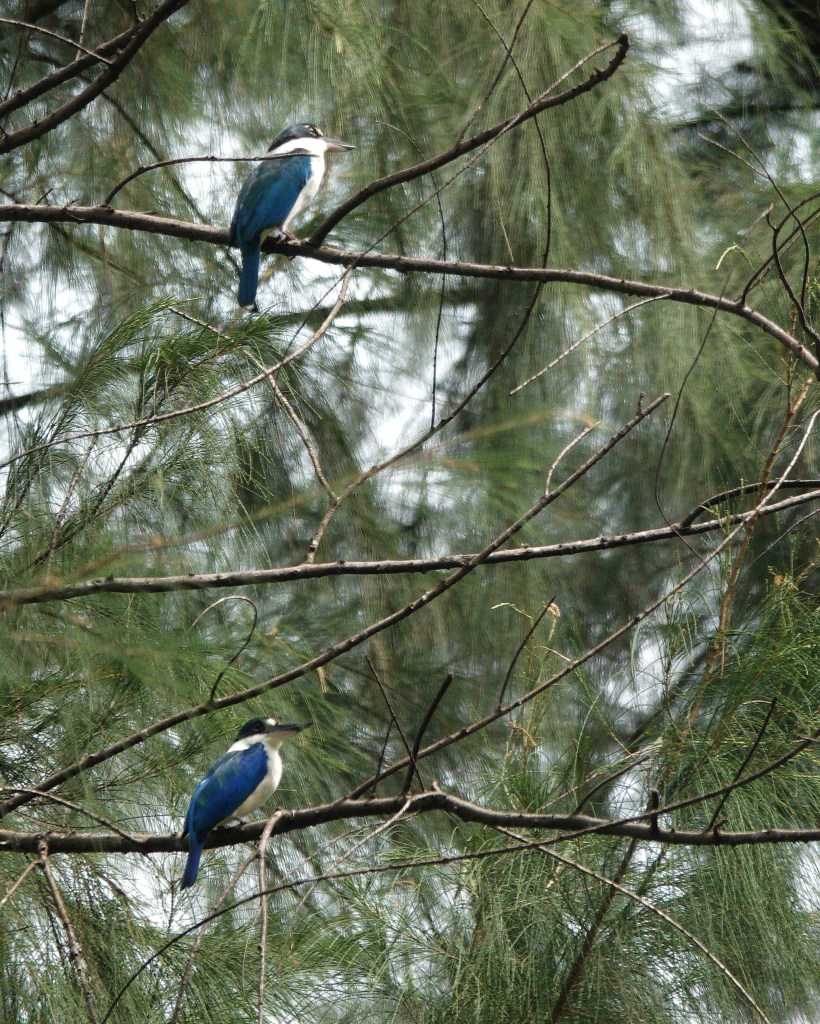
Fast forward to last week, and I found myself embarking on my first guided intertidal walk. Organised by “Just Keep Thinking” and led by the renowned MJ Biogal, this excursion took place at Changi Beach, right beside the Ferry Terminal to Pulau Tekong. Arriving early, my friend and I seized the opportunity for some impromptu bird watching. We spotted White-Bellied Sea Eagles, Long-Tailed Parakeets, and Collared Kingfishers, along with the Common Mynas, Javan Mynas and House Crows.
White-Bellied Sea Eagle (Icthyophaga leucogaster) Clutches a Catfish in its TalonsA pair of collared kingfishers (Todiramphus chloris) perched on the Casuarina tree (Casuarina equisetifolia)
MJ Biogal, our guide, proved to be a passionate advocate for environmental conservation, truly walking the talk. Her approach to the intertidal walk was a stark contrast to my childhood experiences. She enforced firm guidelines, prohibiting the digging out of creatures and touching, especially venomous species like fire worms and bristle worms. Throughout the walk, MJ actively educated the public, reminding other beachgoers to leave creatures undisturbed.
MJ Biogal with one of her fans.
During the Covid-19 pandemic in 2021, MJ raised awareness about the mistreatment of marine life, notably calling out those skewering through Sand Dollars (Clypeasteroida), like meat chunks on a satay stick, killing them right in front of her eyes. It was a powerful reminder of the need to balance our curiosity with respect for marine life and their habitats and there is a lot more to be done to educate the public.
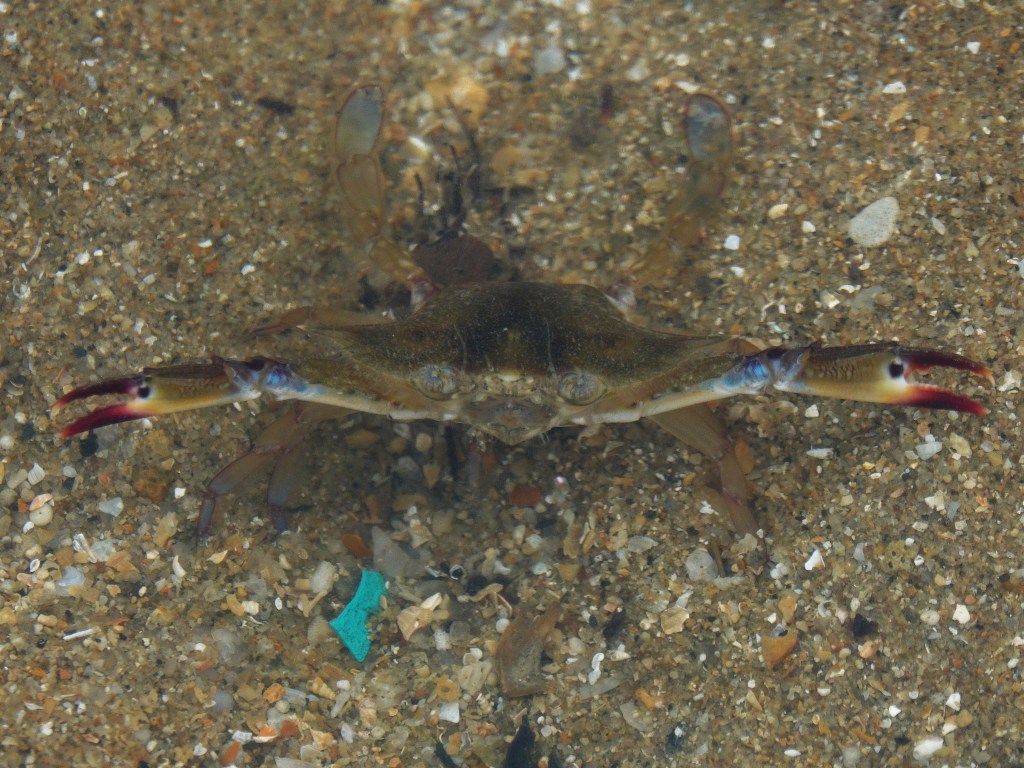
During our guided walk, our group of 36 was divided into smaller clusters, each led by an experienced guide. I found myself in a group led by Jerryl, an avid diver with aspirations of becoming a marine biologist. Our exploration began with a molted flower crab shell. When a young boy in our group mistook it for a dead crab, Jerryl seized the opportunity for an impromptu learning session.
Defensive Dance: A Flower Crab (Portunus pelagicus) Raises Its Claws in a Bold Stand-off
Using engaging questioning techniques, Jerryl sparked curiosity among the group, particularly exciting two enthusiastic boys. “What are the tell-tale signs that this isn’t a dead crab?” he asked, encouraging critical thinking and observation. This interactive approach not only corrected misconceptions but also kindled a deeper interest in marine life among the participants.
As we gathered around, Jerryl revealed the fascinating details that distinguish a molted shell from a dead crab:
The Missing Eyes: In a freshly dead crab, the eyes are still visible. However, on a molted shell, you won’t find any eyes. This absence is a clear sign that what we’re looking at is just the discarded outer layer of the crab.
The Gap: A key indicator is the noticeable gap between the molt. This separation occurs as the crab sheds its old exoskeleton to grow.
Tidal Retreat: Anemone’s Tentacles Withdraw as Waters Recede
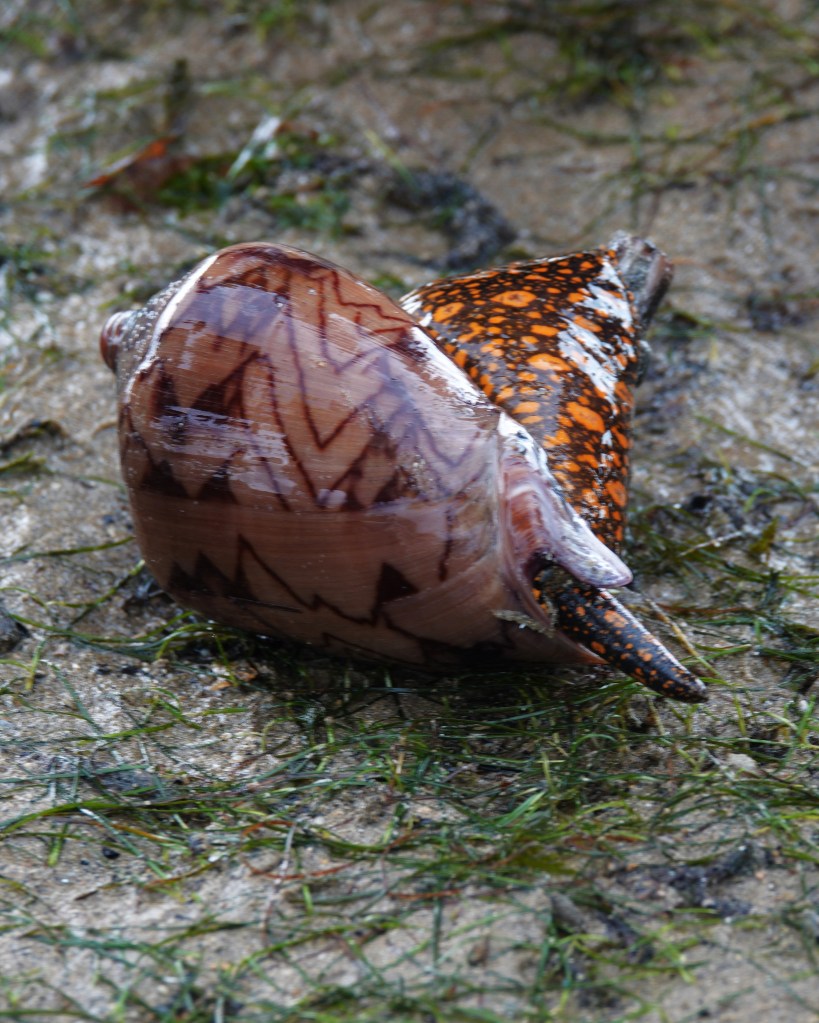
Our first ‘wow’ moment arrived with the discovery of a large hermit crab, snugly ensconced in the shell of a Noble Volute (Cymbiola nobilis). The sight initially sent a jolt of excitement through me, as I mistook the shell for that of the venomous cone snail, infamous for its harpoon-like shooting mechanism. Moments later, another guide brought us a live Noble Volute! It was the prettiest thing I have seen that day. This is a large carnivorous snail that used to be hunted for its beautiful shell and even its edible flesh.
The colours and patterns on the Noble Volute change daily due to the pigment cells constantly infecting its neighbouring cells
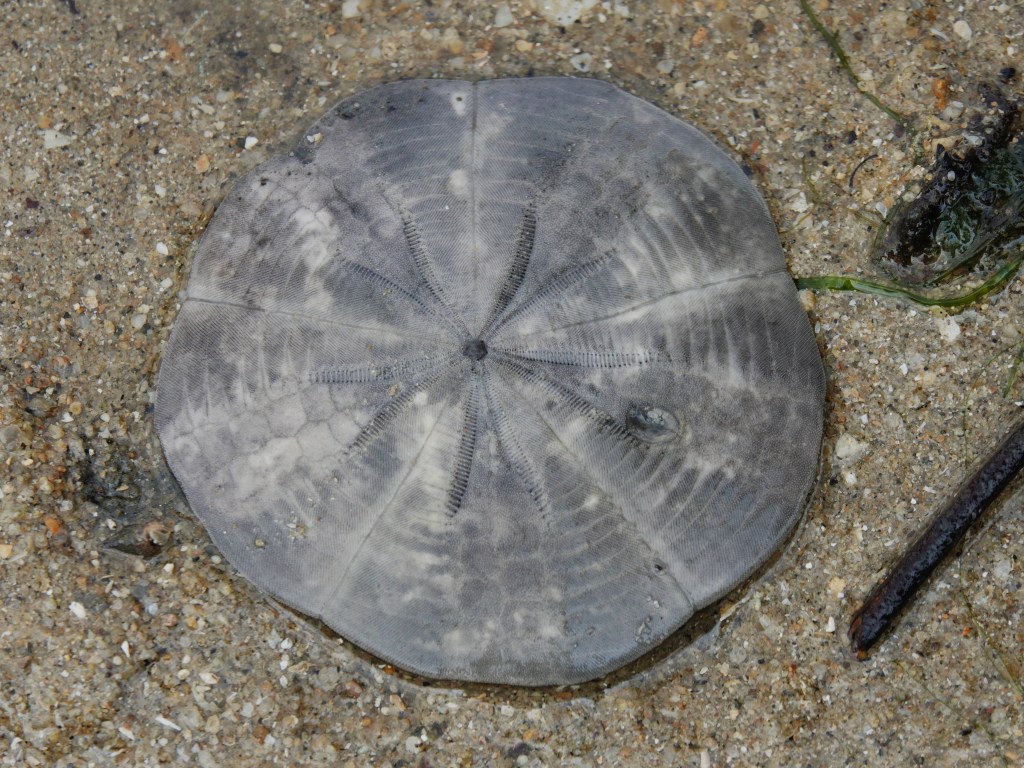
Our exploration led us to a fascinating discovery: Cake Sand Dollars (Arachnoides placenta). It was hard to believe these peculiar discs were living animals. Jerryl, our knowledgeable guide, turned this find into an engaging guessing game, challenging us to identify the top and bottom sides of these flat, clayey-looking creatures.
After a few attempts, Jerryl revealed the secret: the top side typically displays a subtle ‘flower pattern’ and is slightly convex, while the bottom side prominently showcases the pentaradial symmetry characteristic of most echinoderms (a group including sea cucumbers, sea stars, and sea urchins).
Jerryl’s sharing sparked my curiosity, leading me to further research. I learnt that the sand dollar’s unique disc-like shape is an evolutionary adaptation, optimised for efficiently consuming detritus on the ocean floor. It has tube feet on both surfaces to help breathe, navigate and feed.
Anatomy Unveiled: The middle hole is its central mouth on its underside (oral side). Guess where is its anus? It is right at the 10-11’o clock position near the edge.The top side (also known as the petaloid) with the flower petal pattern.
Written by Lucas
Midway through our guided tour, a heavy downpour forced us to seek shelter, despite the absence of lightning risk. We prioritised the well-being of the many young children in our group, not wanting them to catch a cold. Fortunately, it was merely a passing shower, and as we resumed our walk around the intertidal zone, we were greeted with a beautiful rainbow as our backdrop. This natural spectacle added an extra layer of wonder to our already fascinating excursion.
Police boat patrolling between Pulau Tekong and Changi against the colourful backdrop.
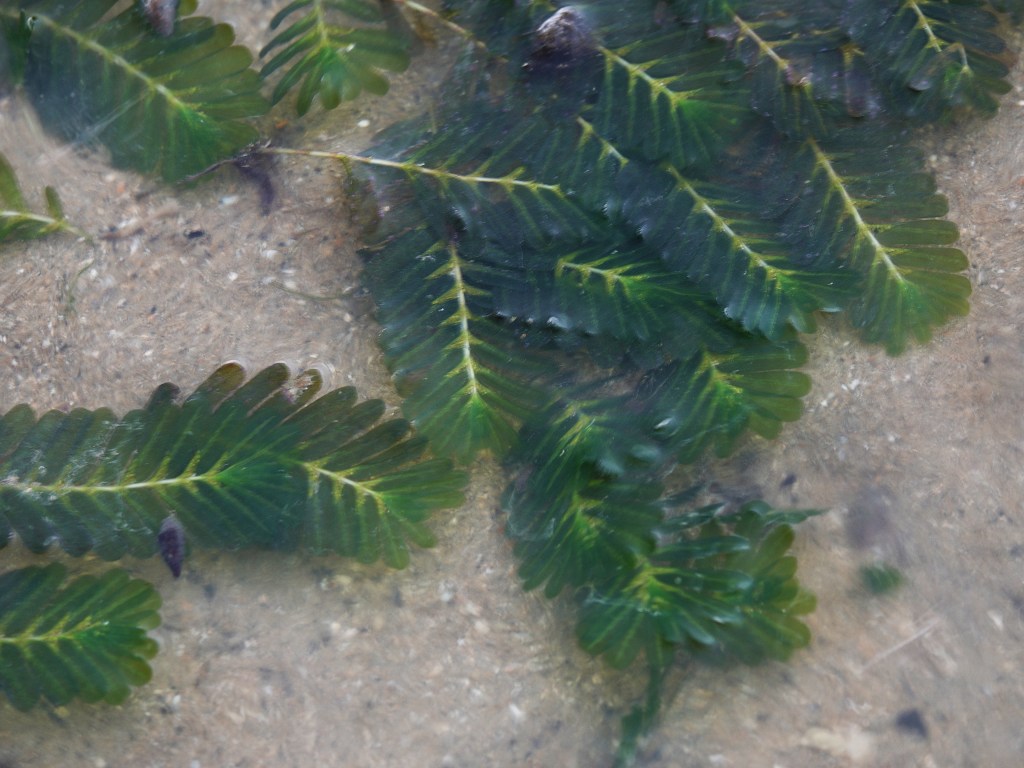
As a plant enthusiast, I found myself drawn to the seagrasses, particularly a species resembling a cross between mimosa and fern – aptly named fern seagrass (Halophila spinulosa). Unlike seaweed, these are true flowering plants that produce fruits. They form a crucial ecosystem, serving as the primary habitat and food source for dugongs. I look forward to capturing photographs of these fascinating plants’ various features during my next solo intertidal walk.
Fern seagrass with snails grazing on it.
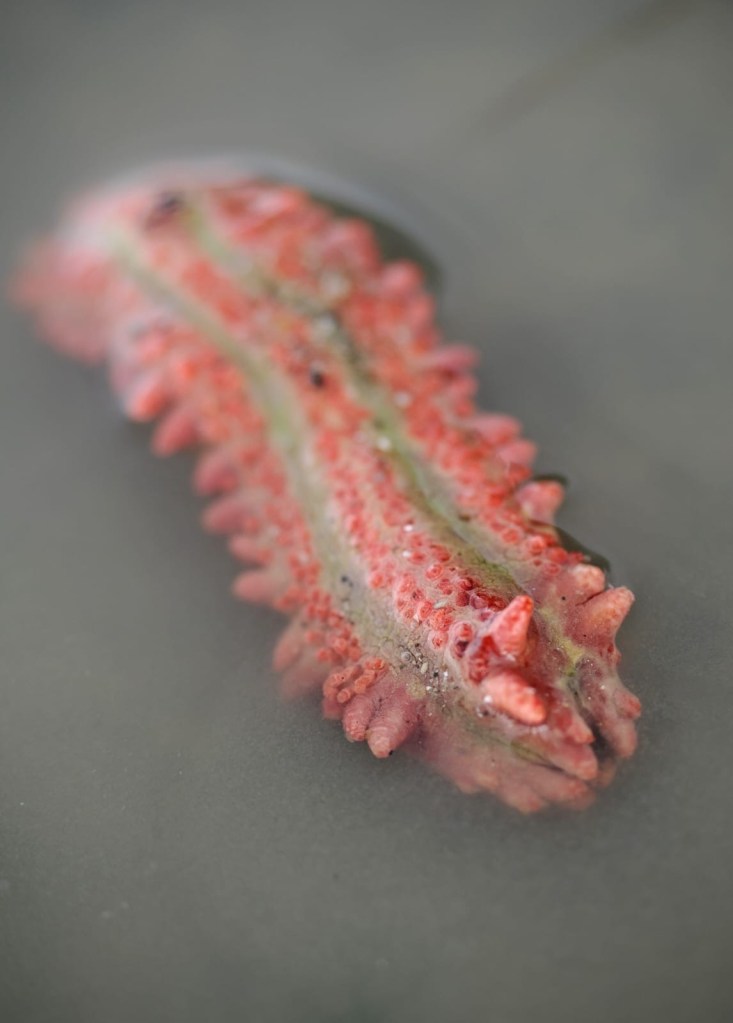
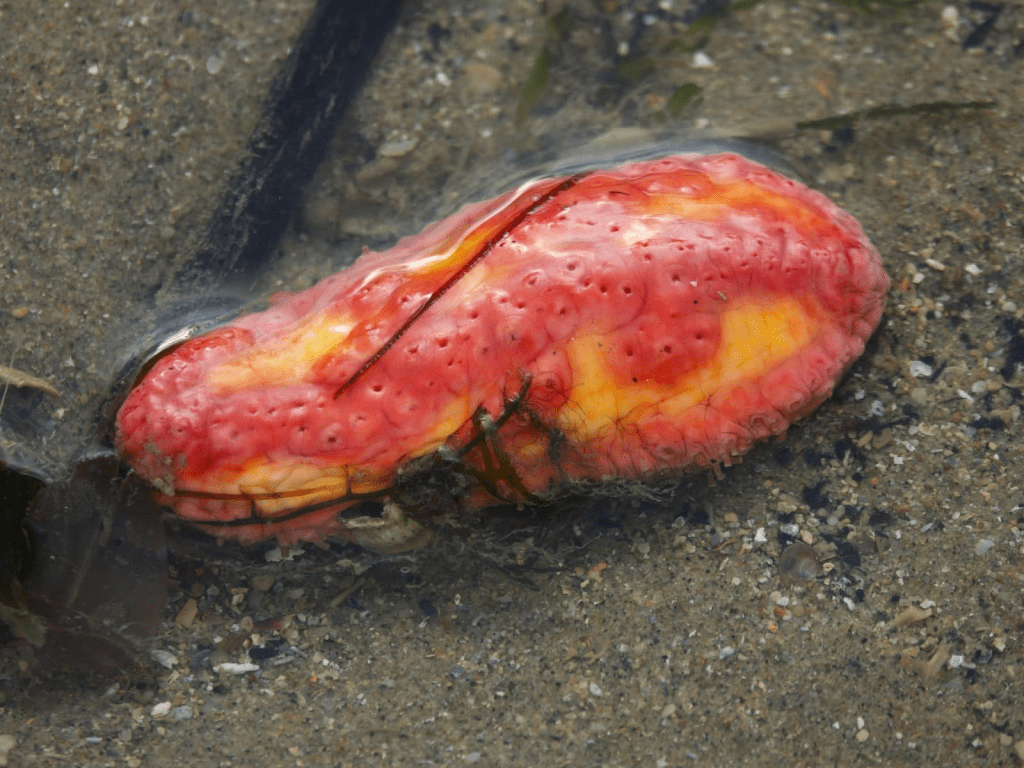
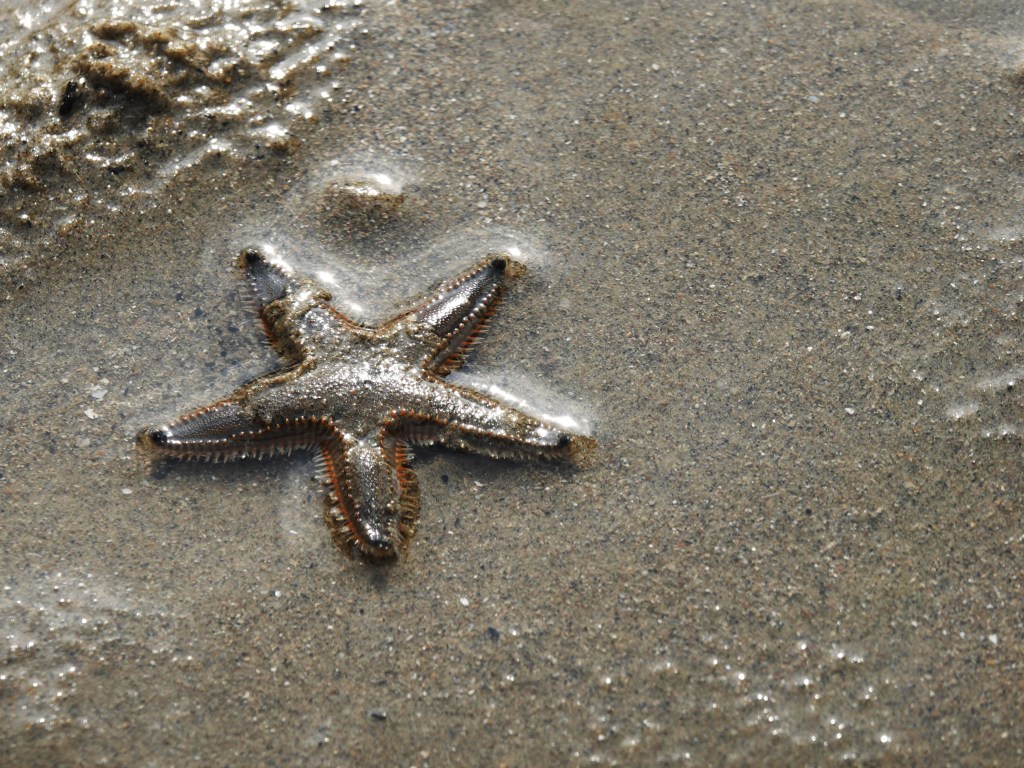
Our exploration revealed three more fascinating creatures exhibiting pentaradial symmetry: the thorny sea cucumber (Colochirus quadrangularis), the pink warty sea cucumber (Cercodemas anceps), and the plain sand star (Astropecten indicus). Both sea cucumber species display a remarkable feeding process, extending their vibrant tentacles from one end while expelling waste from their anus at the opposite end. In stark contrast, the sand star’s muted appearance likely aids in camouflage. This intriguing difference sparked curiosity about how the more flamboyant sea cucumbers manage to conceal themselves in this dynamic environment. Hmm… By aposematism?
Thorny Sea Cucumber Often Mistaken for Its Pink Warty CousinPink Warty Sea Cucumber with its psychedelic looksIn contrast, the plain looking Plain Sea Star
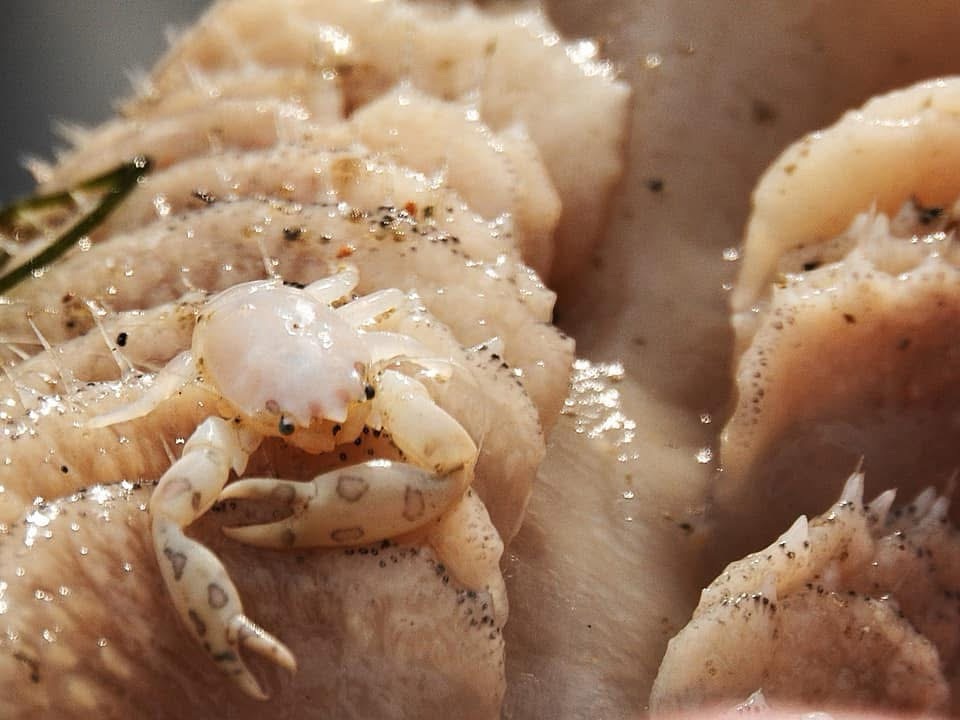
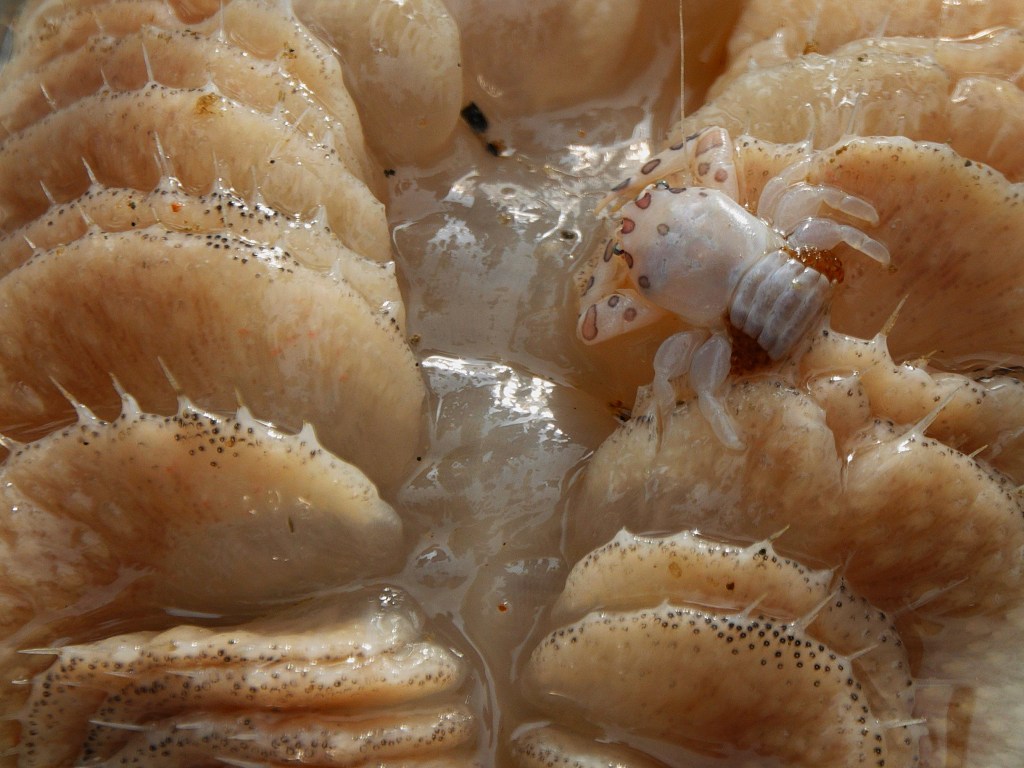
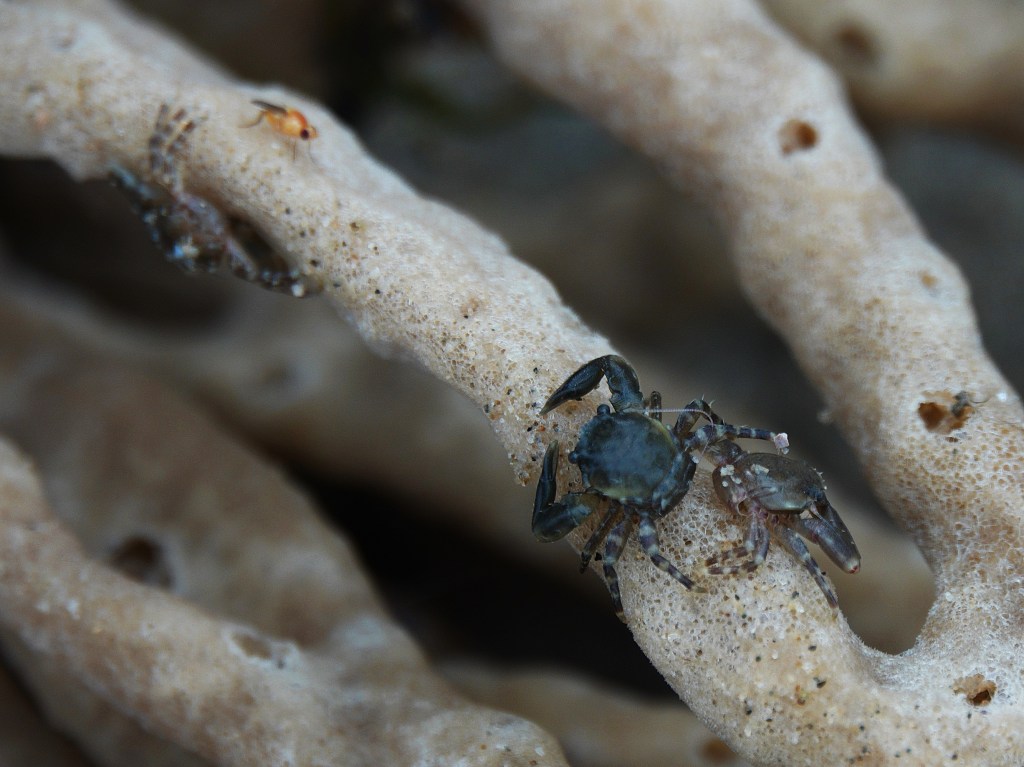
Living organisms like sea pens and sea sponges serve as vibrant habitats for a diverse array of marine life. One of our guides made an exciting discovery: a Spiky Sea Pen hosting two Painted Porcelain Crabs (one of which is carrying a load of eggs), showcasing the intricate relationships within these miniature ecosystems. We also had the opportunity to examine what appeared to be a lifeless sea sponge, yet it was teeming with life, including a brittle star, snails and several tiny crabs. These encounters highlighted the complex interdependencies within marine communities and the importance of seemingly simple organisms in supporting biodiversity.
A female Painted Porcelain Crab on a Spiky Sea Pen. Unidentified tiny crabs on the sea sponge.
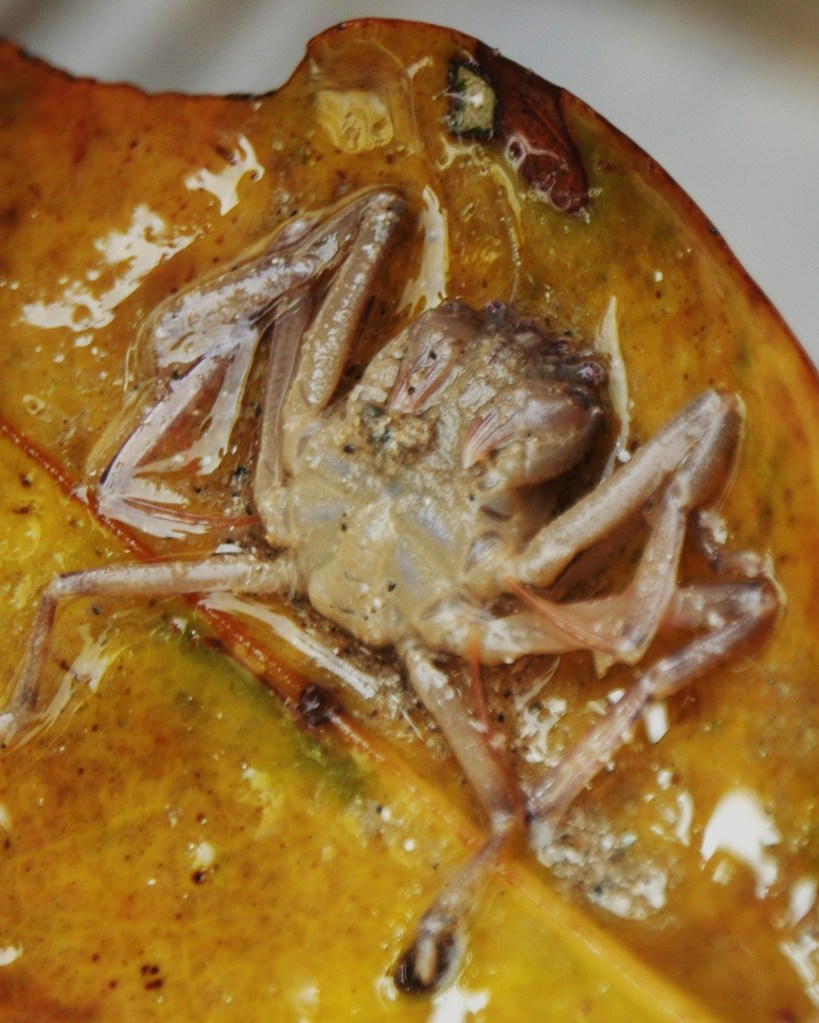
One of the most peculiar crustaceans I encountered, which evoked memories from the seashore life guidebook, was the Leaf Porter Crab (Family Dorippidae). This fascinating creature appears remarkably flat, including its pincers and legs. What makes it truly intriguing is its adaptive behavior: at night, it perches atop floating leaves, taking advantage of the darkness to evade predators from above. During daylight hours, it cleverly conceals itself beneath these same floating leaves, demonstrating a remarkable survival strategy in its marine habitat.
“I surrender!” – This particular image appears to depict someone cornered against a wall.
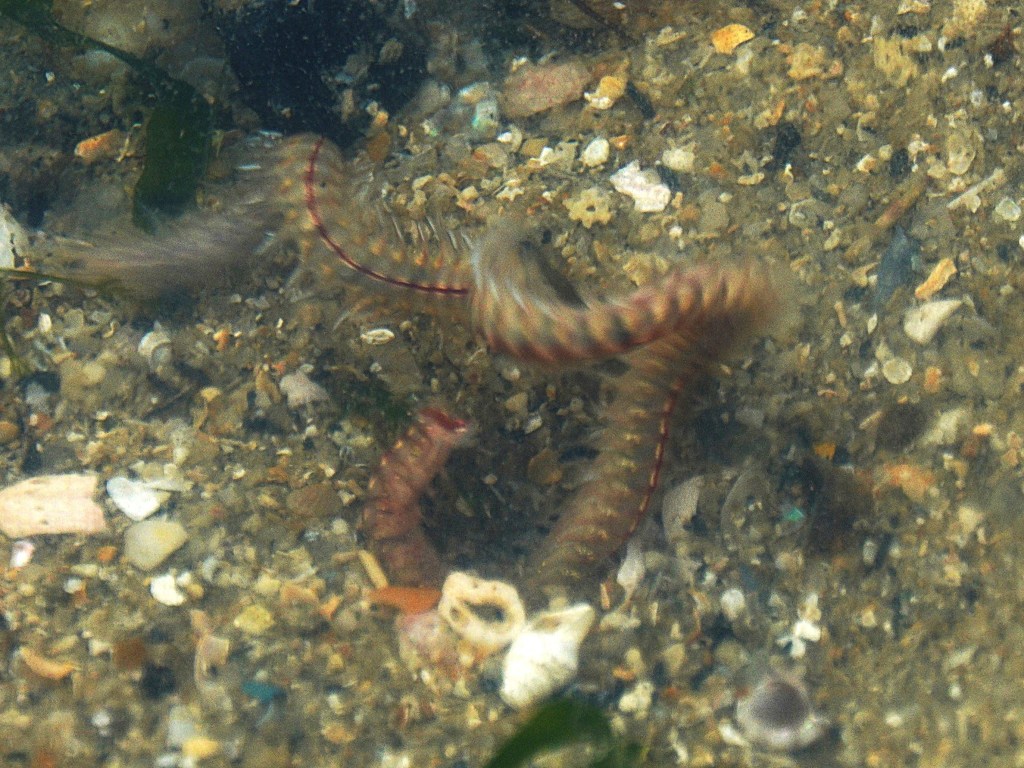
During our exploration, a participant noticed a worm-like creature in a small tidepool, prompting our guide to issue a stern warning against touching any such organisms. Although the guide didn’t identify the species, it bore a striking resemblance to a bristle worm. While this particular specimen appeared to have been decapitated, bristle worms are renowned for their remarkable regenerative abilities, often capable of regrowing body parts lost to predators – including, astonishingly, their heads!
Bristle worms are traditionally used as bait for fishing.
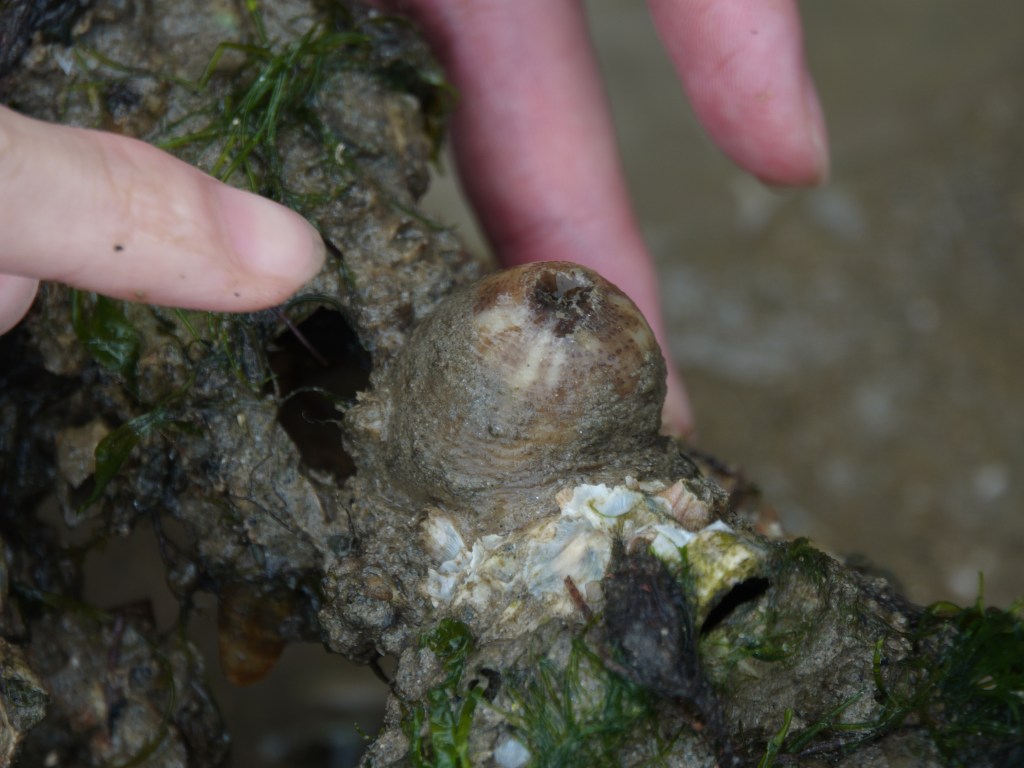
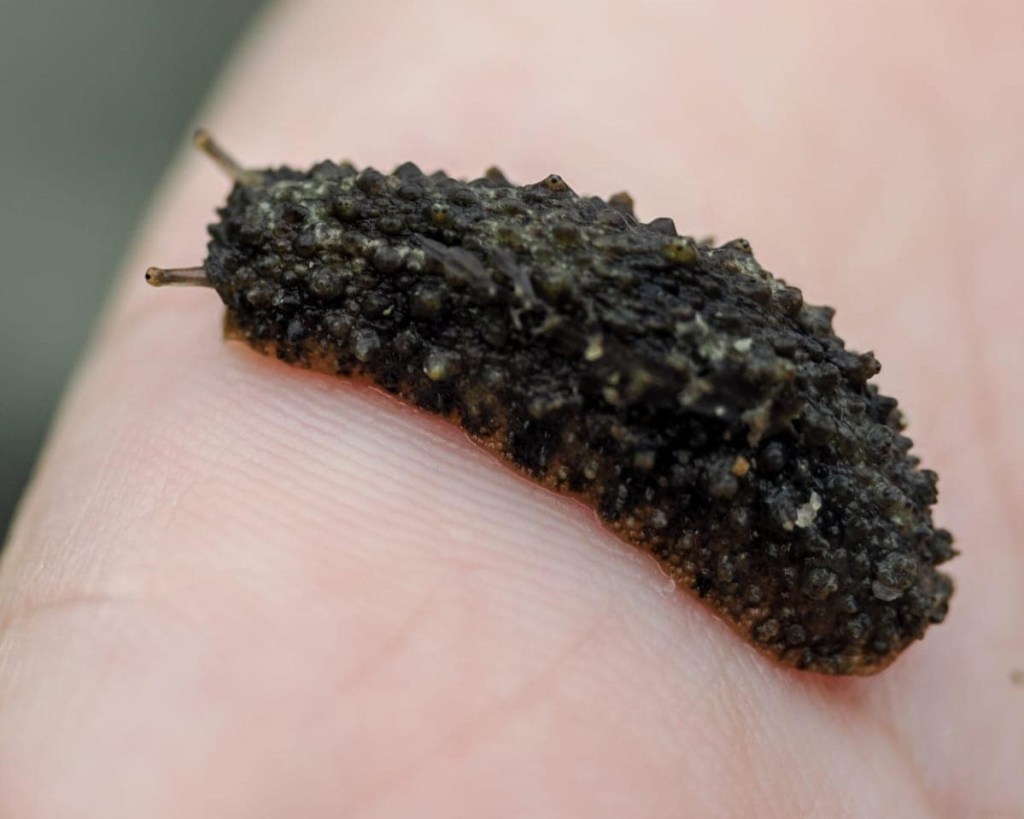
As we approached the canal area where our drainage system discharges, we encountered a vibrant ecosystem thriving on the walls. Algae, barnacles, and periwinkle snails adorned both sides. Jerryl, our guide, picked up some small black objects and offered to place them on our palms. Initially mistaking them for limpets, I was surprised to learn they were Onch Slugs (Family Onchidiidae), grazing on the algae. As one rested on my palm, it began leaving a trail of mucus and excrement while observing me with its distinctive elongated eyes, providing an unexpectedly intimate encounter with these fascinating intertidal creatures.
Onch slugs that breathe air unlike nudibranch (sea slugs)
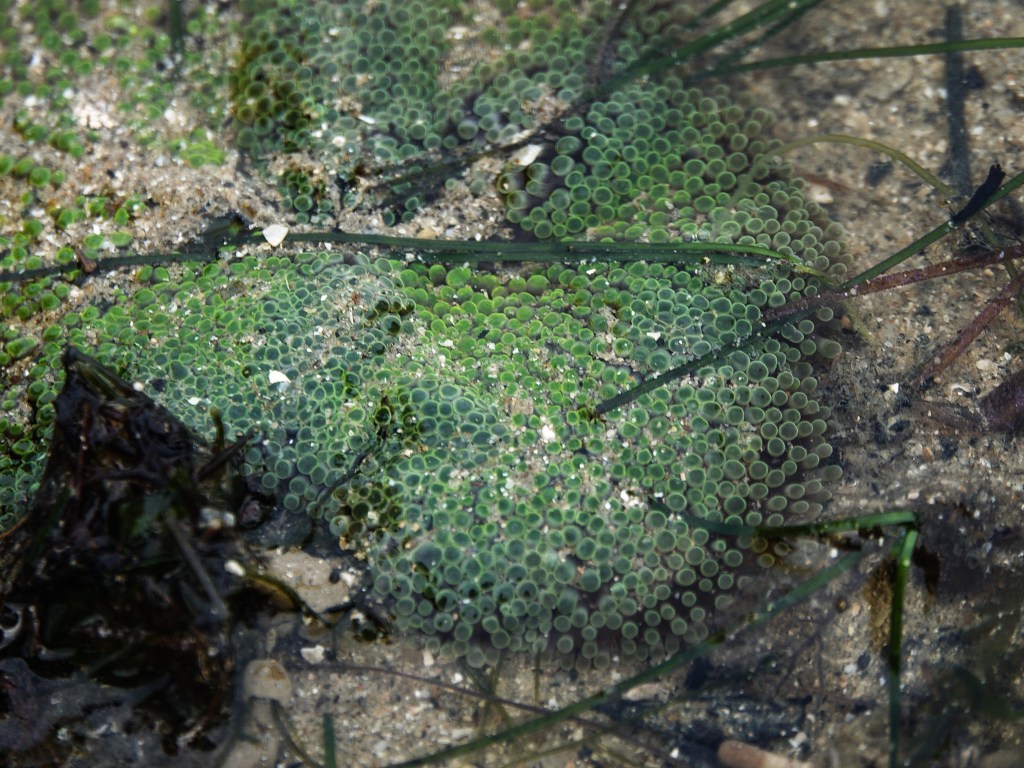
As our guided walk neared its conclusion, we encountered a stunning carpet anemone, its vibrant green hue catching our eyes. Jerryl, our knowledgeable guide, encouraged us to gently touch its stinging tentacles, explaining that the subtle suction we felt was due to a small amount of toxin being released onto our skin. This fascinating experience piqued my curiosity about the various types of carpet anemones and the miniature marine life that might be dwelling among their tentacles.
Apparently, a specific type of carpet anemone may have different kinds of colours
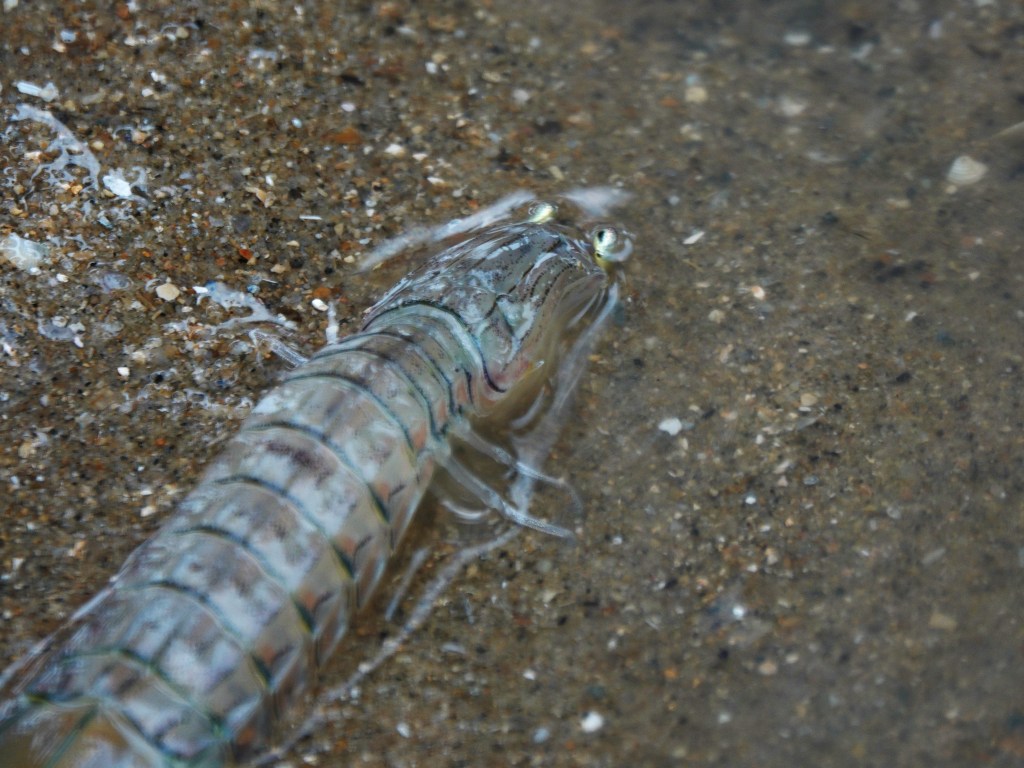
Our excursion concluded with a spectacular sighting: a Spearer Mantis Shrimp (Family Squillidae), spotted by my friend. The creature’s striking appearance drew eager participants who were tempted to touch it. However, our vigilant guides swiftly intervened, warning against such interaction.
Spearer Mantis Shrimp as opposed to the Smasher Mantis Shrimp
The excursion concluded on a high note with a group photograph featuring MJ and her expert guides. As a delightful parting gift, MJ distributed cutesy, beautifully-illustrated stickers to all participants. These stickers depicted the various sea creatures we had encountered during our intertidal adventure, serving as both a memento and an educational tool to reinforce our newfound knowledge of the marine ecosystem.
Thank you MJ Biogal and the guides for such an enriching intertidal walk.