
Do you remember the Flappy Bird mobile phone game launched in 2013? The goal was to navigate a small bird through a series of obstacles, primarily green pipes reminiscent of those in Super Mario Bros. While this game was a simplified, virtual challenge, it inadvertently mirrors a real-world issue: the struggles of migratory birds in urban environments.
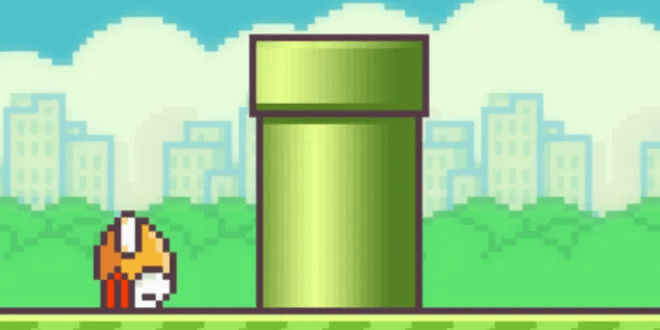
Migratory birds do face significant challenges while navigating Singapore’s urban landscape. These feathered visitors must contend with a complex maze of commercial skyscrapers, residential buildings (HDBs), bridges, and other man-made structures, reminiscent of the digital bird in Flappy Bird dodging obstacles. For example, in November 2023, a Peregrine falcon suffered a collision injury in Sengkang. Fortunately, it was successfully rehabilitated and subsequently released back into the wild (click here for the article).
Crest Secondary School – A Haven for Local Avian Wildlife
At my previous workplace, Crest Secondary School (a specialised school for students who are eligible for Posting Group 1), I earned the nickname ‘Birdman’ because of my love for birds. Whenever bird identification was needed, my colleagues would reach out to me.
The school boasts a spacious pond and a beautiful garden maintained by our beloved gardener, Auntie May, making it a haven for a diverse array of birds, both common urban dwellers and more exotic visitors. Beyond the usual Spotted and Zebra Doves, Javan and Common Mynas, Eurasian Tree Sparrows, House Crows, and Asian Glossy Starlings, the school compound has hosted a variety of other species.

Asian Koels frequent our mulberry tree, their distinctive calls often rivalling the school’s National Anthem in volume. Brown-Throated and Ornate Sunbirds are regular visitors to our ginger plants, while Collared Kingfishers can be spotted perched on the school roof, their calls resonating across the campus. Blue-Throated Bee-eaters adorn the rooftop antenna, and Rose-Ringed Parakeets feast on the fruits of our peacock flower shrubs. A resident Ashy Tailorbird adds its chirps to the chorus of student voices along the corridors.
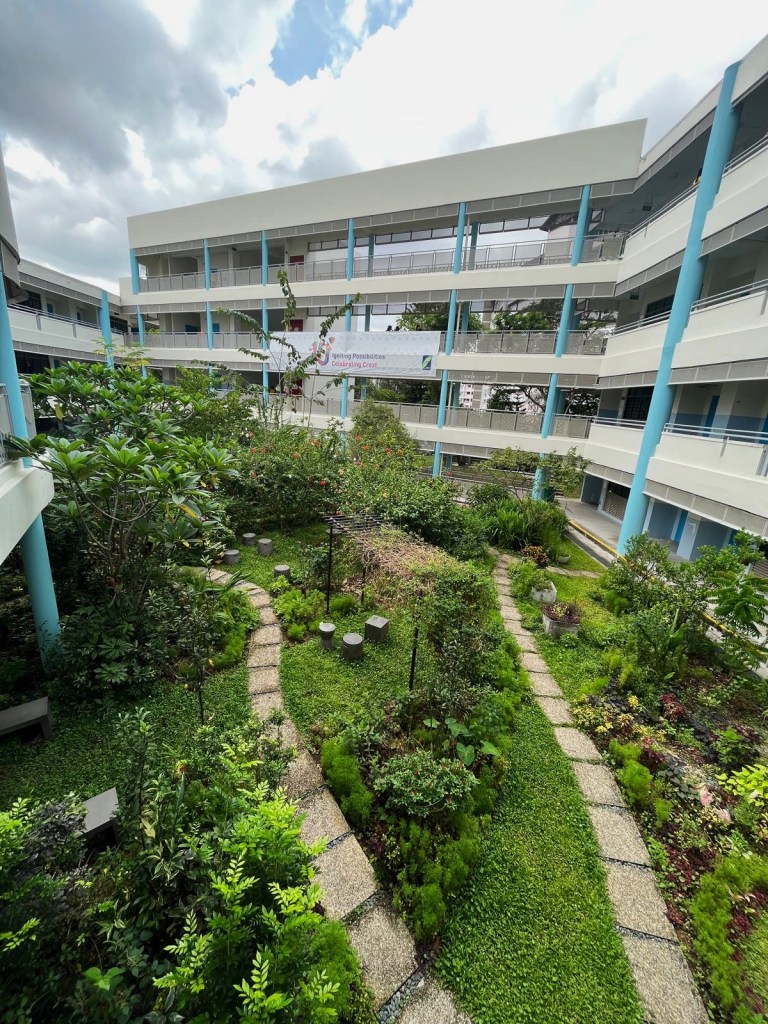
When mango season arrives, we’re treated to visits from Coconut Lorikeets and Blue-Crowned Hanging Parrots, eager to join the fruity feast near the school carpark. Even Smooth-Coated Otters have made appearances, though their visits to our eco-pond have sometimes left a few fish casualties.
During migratory seasons between September and March, the school becomes a temporary home to unexpected avian guests, further enriching our wildlife experience.
Blue-Winged Pitta Trapped in Butterfly Enclosure
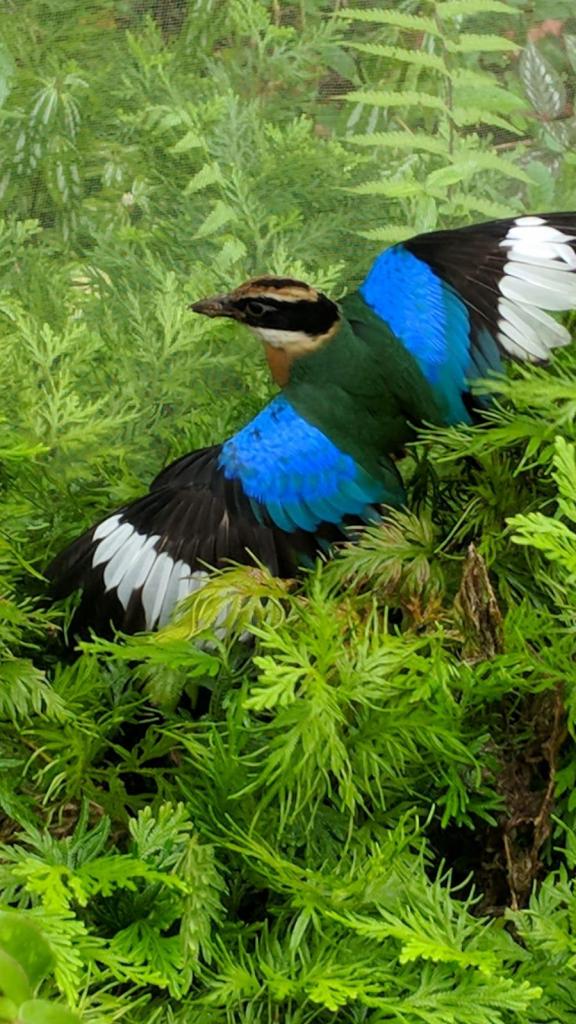
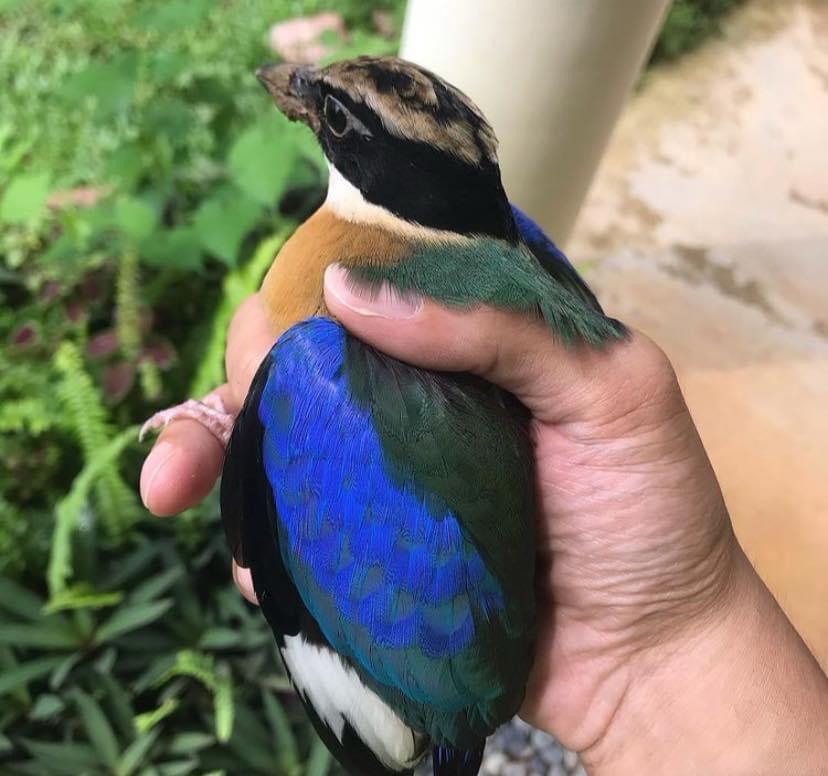
One such memorable incident occurred on 25th October 2018, involving a Blue-Winged Pitta (Pitta moluccensis). This migratory bird found itself in a series of misadventures on our school grounds. Initially, the Pitta had a close call when it collided with a classroom door while being chased by our resident cat. I intervened, shooing away the cat, and was relieved to see the Pitta, though startled, remain active and mobile. After that, I had to rush for lessons and couldn’t find time to attend to it. Later that afternoon, a colleague alerted me to the Pitta’s predicament – it had become trapped inside our Butterfly Enclosure, unable to find its way out.
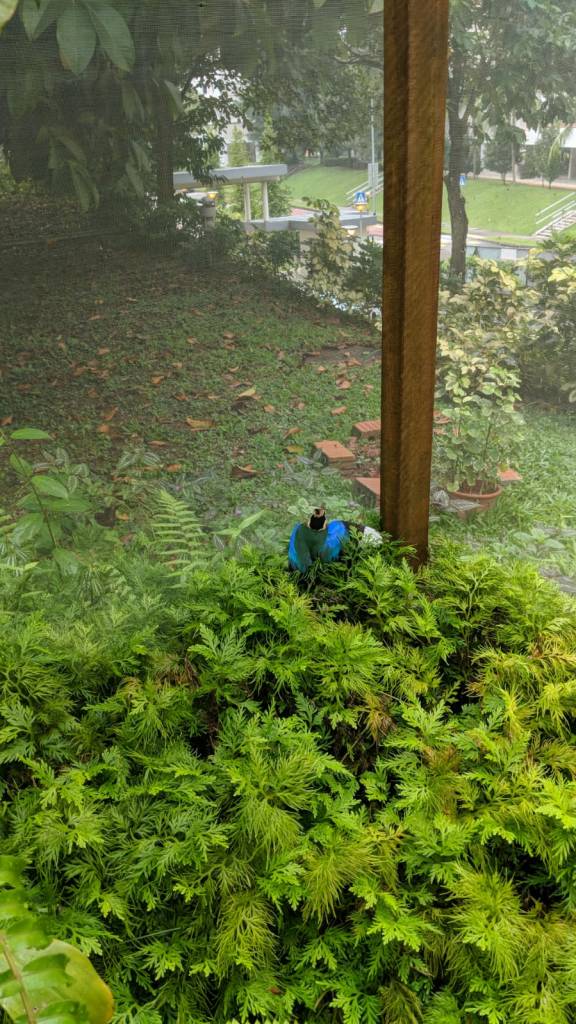
Recognising the urgency of the situation, I carefully removed the confused Pitta and placed it in a quiet box to recover from its stressful day. After allowing sufficient time for the bird to calm down, I chose a location for its release with great care. The school’s open field seemed ideal, offering ample space for take-off while being far from our resident cat. The latter consideration was particularly important, given the Pitta’s ground-feeding habits which make it vulnerable to feline predators. As I opened the box, the resilient Pitta took flight, disappearing into the distance – hopefully to find a safer temporary home on its migratory journey.
Black-Backed Dwarf Kingfisher Crashes into School
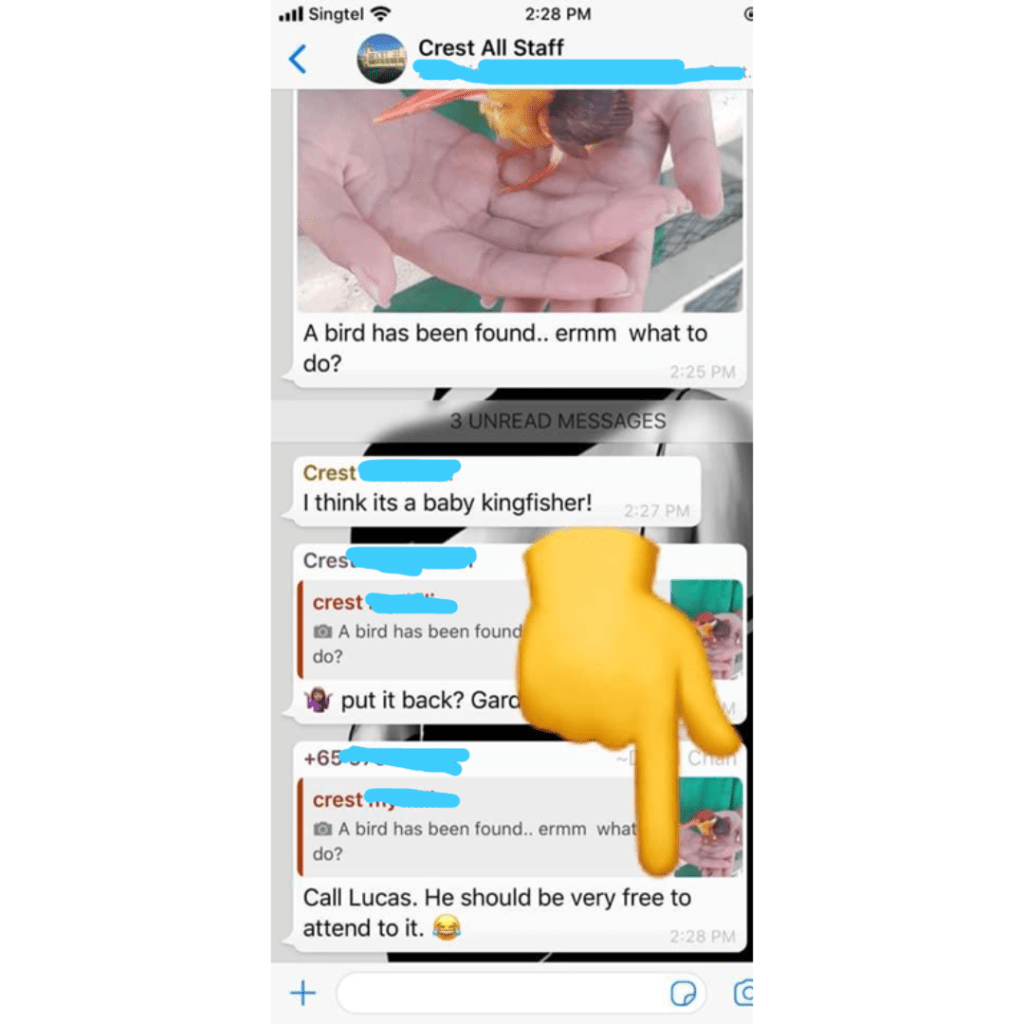
During my temporary absence from the school between 2019 and 2020, my reputation as the ‘Birdman’ lingered on. On one occasion, a colleague texted me about an exciting discovery: a Black-Backed Dwarf Kingfisher (formerly known as the Oriental Dwarf Kingfisher) had been found on school grounds. In the birding community, such a sighting would typically draw huge crowds eager to photograph this rare species, yet it had simply landed in Crest Secondary School. I simply advise them to contact ACRES (Animal Concerns Research and Education Society). The rare visitor was likely rescued and safely relocated as a result of this intervention.
Unexpected Classroom Visitor: A Sparrowhawk’s Misadventure
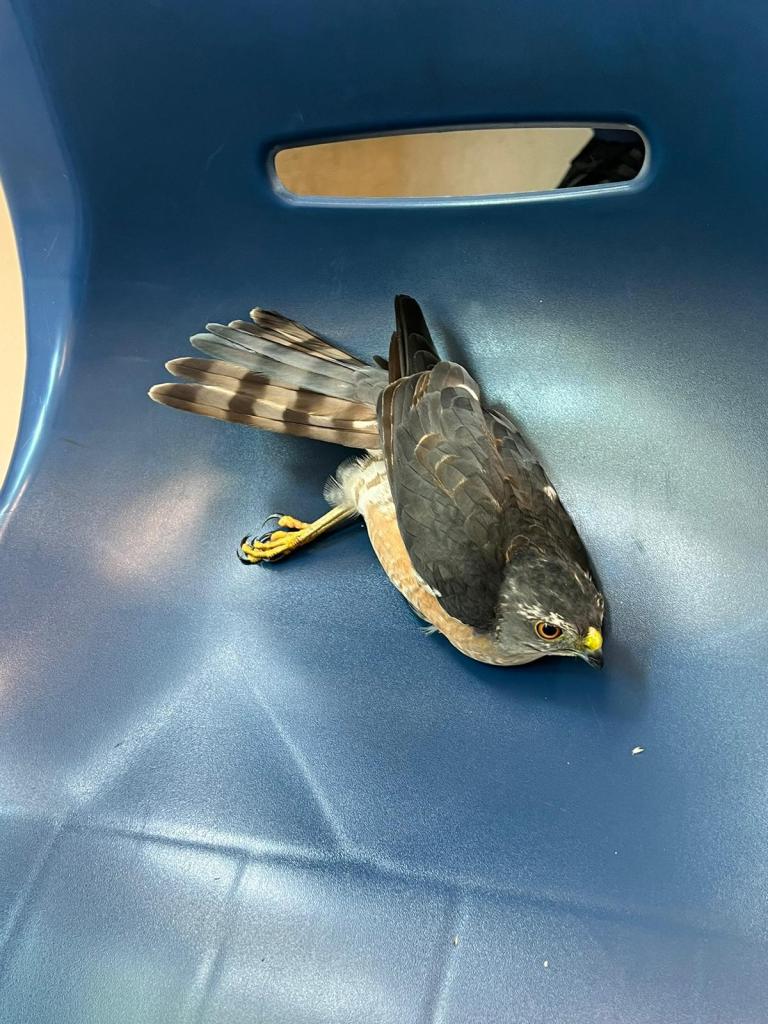
On 15th February 2023, a Sparrowhawk (ID-ed by Tou Jing Yi as a Japanese Sparrowhawk) – Tachyspiza gularis, flew into a classroom during a Mother Tongue lesson. The bird collided with a glass window pane and fell to the floor, where it lay stiff but still breathing. Following ACRES’ advice, I examined the bird for injuries and sent a video to ACRES via WhatsApp for further guidance.
I then placed the Sparrowhawk in a cardboard box, included a bottle of warm water to maintain a suitable temperature within the box in the air-conditioned room, and covered it with a towel, leaving a gap for air circulation. We monitored the bird’s condition, keeping in touch with ACRES, for 3-4 hours before attempting to release it in an open field. It took two attempts before the Sparrowhawk successfully flew off into the open sky.
Not All Survived: The Black Bittern’s Last Flight
While we had a fair share of successful releases, one particular incident still haunts me to this day.
It was an ordinary morning when I received a call from a colleague. “There’s a bird sprawled on the ground outside the administrative block,” they said, concern evident in their voice. I rushed to the scene, wondering if it was a spotted dove or a rock pigeon.
As I approached, I immediately recognised the distressed creature – a Black Bittern (Botaurus flavicollis), a relatively uncommon migrant in our urban landscape. The bird was struggling and clearly in distress. My instincts kicked in, and I prepared my usual tools: an empty printing paper cardboard box and a soft towel.
Cautiously, I began to approach the Bittern. As I drew near, the Bittern, spooked by my presence, mustered what seemed to be its last reserves of strength. In a desperate attempt to escape, it launched itself into the air. The bird, disoriented and weak, flew directly into the building’s wall and plummeted two storeys to the ground.
As I stood there, shocked and guilt-stricken, I noticed a faint imprint left on the wall – a poignant reminder of the Bittern’s final flight. Could I have approached differently? Should I have been quicker? These questions plagued my mind, but I knew dwelling on them wouldn’t change the outcome.
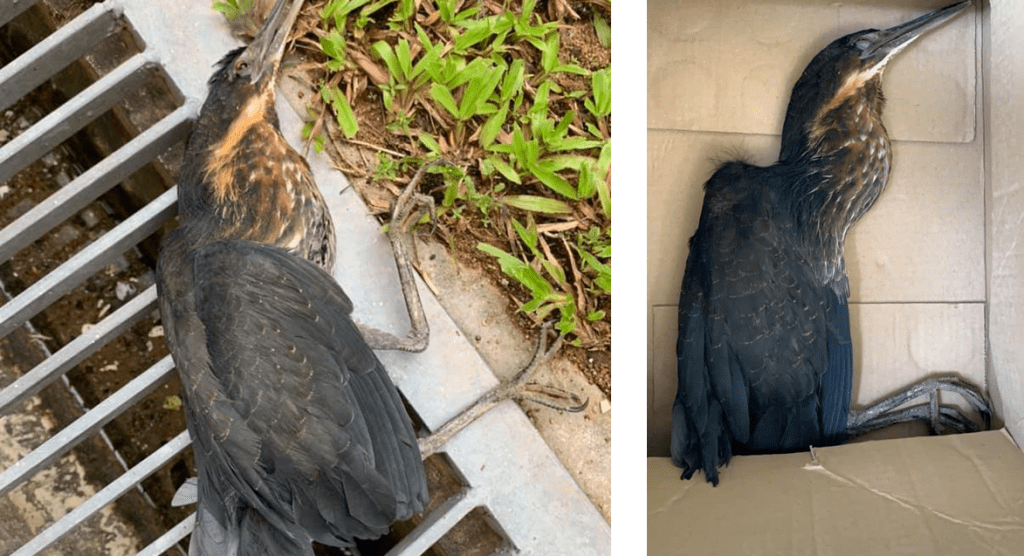
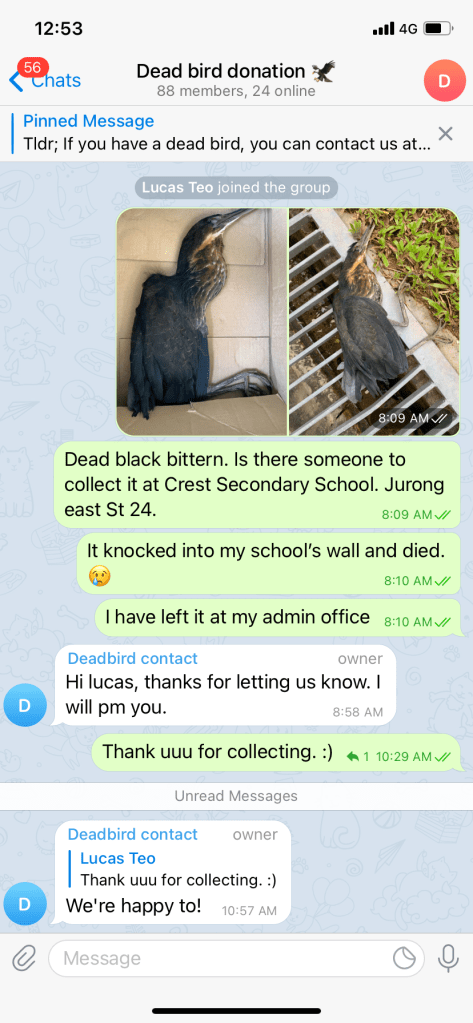
Instead of calling ACRES (Animal Concerns Research and Education Society), I contacted Lee Kong Chian Natural History Museum (LKCNHM) to collect the bird’s lifeless body for research purposes (see contacts at the bottom of this post).
BASIC ‘FIRST-AID’ FOR A BIRD IN SHOCK DUE TO COLLISON
ACRES has been invaluable over the years, consistently providing assistance when we’ve reached out. Even after my departure from the school, my colleagues have continued to rely on their expertise. I recall instances where ACRES even aided injured sparrow nestlings. However, as a charity organisation managing wildlife-related requests across Singapore with limited resources, they undoubtedly face significant challenges in meeting the demands of their crucial work.
Given the challenges faced by wildlife rescue organisations, it’s beneficial for individuals to have some basic knowledge of animal care. ACRES has provided valuable information on responding to “birds in shock”, which can serve as a useful form of triage in such situations.
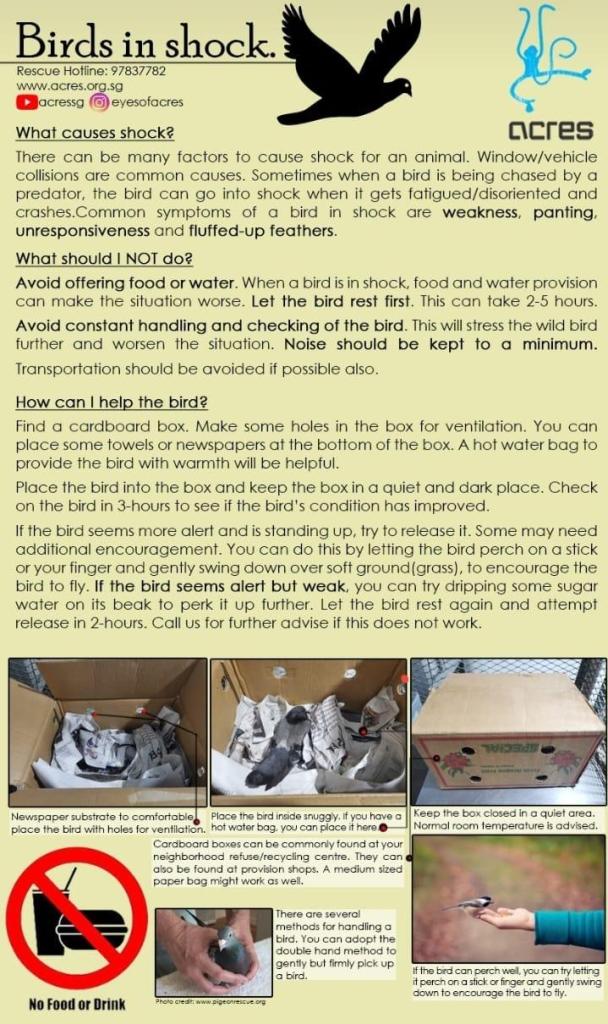
A crucial point to emphasise is the importance of refraining from feeding or giving water to a bird in shock. While many people’s natural instinct is to offer food or water when they encounter a distressed bird, this can actually be harmful. Despite good intentions, it’s not the correct course of action for a bird in shock.
Thank you ACRES for your services and always seeking better ways to support your cause. And also to all others parties such as NPark’s Animal Response Centre as well as LKCNHM’s deadbird hotline services.
To contact ACRES for Wildlife Rescue: WhatsApp 9783 7782
To contact NPark’s Animal Response Centre: 1800-476-1600
To contact LKCNHM’s deadbird hotline (for retrieval of bird carcasses): WhatsApp 84495023
To support with bird collision research, please help to fill up the details in the link provided by Nature Society Singapore (see external link for more details but I am not sure if the research is an ongoing one).
Happy 2025 to the Staff & Students of Crest Secondary School
Last but certainly not least, a heartfelt shout-out to the dedicated teachers at Crest Secondary School who continue to serve their educational mission with passion. A special mention goes to Auntie May for her tireless efforts in maintaining the school’s beautiful garden. To all the staff, we wish you the very best as you attend to your students’ needs. Stay well and keep up the fantastic work!
Written by Lucas Teo
 birdbrainsg
Leave a comment